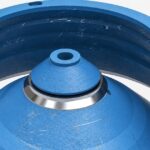
A cone crusher liner needs to fit the chamber and suit the feed. A profile mismatch can affect crushing and wear, while an alloy that does not suit the impact and abrasion may mean an earlier changeout.
Start with the part number and chamber configuration, then review rock, feed size, closed-side setting (CSS) and wear history. The tables below give starting points for a discussion with a foundry, followed by a checklist for a complete request for quotation (RFQ).
Mantle vs bowl liner: which part do you need?
The mantle is the moving inner wear surface. The bowl liner, also called a concave, is the fixed outer wear surface. Rock is crushed between them. Their profiles work together, so check both pieces and their wear even if only one is being replaced. An incompatible pairing can change the chamber and contribute to uneven wear or product shape problems.
Browse cone crusher liners by part number or model match. Confirm the exact configuration before ordering: a machine designation alone may not identify the chamber or the correct pair.
What drives cone crusher liner selection?
- Part identity and fit: Record the part numbers for the mantle and bowl liner, the machine designation, and the seat and locking arrangement.
- Feed and rock: Rock type is useful, but feed size, abrasiveness and consistency also affect wear. Limestone and an abrasive ore may place very different demands on a liner.
- Chamber and CSS: Match the profile to the incoming feed and intended CSS. Review the machine's operating limits before changing settings or chamber type.
- Wear history: Record the wear pattern and, if available, operating hours or tonnes since the last change. Photos of both liners help distinguish local wear from general thinning.
Table A: Manganese grade starting points
| Grade | Typical Mn band | Work-hardening behavior | Better starting point when… | Caution |
|---|---|---|---|---|
| Mn13 | ~12–14% Mn | Needs impact to harden | Softer rock, lower impact or unstable feed | May wear quickly in highly abrasive hard rock |
| Mn18 | ~17–19% Mn | Work-hardens under impact; common quarry starting point | Hard aggregate or typical secondary duty | Still needs sufficient impact energy |
| Mn22 | ~21–24% Mn | Tough manganese family with potential for deeper hardening under suitable impact | Very hard or abrasive rock with coarse, high-impact duty | A low-impact fine chamber may not harden it sufficiently; higher Mn is not automatically better |
Indicative starting points only: Mn bands are industry approximations, not a GUBT guarantee or a complete specification. Carbon-to-manganese ratio, chemistry, heat treatment and section size also matter. Discuss the actual duty with the foundry and review the materials guide and hardness testing guide. If a quotation uses a different grade designation, check the chemistry and requirements using the cast steel grade equivalents guide.
Table B: Chamber profile and duty
| Chamber / profile intent | Typical feed / CSS context | Relative impact | Alloy implication: starting point |
|---|---|---|---|
| Coarse | Larger feed, wider CSS | Higher impact per hit | Mn18 or Mn22 may be appropriate when impact and abrasion justify them |
| Medium | Balanced secondary duty | Moderate | Mn18 is a common starting point |
| Fine / extra-fine | Small feed, tight CSS | Lower impact; abrasion may be more prominent | Reassess Mn level and, where appropriate, other material families; do not automatically select the highest Mn |
These are relative comparisons, not substitutes for the machine's approved chamber and setting limits. Check the profile, seat, locking features and available wear thickness together. Use the dimensional tolerances guide to agree which fit-critical dimensions will be inspected.
If a part number is unavailable or the liner is obsolete, a drawing, photos and a measured sample can support custom parts and reverse engineering. A worn sample needs careful interpretation because its original profile has changed. Consider a trial order and review fit and wear before changing an entire fleet.
Table C: Factory RFQ checklist
| Field | What to send | Why it matters |
|---|---|---|
| Part identity | Mantle, bowl liner or concave; part number if known | Starts the model match |
| Machine identity | Model / series designation already used by the buyer | Helps identify the configuration family |
| Configuration | Coarse, medium or fine chamber; target CSS; known seat and locking style | Helps confirm profile and fit |
| Quantity and logistics | Quantity, ship-to port and Incoterm if known | Supports a complete quotation |
| Duty | Rock type and feed size if known | Helps assess alloy and profile |
| Evidence | Current liner photos, wear notes, drawing or worn sample | Supports fit and wear diagnosis |
| Material preference | Mn13, Mn18, Mn22 or “recommend” | Makes the starting material clear |
| QA expectations | Required chemical, dimensional and non-destructive testing checks | Establishes acceptance expectations for the first article |
Dealers can forward this checklist to the end user. Include both part numbers when available and note whether the request covers one liner or a matched pair.
Next step: qualify the factory
An aftermarket quote is useful only when fit and material requirements are clear. Ask the foundry how it will identify the part, control casting and heat treatment, and document the agreed checks. For a broader supplier assessment, see how to choose a cone crusher parts manufacturer.
FAQ
Is a bowl liner the same as a concave?
In this context, both terms refer to the fixed outer wear liner. Include the part number and a photo because naming can vary between sites.
Can I request a quote with only a part number?
Yes. Send the number and identify whether it is for the mantle or bowl liner. The foundry may request the machine designation, chamber or photos to confirm the match before quoting or manufacturing.
Can a drawing or worn sample be used for model match?
They can support identification and measurement. Provide any known original dimensions and operating details as well; a worn surface alone may not show the original profile.
Can the alloy be specified as Mn13, Mn18 or Mn22?
You can state a preferred grade or ask for a recommendation. Agree the applicable chemistry, heat treatment and inspection requirements for the part and duty rather than relying on the short grade name alone.
How long does a quote or order take?
Timing depends on the information available, stock, tooling, manufacturing and inspection requirements. Ask with the part number and quantity; the MOQ and lead-time guide explains the factors to discuss.
How should I read a hardness report?
Check the specified scale, measurement location and acceptance criteria against the agreed order. As-supplied hardness and the surface after work-hardening describe different conditions; see the hardness testing guide linked above.
Send your liner RFQ
Send Table C, your part numbers and any photos to info@gubtcasting.com, or use the contact form. GUBT can review the model match and discuss a starting material with buyers and dealers.