Short liner life is often a geometry problem, not a “cheap manganese” problem. When the upper band of a mantle stays almost new while the bottom washes out, or when feed bridges and never enters the crushing zone, the chamber profile is fighting the feed and the closed-side setting (CSS). Fix profile and feed first. Alloy and supplier grade come after.
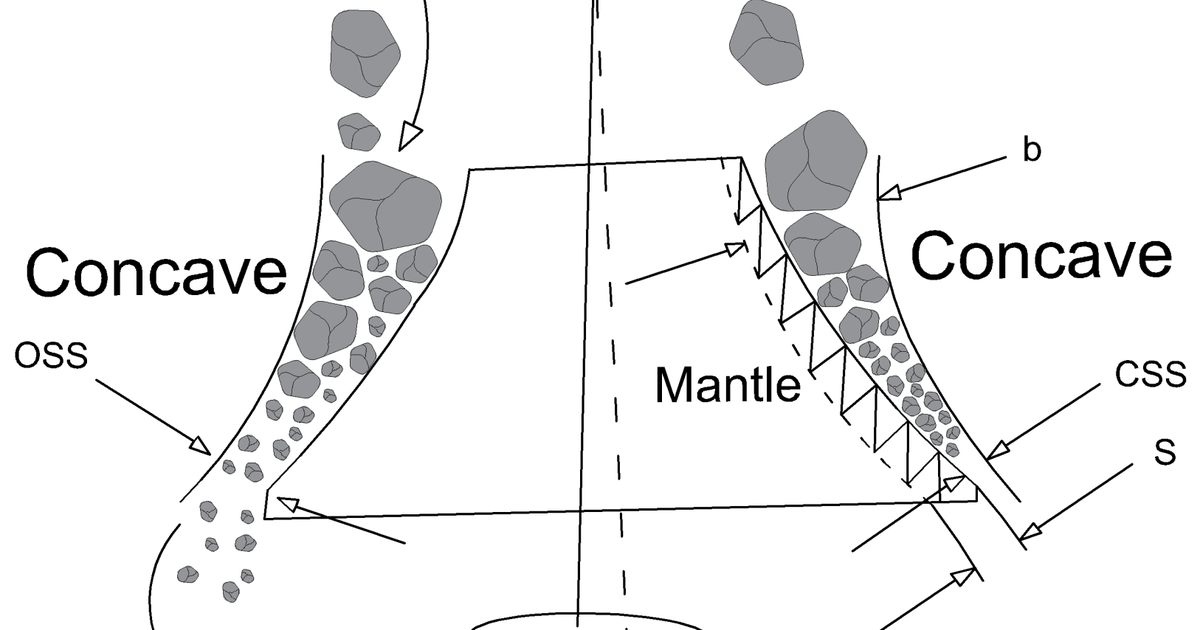
This page is a parameter-table chamber guide for process engineers and dealer technical sales. It complements our cone mantle / bowl liner RFQ — that post covers selection fields and ordering; chamber geometry stays here. Identity for quotes stays part number / model match. Ranges below are indicative starting points, not machine-series capacity charts and not life guarantees.
Answer first: coarse vs medium vs fine?
Q: How do I choose coarse vs medium vs fine cone liners?
A: Start from feed top-size and target CSS, not from alloy. Coarse chambers take larger secondary feed; fine chambers need prepared tertiary feed and tighter CSS. If the upper liner stays unworn while the bottom washes out, the chamber is likely too open or underfed — fix profile/feed before changing brand or grade.
What “chamber profile” means in buyer language
A cone chamber is the mantle + concave (bowl liner) pair, not a single casting. Profile labels such as coarse (C), medium (M), and fine (F) — plus extra-coarse (EC) and extra-fine (EF) on some drawings — describe the opening shape and how feed drops through the crushing cavity as CSS and throw change.
In plant language:
- Opening / feed zone — can the top-size enter without bridging?
- Crushing band — where rock is reduced under choke or stratified feed
- Discharge / CSS window — can you hit product without power spikes or ringing?
Mixing a fine mantle with a coarse concave (or the reverse) breaks pairing rules and often shows up as uneven wear, product that misses the sieve, or seating stress. Treat the pair as one chamber family. For life tactics once geometry is right, see how to extend cone wear life.
Table A — Profile cheat sheet (indicative)
All size and CSS cells below are indicative / application-dependent. Confirm against your drawing, part numbers, and site procedure. Do not treat this as an official machine capacity table.
| Profile | Typical duty window | Feed top-size lean | Product lean | Notes |
|---|---|---|---|---|
| Extra-coarse (EC) | Secondary after large primary | Largest opening | Coarser output / capacity bias | May need adapter / pairing rules — confirm by PN |
| Coarse (C) | Secondary | Large feed | Medium aggregate | Prefer when jaw product is still chunky |
| Medium (M) | Secondary / early tertiary | Balanced | Throughput + moderate fines | Default “versatile” when feed is screened |
| Fine (F) | Tertiary | Controlled / smaller | Finer, more cubical | Needs prepared feed; choke preferred |
| Extra-fine (EF) | Tertiary / quaternary | Small, tight | Sand-like / tight CSS | Easy to underfeed — watch bottom wear |
Practical read: if the jaw or primary product is still chunky, start at coarse (or confirm EC by part number). If the feed is already screened and you need cubical tertiary product, lean fine — but only with prepared feed. Medium is the “versatile” label when feed is controlled and you want both throughput and moderate fines.
Table B — Feed × CSS decision
Use this as the floor checklist before you blame manganese grade.
| Observation | Likely chamber issue | First action |
|---|---|---|
| Feed bridges / won’t enter | Opening too fine for top-size | Coarser profile or pre-screen / reduce top-size |
| Crushing only in lower band; upper liner looks new | Chamber too open / underfed | Finer profile or improve choke / distribution |
| Power spikes + fines shortage | CSS too tight or wrong fine chamber | Open CSS slightly; verify profile pair |
| Product too coarse at target CSS | Chamber too coarse or throw mismatch | Finer pair; confirm throw / CSS together |
| Uneven left/right wear | Feed segregation | Fix feeder / chute before changing alloy |
Choke feed and chamber utilization. Choke feeding usually helps chamber utilization and even wear when the profile matches the feed. It does not fix a chamber that is simply too fine for top-size, and it will not save an EF chamber that is chronically starved. Distribution and feeder setup matter as much as the label on the casting.
CSS vs throw. CSS and eccentric throw work together. Changing CSS alone can look like a “profile problem” if throw is unknown or recently changed. Note both when you RFQ a new pair.
Table C — Wear pattern → cause → action
Photograph worn pairs (desensitized for sharing) before the next order. Patterns beat anecdotes.
| Wear pattern | Probable cause | Action before next order |
|---|---|---|
| Bottom-heavy wash | Underfeed / chamber too large | Profile down or choke feed |
| Top / feed-zone wash | Oversize feed / bridging cycles | Coarser opening or better scalping |
| Ringing / plastic mushroom | Overload / tramp / wrong CSS | Protect tramp path; review CSS |
| Even band, short life | Abrasive feed / alloy mismatch | Keep profile; review alloy (chrome vs Mn decision tree) |
| Seating face damage | Backing / fastening issue | See torch-ring / fastening checklist |
Even wear with short life is the one case where alloy and duty hardness usually deserve the next look — after you confirm the chamber family is correct. Track campaigns with a cost-per-ton log so “short life” is measured, not guessed.
Table D — Mantle + concave pairing checklist
| Check | Pass rule |
|---|---|
| Same chamber family | Coarse mantle with coarse concave (etc.) — don’t mix families |
| CSS window | Target product inside recommended CSS band for that pair |
| Throw / speed context | Note eccentric setting if known |
| Backing / seating | Clean seat; correct compound; no oil on friction seats |
| Identity | Part numbers / model match for both mantle and concave |
Order and quote the pair together whenever possible. A single “same model” mantle against an unknown concave revision is a common source of dealer returns that look like quality failures and are really pairing failures.
Alloy only after geometry
Once feed, CSS, and chamber family line up, choose manganese vs high-chrome (or intermediate grades) from duty — impact severity, abrasion, tramp risk — using the high-chrome vs manganese decision tree and the materials overview. Changing alloy on a mismatched chamber usually burns money twice: once on the wrong profile, again on the wrong grade.
Table E — RFQ fields for chamber-sensitive orders
Use the live part number / model-match RFQ template and add chamber context:
| Field | Send |
|---|---|
| Identity | Mantle PN + concave PN / model match |
| Chamber label | C / M / F / EC / EF if marked on drawing or old part |
| Feed | Top-size, % passing key screens, rock type |
| CSS | Current and target (mm) |
| Symptoms | Photos of worn pair + product sieve if available |
| Alloy preference | Mn / high-chrome / recommend |
Fictional placeholder examples only (never treat as GUBT catalog SKUs): PN-MANTLE-EX-001 + PN-CONC-EX-001 with chamber label M, feed top-size noted, CSS current/target in mm.
FAQ
Can I run a fine mantle with a coarse concave?
No as a default practice. Chamber families are designed as pairs. Mixed families change the crushing cavity in ways that produce uneven wear, odd product, or seating stress. Quote and install matched C/M/F (or EC/EF) pairs unless engineering has explicitly approved a special combination by drawing revision.
Does choke feeding always help?
It helps when the profile matches feed and the chamber can be kept full without bridging. It does not fix an opening that is too fine for top-size, and chronic underfeed on a fine or extra-fine chamber still drives bottom-heavy wear. Fix feeder and profile first.
How do CSS and throw interact?
CSS sets the discharge gap; throw (eccentric) affects how rock is compressed through the cavity. Changing one without noting the other can look like a wrong chamber. Record both when diagnosing product or power issues.
When should I change both liners together?
When wear on either side would leave an unsafe or badly mismatched cavity, or when seating/backing work already opens the machine for a full set. Many sites change the pair on the same campaign end; confirm from measured wear, not calendar habit alone.
Are feed-size and CSS numbers in tables guaranteed?
No. They are indicative starting points. Rock type, moisture, scalping, throw, and machine condition all move the usable window. Use them to pick a starting family, then confirm with site data and part numbers.
Same part number, different chamber label — what then?
Photograph markings, send the drawing revision if you have it, and describe feed/CSS symptoms. Some PN families cover more than one chamber label across revisions. Do not assume “same PN” means the same cavity — use model-match RFQ fields and marking photos.
Should I change alloy before profile?
Almost never when wear is bottom-heavy, top-washed, or bridging-related. Those are geometry and feed signals. Alloy changes belong after even wear or when abrasive duty is confirmed with a correct chamber.
Close
Match chamber × feed × CSS before you argue manganese grade. Use Tables A–C on the floor, pair mantle and concave as one family, then RFQ by part number / model match with worn-pair photos.
GUBT is a source foundry for model-match cone liners. For a chamber-sensitive quote, send the Table E fields to info@gubtcasting.com or use Contact Us.