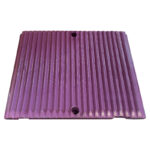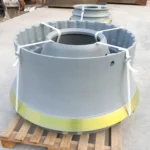
Jaw dies, cone liners and HSI blow bars are all called wear parts, but they contact the feed in different ways. A mixed parts list is easier to buy when each item is tied to its machine and its position in the chamber. That simple separation also prevents a catalogue reference for one assembly being mistaken for a complete set.
Three different wear interfaces
Jaw crushers rely on fixed and moving jaw dies, with tooth patterns selected based on the feed material and application. Cheek plates function as separate side protective pieces. Cone crushers operate between a moving mantle and a stationary bowl liner or concave. HSI units utilize blow bars, breaker-plate liners, and side liners. Because these components interact differently within each chamber, buyers should provide the specific machine model and serial number. Requesting parts based on a generic reference number is insufficient, as these codes do not account for the specific chamber configuration or the mechanical tolerances required for proper installation.
Name the part before comparing codes
A reference code serves only as an identifier and does not confirm that a part will fit or perform as expected. For cone crushers, the chamber profile, feed size, feed properties, and closed-side setting dictate the correct liner choice. Ancillary pieces like feed plates also vary by model. For HSI machines, the rotor version, bar dimensions, and locking or fastening arrangements are the primary factors. Buyers should clarify whether the requested part matches the current rotor configuration, as blow-bar material choices depend on impact, abrasion, and the risk of foreign metal entering the crushing chamber.
Match material to the duty
To verify compatibility, request documentation that links the part to the specific equipment manual. For jaw crushers, ask for details regarding the tooth profile and material composition relative to the feed. For cone crushers, request information on how the liner interacts with the existing mantle and bowl liner geometry. For HSI units, ask for the specific rotor balancing requirements and fastening specifications. If a supplier cannot provide documentation that aligns the part with the manufacturer’s original equipment manual, request a technical drawing or a cross-reference verification that accounts for the specific machine serial number.
Inspect the actual order
Upon delivery, inspect the physical dimensions of the parts against the specifications provided during the quotation phase. For jaw dies, check the mounting surfaces and bolt hole alignment. For cone liners, confirm the profile matches the required closed-side setting parameters. For HSI blow bars, verify the dimensions and the integrity of the locking arrangement. Note that bearing inspection and change-out for jaw crushers are machine-specific tasks that require qualified site personnel and the exact manual. Do not attempt installation if the physical dimensions deviate from the equipment manual’s guidelines for wear limits and assembly tolerances.
List each machine separately
Put fixed and moving jaw dies on separate lines. For a cone crusher, distinguish the mantle from the bowl liner or concave and record the chamber profile. For an HSI, identify the blow bar and the appropriate breaker-plate or side liner position, together with the rotor version. Add quantities, material requests and any hardware to each line. The exact equipment manual governs installation and wear limits; this guide is for identifying what to order.