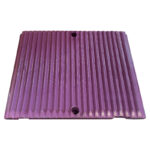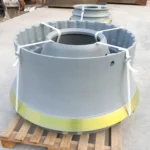
A company profile and a photograph of a casting tell you very little about the part that will arrive at your site. When comparing a foundry, a trader and an aftermarket supplier in China, start with the part and the documents each can actually provide for this order. The same question applies regardless of company size: can the offer be checked against your machine and the piece you need to replace?
Start with the part, not the company profile
Cone crushers rely on the interaction between a moving mantle and a stationary bowl liner. Selecting the right part requires knowledge of the specific machine version, the intended closed-side setting, and the feed properties. Ancillary components like feed plates often vary by model, while HSI wear pieces such as blow bars and breaker-plate liners require matching to the specific impact and abrasion conditions of the site. A public reference code serves only as an identifier and does not guarantee interchangeability. Buyers should provide measured geometry or specific drawing revisions rather than relying solely on part numbers.
What the quotation can establish
A quotation is a commercial document, not a technical validation. Suppliers may provide a price based on a reference code, but this does not confirm the part fits the specific chamber profile or operating history of the crusher. Buyers should request a formal document that lists the material specifications, the scope of supply, and the required acceptance evidence. Distinguish between a general price list and a technical proposal that addresses the specific wear application. If a supplier cannot provide a detailed breakdown of the material composition and the manufacturing process, request a technical drawing for verification before proceeding.
Which records belong to this order
Requesting documentation is standard, but understanding the limits of that evidence is necessary. A sample inspection report only proves the quality of the specific sample tested, not the quality of the entire production run. Ask for production scope documents to determine if the supplier has the capability to manufacture the requested geometry consistently. If a supplier provides test results, confirm whether those results apply to the specific batch being ordered. Do not assume that previous performance or generic quality certifications apply to new orders. Always ask for documentation that specifically references the current production lot.
Check the delivered piece
When receiving an order, compare the physical dimensions of the delivered parts against the original drawings or measured geometry provided during the procurement phase. Verify that the material delivered matches the specifications agreed upon in the written quote. Check the packaging and freight terms against the initial agreement to ensure the parts arrived as expected. If the parts do not align with the provided technical data, the documentation provided at the time of order is the primary reference for resolution. Keep all records of the initial technical requirements to facilitate a clear comparison upon arrival.
An RFQ a supplier can answer
Send the machine and version, the part position, complete public reference if available, requested material, quantity and destination. Attach an authorized drawing or measured dimensions when identification is uncertain. Ask which entity will make the casting, who will inspect it, what records can accompany this batch and how a discrepancy will be handled. The reply should state a delivery term and a commitment for this order; a generic stock statement is no substitute.