
In the rigorous environments of aggregate production and mining, the dimensional accuracy and metallurgical stability of crusher wear parts are paramount. These components—ranging from jaw plates and mantles to concave segments and blow bars—determine the throughput, particle size distribution, and operational costs of the crushing circuit. For high-capacity operations, utilizing premium aftermarket replacements that match or exceed OEM specifications is a critical strategy for minimizing maintenance downtime and reducing the cost per ton.
At CHENGDU GUBT INDUSTRY CO., LTD. (GUBT), we bridge the gap between quality and availability in the aftermarket sector. As a dedicated manufacturer of crusher wear parts, we leverage advanced industrial metrology and metallurgy to deliver components suitable for leading brands like Metso, Sandvik, and Terex. By integrating precision 3D scanning into our workflow, we ensure that every manganese liner and alloy casting offers guaranteed fitment and predictable wear life. This article explores how our reverse engineering protocols validate the geometry and performance of heavy-duty wear components.
Optimizing Crusher Wear Parts via Industrial Metrology
The Role of 3D Scanning in Liner Manufacturing
To manufacture high-performance crusher wear parts, strict adherence to geometric tolerances is non-negotiable. 3D laser scanning technology allows us to capture the exact topology of existing components, ensuring that our aftermarket replacements maintain the precise mating surface contact required for load transfer. By generating high-density point clouds of wear patterns, we can also analyze localized wear zones, providing data that drives profile modifications for extended service life in specific crushing applications.
Metallurgical and Dimensional Precision
GUBT’s reputation is built on the intersection of stable metallurgy and dimensional control. Utilizing industrial-grade 3D scanners, we achieve measurement accuracies up to 0.025mm. This precision is critical when verifying the machined surfaces of cone crusher mantles or the seating faces of jaw plates. It ensures that our crusher wear parts install seamlessly without needing dangerous and time-consuming onsite modifications, protecting the crusher’s main frame from damage caused by poor fitment.
The Reverse Engineering Workflow at GUBT
Data Acquisition and Wear Analysis
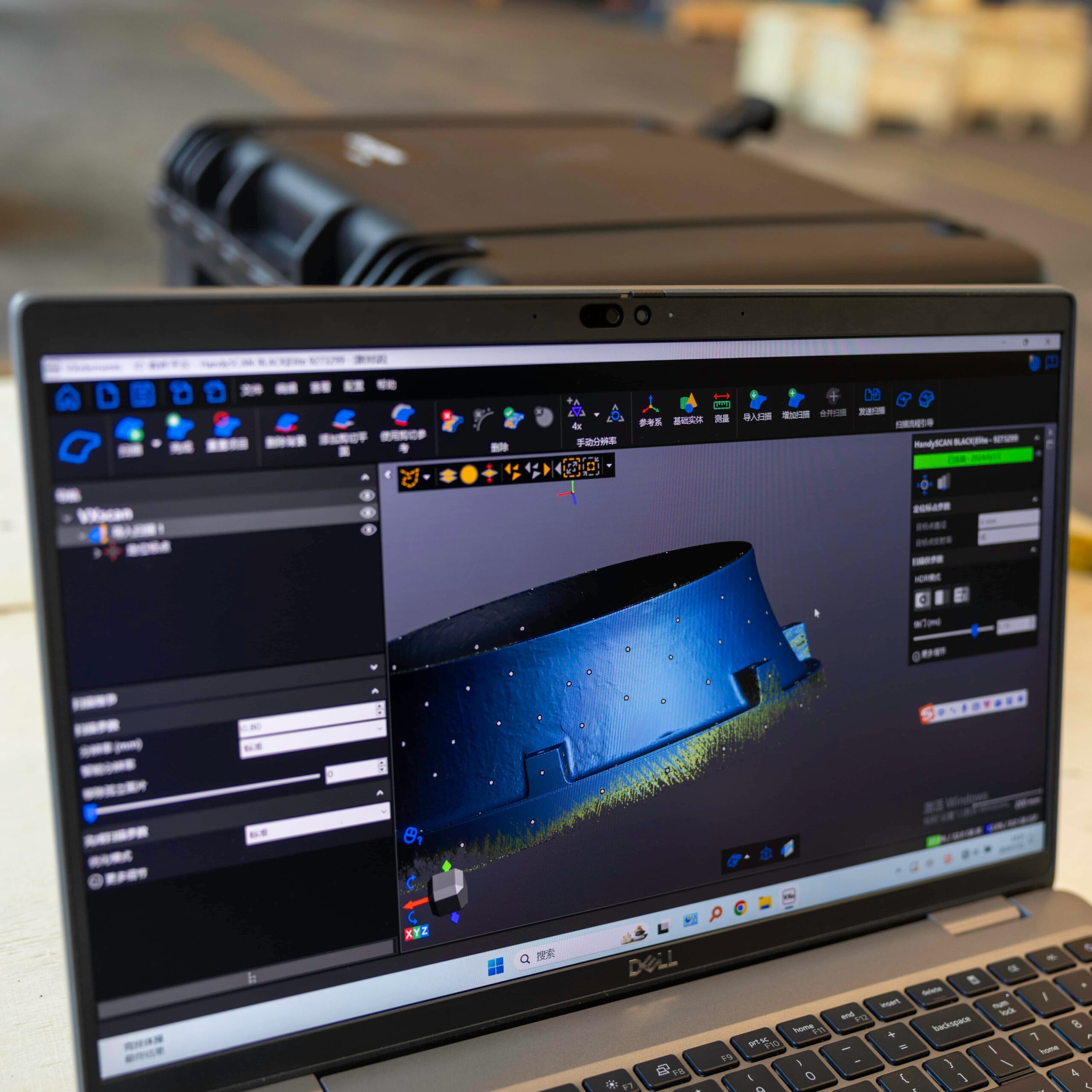
The reverse engineering process begins with the acquisition of complex geometry. As illustrated in the image, our engineers utilize portable blue-laser 3D scanners to digitize the physical component. This is particularly valuable for analyzing crusher wear parts that have been removed from service. By scanning a worn liner, we can overlay the worn geometry against the original profile to calculate precise wear rates and identify high-stress zones inside the crushing chamber.
CAD Modeling and Manufacturing Blueprints
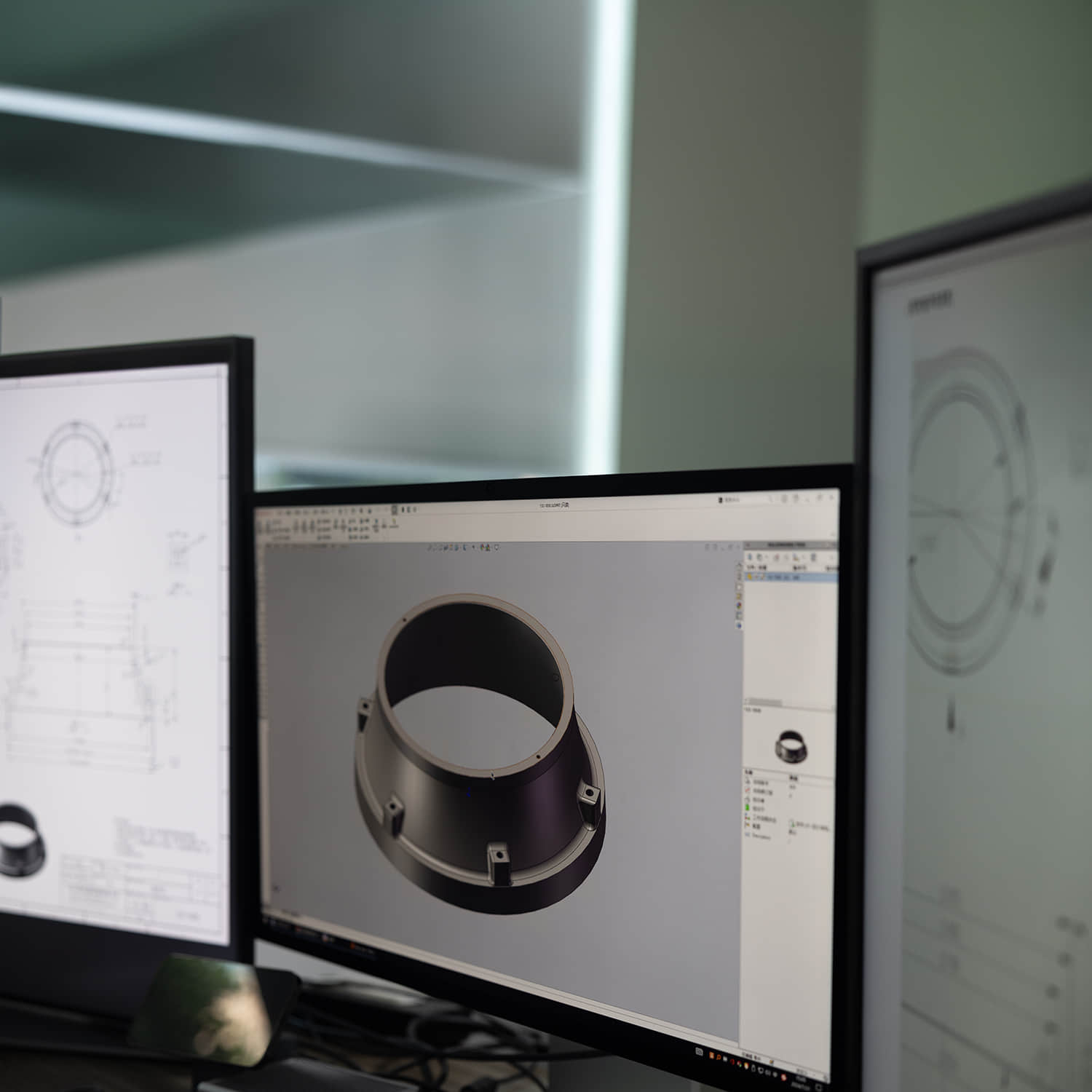
Once the scan data is processed, it is converted into high-fidelity solid models, as shown here. This digital twin is critical for generating manufacturing blueprints and machining paths. For crusher wear parts like bowl liners, this stage allows us to verify the Closed Side Setting (CSS) parameters and nip angles. We use this data to simulate the casting process, ensuring the final manganese steel pour is free from porosity and internal defects.
Chamber Optimization and Profile Enhancement
Our capabilities extend beyond replication. We employ reverse engineering to optimize standard chamber profiles. By adjusting the curve of a concave or the tooth profile of a jaw plate based on site-specific feed material analysis, we can improve the crushing efficiency. GUBT’s engineering team can propose modifications—such as thickening high-wear zones or altering the corrugation—to enhance the longevity of crusher wear parts and maintain a consistent product gradation throughout the liner’s life.
Manufacturing Excellence in Manganese Steel
Specialized Alloys and Heat Treatment
Geometry represents only half of the equation; metallurgy is the other. GUBT engineers utilize the gathered data to select the optimal alloy, typically ranging from standard Mn13Cr2 to Mn18Cr2 and Mn22Cr2 high-manganese steels. Our controlled heat treatment and water quenching processes ensure that the authentic austenitic structure is achieved, providing the necessary toughness and work-hardening capabilities required for effective crushing.
Quality Assurance for Critical Components
Every batch of crusher wear parts undergoes rigorous quality assurance. We utilize the reverse-engineered digital models as a reference for final dimensional inspection. This ensures that critical dimensions—such as the lock-nut threads on a cone crusher shaft or the toggle plate seats on a jaw crusher—are within strict tolerance bands before the parts leave our foundry.
Collaboration and Technical Support
Custom Solutions for Aggregates and Mining
We recognize that specific geological conditions demand specific solutions. GUBT collaborates directly with mine sites and quarry operators to develop tailored crusher wear parts. Whether you require a heavy-duty solution for abrasive granite or a high-throughput profile for limestone, our reverse engineering capabilities allow us to prototype and manufacture bespoke castings that solve your specific operational pain points.
Global Aftermarket Support
With an annual casting capacity exceeding 20,000 tons, GUBT is positioned to support large-scale mining operations globally. We build long-term partnerships by delivering consistent quality and reliable lead times. Our technical archives cover thousands of part numbers, ensuring that we can rapidly supply suitable replacements for the vast majority of crushers operating today.
Delivering Performance and Value
From Digital Scan to Casting Floor
The seamless integration of 3D scanning into our foundry workflow reduces the development time for new patterns. This efficiency translates to faster delivery for our clients. By validating the design digitally before pouring molten metal, we minimize waste and ensure that every delivered pallet of crusher wear parts yields maximum performance.
Final Inspection and Logistics
Prior to dispatch, all parts undergo hardness testing, dimensional checks, and visual inspection. Our logistics team ensures robust packaging to prevent damage during transit. GUBT’s systematic approach ensures that when your parts arrive, they are ready for immediate installation and operation.
Advanced Simulation and Design Verification
To support our international client base, we utilize remote collaboration tools and advanced simulation software. We employ DEM (Discrete Element Method) simulations to model material flow through the crushing chamber. This allows us to visually demonstrate how our optimized crusher wear parts will perform under load, validating expected improvements in throughput and wear distribution before manufacturing begins.
Frequently Asked Questions (FAQs)
1. Why is reverse engineering important for crusher wear parts?
It ensures 100% interchangeability with OEM components and allows for design improvements that address specific wear issues in your application.
2. What types of crusher parts can GUBT manufacture?
We manufacture a wide range of wear parts including cone crusher mantles and bowl liners, jaw crusher plates, impact crusher blow bars, and VSI wear tips.
3. Can you modify the material specification?
Yes. While standard Mn18Cr2 is common, we can supply Mn22Cr2 or alloy-enhanced manganese steel for highly abrasive environments to extend wear life.
4. How do you ensure the parts fit my crusher?
We utilize a massive database of verified OEM drawings and own extensive patterns. For unique or obsolete machines, we use on-site 3D scanning to guarantee fitment.
5. How can I request a quote for replacement parts?
Simply provide the OEM part number or machine model. For custom solutions, our engineering team will guide you through the process. Click here to contact our sales team.
Latest Insights

Cone Crusher Liners vs Jaw Plate Parts: Wear Mechanism, Structure Differences & Replacement Cycles

Long Life Crusher Liners:Material Selection, Wear Optimization & Cost Reduction Guide

Mining Crusher Parts for Hard Rock: High-Performance Wear Solutions & Cost Optimization Guide