HSI Crusher Parts Price 2026 – Quick Overview
If you’re looking for a straight answer on HSI crusher parts pricing in 2026, honestly speaking, prices vary more than most buyers expect. The range isn’t just wide — it’s wide for good reason, and understanding those reasons is the difference between a smart purchase and an expensive mistake.
Here’s a realistic snapshot of what you’re looking at:
- Blow bars: $80 – $600+ per piece, depending on material (high chrome, martensitic, ceramic inserts) and machine size
- Impact plates / breaker plates: $200 – $1,500+ per set, based on alloy and dimensions
- Liners (side liners, back liners): $150 – $900+ per piece, varying by thickness and application
The spread is driven by two big factors: material composition and supplier type. A high-chrome blow bar from an established foundry with proper heat treatment will cost more upfront than a generic casting — but its cost per ton often ends up dramatically lower. The same logic applies to liners and impact plates. In this guide, we break down what drives these differences so you can make decisions based on real cost, not just purchase price.
Main HSI Crusher Parts and Their Prices
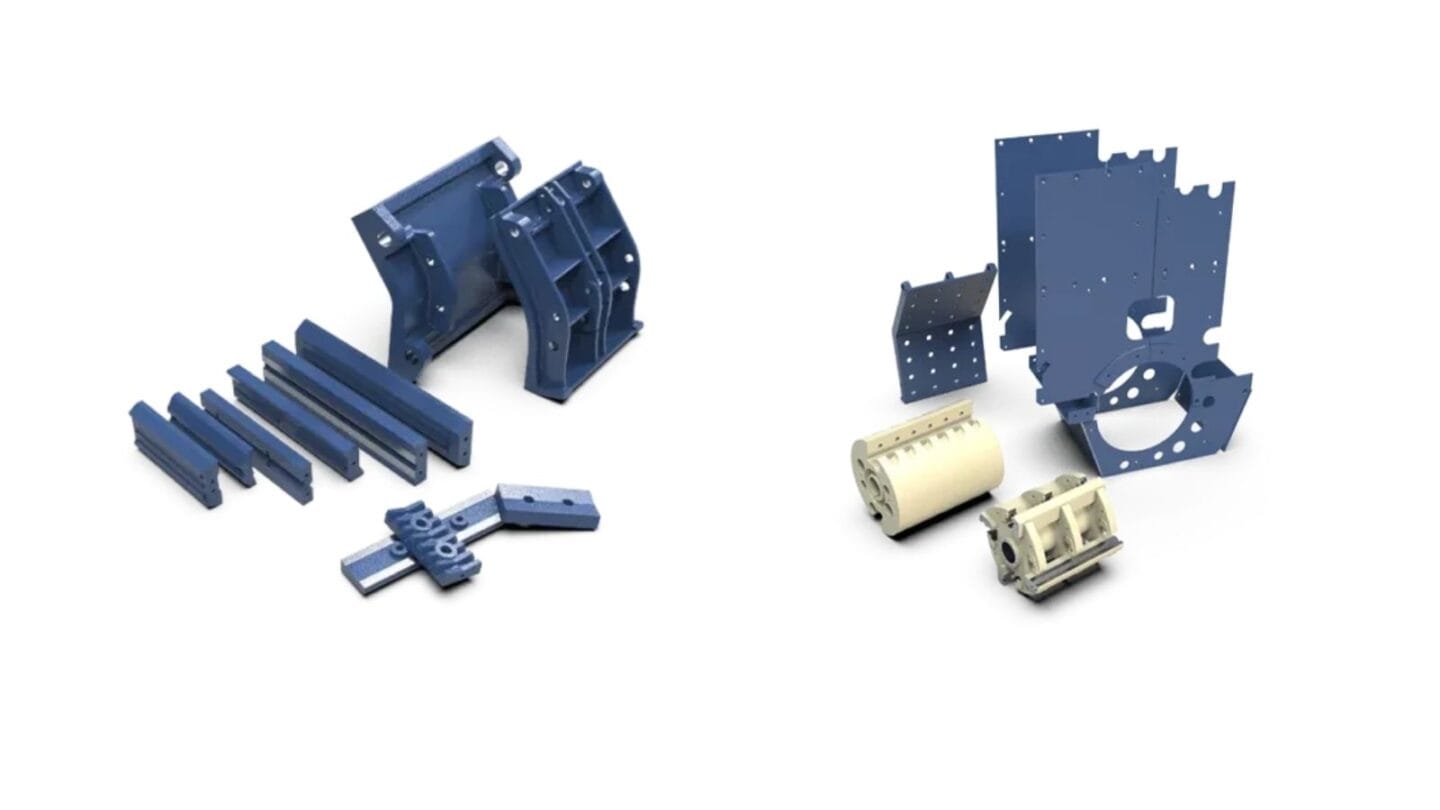
An HSI (Horizontal Shaft Impactor) crusher relies on several key wear components. Understanding each one — and why pricing varies — helps you plan maintenance budgets accurately and avoid nasty surprises.
Blow Bars
Blow bars are the highest-wear component in an HSI crusher. They’re mounted on the rotor and take the first and hardest hit from incoming material. I’ve seen buyers seriously underestimate how much blow bars affect total operating cost — they’re the part you’ll replace most frequently, so small differences in quality compound fast.
Price range: $80 – $600+ per bar. The gap comes down to material grade, foundry quality, and size. A small blow bar in standard high chrome might run $80–$150. A large martensitic steel bar with ceramic inserts for abrasive rock can exceed $500–$600 each.
Impact Plates (Apron Liners)
Impact plates, also called apron liners, sit in the crushing chamber and take secondary impact from rebounding material. They wear at a moderate rate compared to blow bars but still need regular replacement.
Price range: $200 – $1,500+ per set. Larger machines and harder materials push costs higher. Material choice (standard manganese vs. high chrome alloy) accounts for much of the price gap.
Breaker Plates
Breaker plates are heavier impact-absorbing liners, often positioned at the rear of the crushing chamber. They tend to last longer than blow bars but are still a significant cost item.
Price range: $300 – $1,200+ per piece. Custom-fit plates for specific machine models can run at the top end of this range.
Liners (Side & Back Liners)
Liners protect the crusher housing from abrasion and impact. They include side liners, back liners, and feed liners, all of which gradually wear down depending on material hardness and throughput volume.
Price range: $150 – $900+ per piece. Thin standard-alloy liners are at the low end; thick abrasion-resistant steel or ceramic-composite liners for mining applications are at the high end.
HSI Crusher Parts Price Comparison Table (2026)
The table below summarizes typical 2026 pricing across part types, materials, and expected lifespan. One key insight: cheap parts usually cost more per ton in the long run.
| Part | Material | Price Range (USD) | Est. Lifespan |
| Blow Bar | Standard High Chrome | $80 – $200 | 150–400 hrs |
| Blow Bar | Premium High Chrome (Cr27+) | $180 – $380 | 350–600 hrs |
| Blow Bar | Martensitic Steel | $250 – $500 | 400–700 hrs |
| Blow Bar | Ceramic Insert | $400 – $600+ | 600–1,000+ hrs |
| Impact Plate | Manganese Steel | $200 – $500 | 500–900 hrs |
| Impact Plate | High Chrome Alloy | $350 – $900 | 700–1,200 hrs |
| Breaker Plate | High Chrome / Mn Steel | $300 – $1,200 | 800–1,500 hrs |
| Side Liner | AR Steel / Chrome Alloy | $150 – $600 | 600–1,200 hrs |
| Back Liner | AR Steel / Chrome Alloy | $200 – $900 | 700–1,400 hrs |
Reading this table, it’s tempting to pick the lowest price column. But consider the lifespan column equally. A $600 ceramic insert blow bar lasting 1,000 hours beats a $100 standard chrome bar lasting 200 hours — by a wide margin on cost per hour and on downtime.
What Affects HSI Crusher Parts Price?
Price differences in HSI wear parts are rarely random. They trace back to four core factors that any serious buyer should understand before placing an order.
1. Material (High Chrome, Martensitic, Ceramic)
Material is the single biggest driver of both price and performance. But don’t be fooled by ‘high chrome’ alone — the label covers a broad range of compositions with very different results. A Cr15 casting and a Cr27 casting are both ‘high chrome’, but they behave completely differently under hard rock impact.
Here’s a quick comparison:
- High Chrome (Cr15–Cr26): Good hardness, moderate toughness. Suitable for medium-abrasion applications. Wider price range due to variable Cr and carbide content.
- Martensitic Steel: Higher toughness than high chrome, handles impact-heavy applications (like recycling or demolition) without fracturing. Typically costs 20–50% more than comparable chrome grades.
- Ceramic Insert: Highest wear resistance, best for highly abrasive stone quarrying or mining. Significantly more expensive upfront but justifies cost in high-wear scenarios.
Composition matters more than the label. Always ask for material test certificates — Brinell hardness, chemical composition, heat treatment records. Reputable suppliers provide these without hesitation.
2. Manufacturing Process & Heat Treatment
Same material, different process — big lifespan difference. This is one of the most overlooked factors in parts purchasing. I’ve seen parts fail early specifically because of poor heat treatment, even when the base alloy was correct.
Key process factors that affect price and performance:
- Casting method: Sand casting vs. lost foam vs. investment casting — precision and microstructure density vary significantly
- Heat treatment: Proper austenitizing, quenching, and tempering cycles determine final hardness distribution. Rushed or inconsistent heat treatment creates soft spots.
- Post-processing: Machined mounting surfaces, bore tolerances, and balancing (for blow bars) all affect fit and vibration characteristics in operation.
Premium parts from specialized foundries cost more partly because these process steps are done correctly — and consistently — batch after batch.
3. OEM vs Aftermarket Pricing
OEM parts (from the original crusher manufacturer) typically carry a 40–120% price premium over aftermarket alternatives for comparable specifications. That said, most real-world crushing operations actually rely on aftermarket parts for the majority of their wear component needs.
Here’s the honest breakdown:
- OEM parts: Guaranteed fit and specification match, strong quality consistency, but premium pricing and sometimes long lead times. Best for newer machines under warranty or for operators who prefer zero-risk sourcing.
- Aftermarket parts: Lower price, often equivalent or better wear life when sourced from quality foundries, more flexibility in material upgrades. Higher variability — quality depends heavily on the supplier.
The market for aftermarket HSI parts is mature and well-developed. However, not all aftermarket suppliers are equal — always request material certifications and consider small-batch testing before committing to large orders.
4. Customization & Application
Application environment is a direct multiplier on both wear rate and cost. Hard, abrasive materials increase wear dramatically and often necessitate upgraded alloys — which cost more per piece but extend life enough to lower cost per ton.
Industry-specific cost drivers:
- Mining (hard rock): High abrasion, high impact. Requires ceramic inserts or premium martensitic grades. Higher unit cost, but cost per ton remains competitive given the extended lifespan.
- Quarry (aggregate): Moderate-to-high abrasion. High-chrome blow bars are standard. Mid-range pricing works well here.
- Concrete recycling / demolition: High impact, moderate abrasion, plus rebar risk. Martensitic grades dominate. Customized bar profiles (thickness, notch geometry) add to cost but reduce rotor damage.
Custom-fit parts — made to non-standard dimensions or with specific geometry modifications — command a 10–30% premium over catalog items but often outperform generic alternatives in specific applications.
HSI Crusher Parts Price by Application
Actual cost depends more on wear rate than on purchase price. The same part in two different applications can have a 3x difference in effective cost per ton. Here’s how pricing plays out across major industries:
| Industry | Wear Level | Typical Material | Avg. Blow Bar Cost | Cost Impact |
| Hard Rock Mining | Very High | Ceramic / Martensitic | $350 – $600+ | High unit cost, moderate CPT |
| Aggregate Quarrying | Medium–High | High Chrome Cr20+ | $150 – $350 | Balanced unit & CPT |
| Limestone/Soft Stone | Low–Medium | Standard High Chrome | $80 – $200 | Low unit cost, low CPT |
| Demolition / Recycling | High (impact) | Martensitic Steel | $250 – $500 | Higher unit, low CPT |
| Asphalt Recycling | Medium | High Chrome / Martensitic | $150 – $380 | Moderate across both |
CPT = Cost Per Ton. The key takeaway: in hard rock mining, you’ll pay more per blow bar, but properly specified premium parts wear more slowly — resulting in acceptable CPT and fewer change-outs. In soft stone applications, standard chrome works fine and cost remains low. Mismatching material to application is where real money is wasted.
Cheap vs Premium HSI Parts – Real Cost Comparison
Let’s be direct: cheap parts are often the most expensive choice. The math is straightforward once you factor in lifespan and downtime — but many purchasing decisions still happen on unit price alone.
| Type | Unit Cost (Blow Bar) | Est. Lifespan | Change-outs / 1,000 hrs | Cost per 1,000 hrs | Downtime Cost* |
| Budget (low-grade chrome) | $90 | 180 hrs | ~5.5× | $495 | High |
| Standard (Cr20 chrome) | $200 | 380 hrs | ~2.6× | $520 | Moderate |
| Premium (Martensitic) | $380 | 650 hrs | ~1.5× | $570 | Low |
| High-end (Ceramic insert) | $550 | 950 hrs | ~1.1× | $605 | Very Low |
*Downtime cost includes labor, lost production, and associated maintenance. Not included in ‘Cost per 1,000 hrs’ above — but it’s often the largest hidden cost.
Notice that the raw ‘cost per 1,000 hrs’ converges across tiers — the premium part’s advantage shows up most clearly in reduced downtime and change-out frequency. A plant running two shifts can lose $5,000–$20,000 per unplanned stop. Fewer change-outs means fewer stops. That’s where premium parts pay for themselves.
The real calculus isn’t ‘cheapest part’ — it’s lowest total cost of ownership per ton produced.
How to Get the Best Price from an HSI Parts Supplier
Negotiating on HSI wear parts isn’t just about asking for a discount. Buyers who get the best outcomes focus on total value, not just unit price. Here’s a practical approach:
- Request material test certificates upfront: Hardness (HRC or HB), chemical composition, and heat treatment records should come standard. Any supplier hesitant to provide these is a risk.
- Calculate cost per ton, not cost per piece: Ask the supplier for reference lifespan data in your specific application. Compare CPT across options, not just price tags.
- Test a small batch first: Don’t order large quantities blindly. Run 4–6 pieces through a full wear cycle, measure actual lifespan in your conditions, then scale up. This protects against batch quality variation.
- Consolidate orders: Buying blow bars, liners, and impact plates from a single specialized supplier often unlocks 10–20% volume pricing and simplifies quality accountability.
- Ask about material upgrades: Some specialized manufacturers — particularly foundry-focused suppliers who prioritize wear life over catalog pricing — can offer alloy upgrades for marginal cost increases that significantly extend part life.
Some suppliers focus primarily on price competition; others compete on wear performance and technical support. The latter category tends to deliver better long-term value for high-throughput operations.
Common Pricing Mistakes Buyers Make
After seeing how purchasing decisions play out across different operations, a few patterns emerge consistently — and they’re worth naming directly.
Mistake 1: Optimizing for Purchase Price Only
The most common error. A buyer sees a $90 blow bar and a $300 blow bar and selects the $90 one without asking the next question: how long does each last in my specific application? I’ve seen entire batches fail early in hard-rock applications because they were purchased for soft-stone conditions. The wrong part in the wrong application loses money on every ton.
Mistake 2: Ignoring Material Documentation
‘High chrome’ and ‘martensitic steel’ are labels, not guarantees. Without material test reports — hardness values, Cr content, heat treatment specs — you’re buying on trust. Reputable suppliers don’t hesitate to share these. If documentation isn’t available, treat it as a red flag.
Mistake 3: No Controlled Testing Before Scale Orders
Ordering a full quarterly stock of blow bars from a new supplier without a test run is a significant gamble. Production conditions vary, and what works in one quarry may perform differently in yours. Even a 4–6 piece test run reveals major quality issues before they become a budget problem.
Mistake 4: Underestimating Downtime Cost
Parts cost is visible on the invoice; downtime cost isn’t. A single unplanned stop for emergency blow bar change-out in a two-shift quarry operation can cost more than the price difference between cheap and premium parts for an entire month. Factor it in.
Mistake 5: Not Comparing Total Wear Life Across Suppliers
Two suppliers quoting $280 per blow bar can have vastly different real-world results. Testing both side-by-side — or requesting wear-rate data from reference customers in similar applications — is the only way to know which is actually the better deal.
Final Thoughts: How to Choose Based on Cost, Not Just Price
The central principle of smart HSI parts purchasing in 2026 comes down to one equation: price is what you pay at the invoice; cost is what you pay per ton produced over time. These are not the same number.
The lowest quote rarely wins in real operations. What wins is the combination of:
- Correct material specification for your application and material hardness
- Documented quality (heat treatment records, hardness certifications)
- Proven lifespan in comparable conditions
- A supplier relationship that supports long-term performance, not just transactions
The HSI parts market in 2026 has matured significantly. Good aftermarket options exist at competitive prices — but the quality gap between suppliers remains wide. The frameworks in this guide — cost per ton, controlled testing, material verification — give you the tools to identify which parts and suppliers actually deliver value.
Take a long-term view. The operation that tracks wear life, documents supplier performance, and makes decisions on real data consistently outperforms the one chasing the lowest quote. That’s not theory — it’s the outcome you see in every well-run quarry or recycling facility that has been doing this long enough to learn from experience.
Looking for HSI Parts that Actually Lower Your Cost Per Ton?
While market prices in 2026 fluctuate, the real value lies in the consistency of the casting and the precision of the heat treatment. At GUBT, we don’t just sell “spare parts”; we provide engineered wear solutions designed to survive the toughest crushing environments.
Why global operators trust GUBT HSI Spares:
- Material Certification: Every Blow Bar and Liner comes with documented chemical composition and hardness reports (HRC/HB), ensuring you get the exact alloy (Cr27, Martensitic, or Ceramic) you paid for.
- Precision Fit: Our parts are manufactured to strict tolerances, ensuring seamless compatibility with major brands like Metso, Sandvik, and Kleemann, reducing vibration and rotor wear.
- Direct-from-Foundry Advantage: By cutting out the middleman, we offer premium-grade wear parts at a fraction of OEM prices without compromising on-site performance.
Expert Tip: Don’t let downtime eat your 2026 profits.Contact GUBT’s technical teamtoday for a customized wear analysis or to request aQuick Quotefor your specific HSI model.
FAQ: HSI Crusher Parts Price
How much do HSI blow bars cost in 2026?
Blow bar prices in 2026 typically range from $80 to $600+ per piece, depending on material (high chrome, martensitic steel, ceramic insert), machine size, and supplier type. Standard high-chrome bars for medium-wear applications run $100–$250; premium ceramic-insert bars for hard rock can exceed $500.
What is the lifespan of HSI crusher liners?
Liners typically last 600–1,400 hours depending on material grade, application abrasivity, and throughput. Soft stone applications at the high end; hard rock mining at the low end. Premium AR steel and chrome-alloy liners last longer but cost more upfront.
Are OEM HSI parts worth the premium over aftermarket?
For most established operations, quality aftermarket parts deliver equivalent or better wear life at 40–60% lower cost than OEM pricing. OEM parts make sense for machines under warranty, for precise-fit requirements, or when sourcing documentation is critical. Otherwise, aftermarket from a reputable foundry-focused supplier is the practical standard.
What is ‘cost per ton’ and why does it matter for HSI parts?
Cost per ton (CPT) divides the total cost of a wear part — including its purchase price and any downtime costs from installation — by the total tons processed before replacement. It’s a more accurate measure of part value than unit price alone. A $400 bar lasting 800 hours at 200 tph yields far lower CPT than a $100 bar lasting 150 hours.