
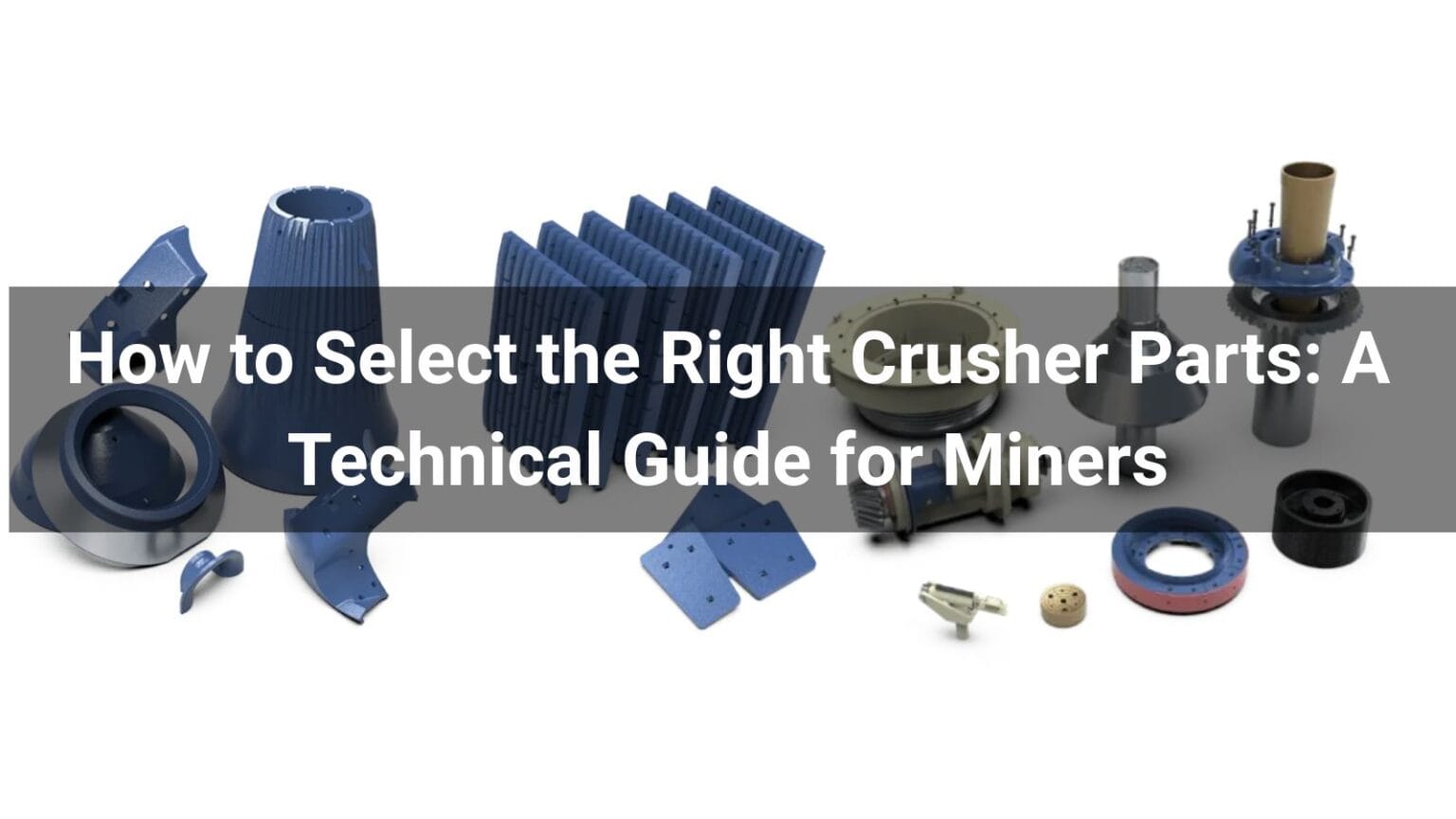
In the global mining industry, the selection of wear-resistant components is frequently treated as a routine procurement task. However, this oversight costs operations millions in lost revenue annually. Choosing the right crusher wear parts is a sophisticated engineering challenge that requires a deep understanding of metallurgy, rock mechanics, and chamber kinematics. For mine owners, the goal must shift from finding the lowest invoice price to achieving the lowest cost per ton crushing analysis.
1. The Financial Reality: Why Cheap Liners Increase Operational Costs
Most mine operators ask two questions: “Who has the cheapest liners?” or “Which one lasts the longest?” From a technical perspective, these questions ignore the complexity of crusher downtime cost. A procurement manager might save 20% on the initial purchase of aftermarket crusher parts, but if those parts fail 30% faster, the operation suffers. When a crusher is idle for an unscheduled liner change, the lost production revenue far outweighs the savings on the steel itself. Every hour of downtime in a high-capacity mine can represent tens of thousands of dollars in lost opportunity.
2. Rock Mechanics and the Mining Ore Abrasion Index (AI)
Before selecting a jaw crusher liner material or a cone crusher mantle, you must audit the rock itself. The “personality” of your ore determines the wear pattern. The mining ore abrasion index (AI) is the most critical metric; it quantifies how much the rock will “sandpaper” the metal surface. High-silica ores like quartz, taconite, or granite are extremely abrasive. If you do not know your AI, you are effectively guessing your wear life.
Furthermore, you must analyze the Particle Size Distribution (PSD). If your feed contains too many fines—material that should have been removed by pre-screening—the fines settle at the bottom of the crushing chamber. This creates a “packing” effect, leading to massive pressure spikes and wasted energy. It wears out the discharge end of your liners while the feed end remains at 90% thickness, forcing a premature change-out.
3. The Science of Manganese Steel Work Hardening
Hadfield’s manganese steel is the undisputed king of crushing due to its ability to work harden. Under the stress of impact, the surface (top 2-3mm) transforms its molecular structure to become incredibly hard, while the inner core remains ductile and flexible. This prevents the part from shattering. However, matching the manganese grade to the rock is essential:
- 14% Manganese (Mn13): Suitable for soft, low-abrasion rock like limestone or gypsum. If the rock isn’t hard enough to trigger the hardening effect, the steel stays soft and rubs away.
- 18% Manganese (Mn18): The industry standard workhorse. It provides a balanced lifecycle for medium-hard ores and is the safest bet for most mining operations.
- 22% Manganese (Mn22): Designed for the most extreme, high-impact environments. It work-hardens faster and deeper, making it ideal for hard iron ore or quartzite.
A critical rule for crusher wear monitoring: replace your liners when they reach 10% of their original tooth height. Waiting too long allows the liner to thin out to the point where it can no longer protect the crusher frame. Rebuilding a damaged crusher head or frame is an expense that makes a set of liners look like pocket change.
4. Technical Optimization of Cone Crusher Chamber Geometry
In cone crushers, the interaction between the stationary concave and the moving mantle creates the “crushing zone.” A “one-size-fits-all” approach to cone crusher mantle selection is a recipe for inefficiency. If you use a coarse chamber for a fine feed, the material falls too far into the chamber before being crushed, leading to “bell-mouthing”—where the bottom of the liner wears into a thin edge while the top is untouched. This uneven wear destabilizes the main shaft and increases electricity consumption by up to 15%.
5. Installation Integrity: Backing Compound and Break-in Protocols
Even the highest-quality casting will fail if the installation is flawed. The crusher backing compound is a specialized epoxy resin that serves as a load distributor and shock absorber. If the compound is mixed poorly or contains air voids, the liner will flex under the massive crushing force. This localized flexing generates heat and leads to fatigue cracking, causing the liner to shatter prematurely.
Furthermore, the initial break-in period is where many mines lose 30% of their potential liner life. New manganese liners are relatively soft (approx. 220 Brinell). They require time to develop their “armor.” Every site manager should enforce a protocol of running the crusher at 50% capacity for the first six hours. Going straight to 100% load risks “metal flow,” where the manganese literally squeezes out like toothpaste, potentially jamming the adjustment ring and ruining the part’s profile forever.
6. Conclusion: A Data-Driven Mining Equipment Maintenance Strategy
Selecting the right crusher parts is not about finding a bargain; it is about managing the efficiency of your entire production line. By prioritizing the abrasion index, matching the manganese steel grade to your ore, and adhering to strict installation protocols, you move from reactive maintenance to proactive profit generation. In the high-stakes world of mining, the goal is to move the most rock with the fewest interruptions. If these technical strategies keep your crusher running for an extra 50 hours a year, the resulting profit will far exceed any perceived savings from “cheap” liners.
Technical Long-tail Keywords: crusher wear parts selection, cost per ton crushing analysis, manganese steel work hardening, crusher downtime cost, mining ore abrasion index, jaw crusher liner material, cone crusher mantle selection, crusher backing compound, mining equipment maintenance strategy, crusher wear monitoring.
Technical FAQ: Crusher Wear Parts Troubleshooting
To help plant managers and maintenance engineers reduce unscheduled stops, we have compiled the most frequent technical inquiries regarding liner life and performance optimization. Addressing these issues early is key to maintaining a healthy production flow.
Q1: Why are my jaw plates cracking before the wear surface is fully utilized?
A: Premature cracking is usually a symptom of “Brittle Fracture.” This occurs if the manganese steel grade is too high for the impact level (e.g., using 22% Mn on soft rock) or if the crusher backing compound was poorly applied, leaving voids that allow the liner to flex and fatigue under load.
Q2: How does the “Nip Angle” affect the wear rate of my jaw crusher?
A: If the nip angle is too wide, the rock will “bounce” rather than be gripped and crushed. This creates excessive abrasive wear at the top of the jaw dies and significantly reduces throughput. Proper jaw crusher liner material selection should include a profile that maintains an aggressive nip angle throughout the liner’s life.
Q3: What is the primary cause of “Ring Bounce” in cone crushers?
A: Ring bounce is typically caused by “Packing” in the crushing chamber. When the feed contains excessive fines or the Particle Size Distribution (PSD) is poorly managed, the material becomes uncrushable at the bottom of the cavity. This wastes energy and causes severe impact damage to both the mantle and concave.
Q4: Can I use the same liner profile for different types of ore?
A: No. Each ore has a unique mining ore abrasion index (AI). A profile designed for limestone will fail prematurely in a granite application. Cone crusher mantle selection must be tailored to the specific hardness and feed size of your current deposit to ensure even wear.
Q5: Is “Metal Flow” a sign of poor quality casting?
A: Not necessarily. Metal flow (where the manganese spreads like toothpaste) usually indicates that the liner was not properly “broken in.” Skipping the mandatory 6-hour 50% load period prevents the work hardening process from forming a stable armor, causing the soft manganese to deform under full pressure.
The GUBT Advantage: Engineering Your Profit Margin
Selecting the right parts is an exercise in data-driven decision-making. As we have explored, the difference between a high-performing mine and an inefficient one often comes down to the quality of the wear parts and the precision of the mining equipment maintenance strategy. While many suppliers simply sell “pieces of steel,” a true partner provides technical solutions that lower your cost per ton crushing analysis.
*Based on average field performance with GUBT tailored manganese alloys and chamber optimization.
This is where GUBT excels. As a leading global crusher wear parts manufacturer, GUBT does not just replicate OEM shapes; we enhance them. With a massive database of over 15,000 sets of drawings and a deep mastery of manganese steel work hardening, GUBT provides parts that are pre-engineered to tackle the world’s harshest ores. Our focus is on precision—ensuring that every mantle, concave, and jaw plate fits perfectly and performs predictably.
By integrating GUBT into your crusher wear monitoring routine, you gain access to decades of metallurgical expertise and a supply chain designed for speed. Whether you are dealing with high-abrasion taconite or seeking to eliminate crusher downtime cost in a recycling plant, GUBT delivers the reliability your production targets demand. Don’t settle for “cheap” steel when you can invest in engineered performance that secures your mine’s bottom line.
Latest Insights
Cone Crusher Liners vs Jaw Plate Parts: Wear Mechanism, Structure Differences & Replacement Cycles

Long Life Crusher Liners:Material Selection, Wear Optimization & Cost Reduction Guide
Mining Crusher Parts for Hard Rock: High-Performance Wear Solutions & Cost Optimization Guide