Why Choosing the Right Jaw Crusher Parts Manufacturer Matters
Honestly speaking, most buyers focus on price first. That’s where problems usually start. A jaw crusher sitting idle costs thousands of dollars per hour in lost production — and in most cases, the reason it stopped is not the machine itself but the wear parts that failed ahead of schedule.
The manufacturer you choose determines how long your jaw plates last, how consistently they perform across batches, and how quickly you can get replacements when you need them. A part that costs 20% less but wears out 40% faster is not a saving — it’s a recurring expense plus unplanned downtime.
This guide is built around what actually matters in a commercial procurement decision: material quality, manufacturing process control, application fit, and the real cost per ton processed — not just the price per unit on the invoice.
| Impact Area | Effect of Wrong Manufacturer Choice | Effect of Right Manufacturer Choice |
| Wear part lifespan | 30–50% shorter than expected | Consistent with or exceeding spec |
| Planned downtime | Frequent, unscheduled replacement cycles | Predictable, scheduled change intervals |
| Unplanned downtime | High risk — parts fail mid-operation | Low risk — consistent wear behavior |
| Cost per ton processed | Higher due to frequent replacement | Lower over full production cycle |
| Inventory management | Larger safety stock needed | Leaner stock, predictable lead times |
| Equipment damage risk | Higher — poor fit causes abnormal wear | Lower — correct spec protects crusher |
Key Types of Jaw Crusher Parts You Need to Consider
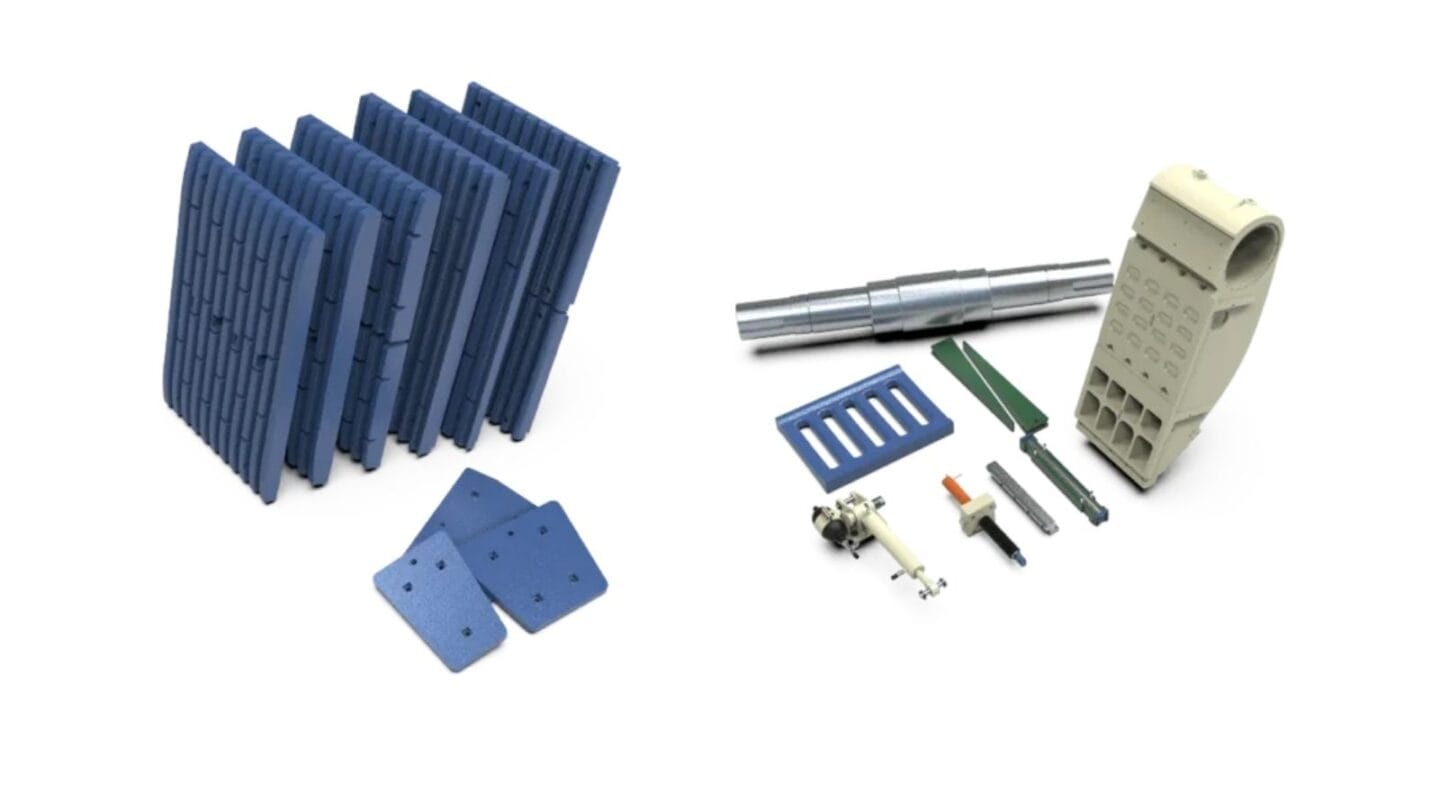
I’ve seen many buyers underestimate jaw plates — treating them as interchangeable commodities. They’re not. Each part type has specific material and dimensional requirements, and the wrong specification for your application will cost you significantly more than the price difference suggests.
| Part Type | Function | Why Material Matters | Typical Material |
| Fixed jaw plate | Stationary crushing surface against which material is broken | Hardness determines wear life; too soft = fast wear, too hard = cracking | High manganese steel (Mn13–Mn22) |
| Movable jaw plate | Reciprocating plate that applies crushing force | Must balance hardness and toughness — high impact loads | High manganese steel (Mn18 with Cr2 common) |
| Cheek plates / liners | Protect side walls of the crushing chamber | Direct contact with abrasive feed — abrasion resistance critical | Mn13 or chrome-moly alloy |
| Toggle plate | Transmits force and acts as safety fuse against overload | Must fracture before crusher frame — correct tensile spec critical | Cast iron or mild steel (by design) |
| Toggle seat | Supports toggle plate at both ends | High point load — must resist deformation without cracking | Alloy steel, hardened |
| Pitman / eccentric shaft | Core drive mechanism — converts rotation to reciprocating motion | Fatigue resistance essential under cyclic loading | Forged alloy steel |
| Jaw wedge / adjustment shims | Set closed-side setting (CSS) — controls product size | Dimensional accuracy critical for product gradation control | Mild or alloy steel |
Jaw Crusher Parts Manufacturer vs Supplier vs Factory: What’s the Difference?
This is where many buyers get confused — and where some suppliers are deliberately vague. Not every supplier is a real manufacturer. Understanding the supply chain structure behind your parts source directly affects your ability to control quality, negotiate on specification, and get reliable delivery.
| Entity Type | What They Actually Do | Advantages | Disadvantages |
| Manufacturer / Foundry | Produces parts directly — controls casting, heat treatment, and QC | Full spec control, customization possible, direct pricing | May have minimum order quantities, longer lead times for custom work |
| Factory with in-house casting | Owns production equipment and processes end-to-end | Good quality control, competitive pricing at volume | May not stock all sizes — production to order |
| Authorized OEM parts distributor | Holds licensed stock of original equipment manufacturer parts | Guaranteed spec match, technical support | Premium pricing, limited to supported crusher models |
| Trading company / agent | Sources from multiple foundries, adds margin | Wide product range, easier communication | No direct quality control, spec consistency varies batch to batch |
| Mixed model supplier | Manufactures some items, sources others | Flexible range, partial quality control | Critical to verify which items are self-manufactured |
The practical test: ask any supplier for photos of their foundry, their casting equipment, and their heat treatment furnace. A real manufacturer can provide these immediately. A trading company will stall or redirect.
What Makes a Reliable Jaw Crusher Parts Manufacturer?
Reliability is not a single factor — it’s the intersection of material quality, process control, and operational support. Here are the four areas that consistently separate good manufacturers from average ones:
1. Material Quality — High Manganese Steel
Don’t be fooled by ‘high manganese’ claims. High manganese steel covers a wide range — Mn13, Mn14, Mn18, Mn22, with varying chromium and molybdenum additions that dramatically affect performance. A supplier quoting ‘high manganese jaw plates’ without specifying the grade and alloy composition is giving you no meaningful information.
The correct manganese grade depends on your feed material and crusher type. High-impact applications (large primary crushers, hard rock) typically benefit from Mn18Cr2 or Mn22 grades. Lower-impact, high-abrasion applications may perform better with Mn13Cr2. Ask for the chemical composition certificate for each production batch — not a generic spec sheet.
| Steel Grade | Mn % | Typical Application | Key Property |
| Mn13 | 12–14% | Low-impact, moderate abrasion | Good wear resistance, cost-effective |
| Mn13Cr2 | 12–14% | Mixed abrasion and impact | Improved hardness retention |
| Mn18Cr2 | 17–19% | High-impact primary crushing | Best work-hardening, excellent toughness |
| Mn22 | 21–23% | Extreme impact, large primary crushers | Maximum toughness, superior impact resistance |
| Chrome-moly alloy | — | High abrasion, lower impact | Higher initial hardness, less ductile |
2. Manufacturing Process and Heat Treatment
I’ve seen identical material specifications perform completely differently across suppliers. The same Mn18Cr2 grade from two different foundries can have 30–40% variance in wear life — because the casting process, pouring temperature, mold design, and heat treatment cycle are all different.
Key process indicators to ask about: solution annealing temperature (typically 1050–1100°C for manganese steel), water quench timing, cooling rate control, and post-cast dimensional inspection. A manufacturer who can explain these parameters in detail — and provide process records — is one who actually controls their production.
3. Customization Capability
Standard parts don’t always fit real working conditions. A jaw plate designed for granite primary crushing in a quarry requires different tooth profile geometry than one for recycled concrete processing or river gravel production. Feed size, material hardness, moisture content, and desired product gradation all influence the optimal plate design.
A manufacturer with genuine customization capability can adjust tooth pitch, profile height, and alloy grade to your specific application. One that can only supply catalog sizes is limiting your operational performance before you’ve even started.
4. Production Capacity and Delivery Reliability
Delayed parts equal stopped production. This sounds obvious, but many buyers discover their supplier’s lead time reality only when they urgently need replacement stock. A supplier who quotes 2 weeks but consistently delivers in 6 is more expensive than a supplier who quotes 4 weeks and delivers in 4.
Ask specifically: What is current production backlog? What is the stocked item list vs made-to-order items? What is the on-time delivery rate for the past 12 months? Can you hold buffer stock for your account? These questions separate operational suppliers from catalog sellers.
OEM vs Aftermarket Jaw Crusher Parts Manufacturer
Most operations actually use aftermarket parts for the majority of their wear parts spend — and that’s a rational decision. However, OEM still matters in specific situations. The key is knowing when each makes sense.
| Criterion | OEM Parts | Aftermarket Parts |
| Unit price | 20–60% premium over aftermarket | Lower — sometimes significantly |
| Spec certainty | Exact match to original design | Varies — quality tier dependent |
| Availability for older models | Often discontinued | Often still available from foundries |
| Customization | None — catalog only | Possible with right manufacturer |
| Warranty support | Full OEM warranty | Varies — supplier dependent |
| Quality ceiling | Consistent but not always optimized for your conditions | Can exceed OEM if well-specified |
| Best use case | Warranty period, complex mechanical components | Wear parts in proven applications |
| Risk level | Low — but higher cost | Moderate — supplier selection critical |
The practical rule: use OEM parts for mechanical components (bearings, toggle plates, pitman assemblies) where dimensional precision is critical. Use well-specified aftermarket for consumable wear parts (jaw plates, cheek plates, liners) where you can verify material quality directly.
How to Evaluate Jaw Crusher Parts Quality Before Buying
Don’t rely on photos or catalogs. The only way to properly evaluate a jaw crusher parts manufacturer is through documented evidence and physical testing. Here’s a practical evaluation sequence:
| Evaluation Step | What to Request | What It Tells You |
| Material certification | Chemical composition test report per batch (heat number traceable) | Confirms actual alloy grade — not just claimed grade |
| Hardness test report | Brinell hardness (HB) test results from multiple sample points | Indicates heat treatment quality and consistency |
| Dimensional inspection report | CMM or manual measurement report against drawing | Confirms fit without requiring trial installation |
| Metallurgical structure report | Microstructure photos (austenitic grain size, carbide distribution) | Reveals casting quality and heat treatment effectiveness |
| Reference operations list | Names of operations using the same parts in similar applications | Real-world performance evidence — follow up directly |
| Production facility audit | Photos or video of foundry, heat treatment equipment, QC lab | Confirms manufacturer vs. trading company |
| Sample order test | Order 1–2 sets before committing to volume | Real wear test under your conditions — no substitute |
Jaw Crusher Parts for Different Applications: Mining, Quarry, Aggregate
Application matters more than most buyers think. The same jaw plate grade that excels in a limestone quarry will underperform in a hard granite mine — not because the part is defective, but because it was specified for different conditions. Match the part to the work, not just to the crusher model.
| Application | Typical Feed Material | Key Wear Challenge | Recommended Grade | Priority |
| Hard rock mining | Granite, basalt, iron ore, quartzite | Extreme abrasion + high impact | Mn18Cr2 or Mn22 | Toughness + wear resistance balanced |
| Limestone quarry | Soft to medium limestone | Moderate abrasion, lower impact | Mn13 or Mn13Cr2 | Cost-efficiency — lower alloy needed |
| River gravel / sand | Rounded, silica-rich gravel | High abrasion, variable impact | Mn18Cr2 | Abrasion resistance |
| Recycled concrete / C&D | Concrete with rebar fragments | High impact from metal contamination | Mn22 — maximum toughness | Impact resistance above all |
| Coal preparation | Soft coal with occasional rock | Low abrasion, moderate impact | Mn13 | Wear life secondary — cost primary |
| Aggregate (mixed feed) | Variable — limestone to granite | Variable — depends on quarry | Mn18Cr2 as standard | Versatility and predictability |
Cost vs Value: Why the Cheapest Jaw Plates Are Not Always Best
Cheap parts are often the most expensive choice — but this is difficult to see when procurement decisions are made on unit price alone. The metric that actually matters in production is cost per ton processed, which accounts for part price, wear life, and the downtime cost of each change-out.
| Part Tier | Unit Price (per set) | Estimated Wear Life | Change-outs per Year | Annual Part Cost | Downtime per Year (est.) | True Annual Cost |
| Budget (low-grade Mn13) | $800 – $1,200 | 400–600 hours | 6–8 sets | $5,600 – $9,600 | 12–16 hours | $17,600 – $25,600+ |
| Mid-range (Mn13Cr2) | $1,200 – $1,800 | 700–900 hours | 3–5 sets | $4,200 – $8,100 | 6–10 hours | $10,200 – $18,100+ |
| Premium (Mn18Cr2) | $1,800 – $2,800 | 1,000–1,400 hours | 2–3 sets | $4,200 – $7,600 | 4–6 hours | $8,200 – $13,600+ |
| Optimized custom spec | $2,200 – $3,500 | 1,200–1,800 hours | 1–2 sets | $2,800 – $7,000 | 2–4 hours | $5,800 – $11,000+ |
Note: Downtime cost calculated at $800/hour lost production — adjust for your operation. These figures are indicative ranges based on typical quarry and mining applications; actual results vary by crusher model, feed material, and operating conditions.
How to Choose the Right Jaw Crusher Parts Manufacturer: Step-by-Step
Don’t rush this decision. A poor supplier choice typically surfaces 3–6 months into a supply relationship — after you’ve already committed budget and potentially stocked the wrong parts. Follow this sequence before committing to a source:
- Define your application precisely — crusher model, feed material type, feed size range, closed-side setting, and daily throughput target. Without this, no supplier can give you a meaningful specification.
- Identify the correct material grade for your conditions — use the application guide in this document or consult a metallurgist. Don’t accept ‘high manganese’ as a specification; require the exact grade and alloy additions.
- Shortlist 3–5 potential suppliers — mix of manufacturers and distributors. Check for foundry ownership, years in business, and references from operations similar to yours.
- Request documentation packages from each — chemical composition certs, hardness test reports, manufacturing facility evidence, and a reference list you can contact.
- Contact references directly — ask specifically about wear life consistency across batches, delivery reliability, and response when problems occurred. This step alone eliminates most of the weak options.
- Order a trial set from your top 1–2 candidates — install under your actual operating conditions and track wear life, fit, and behavior over a full wear cycle before committing to volume.
- Evaluate total cost, not unit price — calculate cost per ton processed based on the trial result. The supplier with the lowest cost per ton processed is the correct choice, regardless of unit price.
- Negotiate supply terms — confirm lead times, minimum order quantities, stock holding options, batch documentation requirements, and warranty terms in writing before signing any supply agreement.
Common Mistakes When Choosing a Jaw Crusher Parts Supplier
I’ve seen entire batches fail within weeks — not because of bad luck, but because of specific, avoidable decisions made during supplier selection. These are the mistakes that come up repeatedly in operations that struggle with wear parts performance:
- Selecting based on unit price alone — the single most common and most expensive mistake. Price per part tells you almost nothing about cost per ton processed, which is the only number that matters operationally.
- Accepting ‘high manganese’ as a specification — this is not a spec. It’s a marketing term. Always require the exact grade (Mn13, Mn18Cr2, etc.) and a chemical composition certificate for each production batch.
- Skipping the sample trial — catalog photos and spec sheets cannot predict how a part will perform under your specific conditions. Every new supplier relationship should start with a trial set installed and monitored through a full wear cycle.
- Not verifying manufacturer status — many ‘manufacturers’ are trading companies sourcing from whoever is cheapest that week. Batch-to-batch consistency is impossible under this model. Ask for foundry photos, heat treatment records, and production capacity documents.
- Ignoring lead time reality — a supplier who quotes 2 weeks but consistently delivers in 5–6 weeks forces you to hold excessive inventory or risk unplanned downtime. Get the on-time delivery rate for the past 12 months, not just a quoted lead time.
- Choosing the same spec for different applications — jaw plates for limestone quarrying and hard granite mining have fundamentally different requirements. Using the same grade across all applications means one is always wrong.
- Failing to specify tooth profile — plate geometry (tooth pitch, height, and profile shape) affects throughput and product gradation as much as alloy grade affects wear life. Standard catalog profiles are not always optimal for your feed material.
Final Thoughts: Choosing a Long-Term Jaw Crusher Parts Partner
The cheapest supplier rarely becomes a long-term partner. What starts as a price saving usually ends in quality inconsistency, delivery failures, and the operational disruption of switching suppliers mid-production season. The operations that manage their wear parts costs most effectively are those that invest time upfront in supplier qualification and then commit to relationships that deliver predictable, consistent performance.
A reliable manufacturer-level supplier gives you more than parts — they give you predictability. Predictable wear life means you can schedule maintenance, control inventory, and plan production without surprises. That predictability is worth more than the savings from the lowest-price option.
| Supplier Evaluation Criterion | Minimum Acceptable | What a Strong Partner Provides |
| Material documentation | Generic spec sheet | Batch-traceable chemical composition certificates |
| Quality control | Visual inspection only | Hardness testing + dimensional inspection per batch |
| Technical support | Product catalog | Application engineering — grade and profile recommendations |
| Lead time reliability | Quoted lead time only | On-time delivery rate data + buffer stock options |
| Customization | Catalog sizes only | Custom dimensions and alloy grades to your spec |
| Reference operations | None provided | Named references in similar applications |
| Problem resolution | Unclear process | Defined warranty, replacement process, and response time |
| Long-term pricing | Spot pricing only | Annual volume pricing with stability commitments |
Some specialized manufacturers focus more on wear life optimization than simply selling parts — working with you to refine the specification based on your specific crusher model, feed material, and production targets. This type of partnership, while requiring more upfront qualification effort, consistently delivers the lowest total cost of ownership.
Stop Paying for “Cheap” Parts—Start Investing in Uptime.
Every hour of downtime is a leak in your profit margin. At GUBT, we don’t just sell castings; we provide engineered solutions that last 30-50% longer than standard aftermarket parts. From custom Mn22 alloys to ISO 9001-certified quality control, we ensure your crusher stays running. 👉 Get a Free Technical Consultation & Quote Today
Frequently Asked Questions
How do I know if a jaw plate is genuine high manganese steel?
Request the mill certificate or heat analysis report from the supplier. This document shows the exact chemical composition by element — manganese percentage, carbon content, and any alloy additions. A legitimate manufacturer can provide this for every production batch. If a supplier cannot produce batch-traceable composition documentation, treat the material claim as unverified.
What is the typical lead time for custom jaw plates?
Custom jaw plates from a manufacturer with in-house foundry capability typically require 4–8 weeks from confirmed order — longer for first-time tooling. Standard sizes from stock can ship within 1–2 weeks. Always confirm current production backlog at the time of ordering, not just a nominal lead time. For operations with critical continuity requirements, negotiate a standing stock agreement with your preferred supplier.
How many jaw plate change-outs per year should I expect?
This varies significantly by application, crusher size, and part quality. In a typical hard rock quarry running a mid-size primary jaw crusher, expect 3–6 change-outs per year with mid-grade parts, or 1–3 with well-specified premium parts. Tracking wear life per set — measured in tons processed or operating hours — is the only reliable way to benchmark your actual performance.
Should I use the same manufacturer for all crusher wear parts?
It simplifies procurement and relationship management, and a single manufacturer with full knowledge of your operation is better positioned to optimize specifications over time. However, it creates single-source dependency risk. A practical approach: primary wear parts (jaw plates, cheek plates) from your qualified main supplier, mechanical components (bearings, toggle plates) from OEM or a specialist mechanical parts supplier.
What certifications should I look for in a jaw crusher parts manufacturer?
ISO 9001 quality management certification is the baseline for any serious manufacturer. Additionally, look for documented compliance with material standards such as ASTM A128 (austenitic manganese steel castings) or equivalent national standards. CE marking may be relevant for European operations. More important than certifications, however, is documented evidence of actual process control — batch test records, dimensional inspection reports, and traceable material certificates.
Authoritative Resources & Further Reading
The following sources are directly relevant to jaw crusher parts specification, material standards, and procurement practice:
Material & Manufacturing Standards
- ASTM A128 — Standard Specification for Steel Castings, Austenitic Manganese — The primary US standard for high manganese steel castings. Use this to verify supplier material claims and request batch compliance documentation.
- ISO 9001 — Quality Management Systems — Baseline quality management certification. Verify current certification status directly with the certification body — do not rely on supplier-provided documents alone.
- ASM International — Metals Handbook (Casting) — Technical reference for casting metallurgy, heat treatment processes, and manganese steel properties. Useful for verifying manufacturer technical claims.
Industry Associations & Technical Bodies
- Society for Mining, Metallurgy & Exploration (SME) — Professional body for mining engineers. Publishes technical guidance on crusher selection, wear part management, and maintenance best practices.
- Aggregates & Quarry Association — Equipment Guidance — Industry resource for quarry and aggregate operations. Covers crusher maintenance, wear parts management, and supplier evaluation in commercial contexts.
- International Mining Magazine — Crusher & Comminution — Trade publication covering mining equipment technology, including wear parts performance and manufacturer comparisons in commercial mining contexts.