
If you have spent any significant time managing a quarry or a large-scale mining operation, you know the specific “sinking feeling” that comes with a sudden machine breakdown. It usually happens at the peak of production, precisely when you can least afford it. When you look at the lead times for an original replacement part from a major international manufacturer, and it is three months out with a staggering price tag, the conversation inevitably shifts toward custom crusher parts and the strategic world of reverse engineering.
For a long time, there was a stigma around non-original parts; they were often dismissed as “cheap knock-offs.” However, the reality on the ground has shifted. Today, utilizing high-end OEM crusher parts services is no longer just a cost-saving measure—it is a sophisticated engineering move to gain total control over your equipment’s uptime.
By leveraging technical data from your specific site and combining it with advanced crusher wear parts manufacturing in China, you can move beyond “standard” solutions. This guide explores how to transform a generic machine into a site-specific asset, ensuring that your metallurgy and geometry are perfectly tuned to the unique hardness of your rock, all while slashing lead times and reclaiming your bottom line.
1. Why More Quarries Are Turning to Custom Crusher Parts
Managing a large-scale quarry comes with a constant shadow: the risk of sudden machine breakdown. When a primary crusher fails, the “sinking feeling” stems from the hidden cost of OEM lead times—often stretching to 12-24 weeks. Relying solely on original manufacturers creates a dangerous dependency that threatens mining operations uptime.
The conversation has shifted from “cheap knock-offs” to high-performance custom crusher parts. Modern aftermarket crusher parts are no longer just budget alternatives; they are OEM replacement parts engineered to solve specific site-site issues that original “one-size-fits-all” designs often ignore.
2. What Reverse Engineering Really Means
In crusher wear parts manufacturing, reverse engineering crusher parts is a rigorous discipline of data acquisition. If a supplier simply uses a tape measure on an old jaw plate, they aren’t engineering; they are guessing.
- High-Precision 3D Scanning: Capturing geometries to a fraction of a millimeter using LiDAR or structured light.
- Design Intent Reconstruction: A scan shows a deformed part. Our engineers “math out” the original dimensions while evaluating structural stress to reconstruct what the part should have been.
- Improving Flawed Designs: We identify OEM weak points. If a part frequently cracks in high-impact zones, our custom engineering solutions add reinforcement or alter profiles to match your specific feed material (e.g., Granite vs. Basalt).
3. The Metallurgy Behind Performance: Lifespan Determinants
A perfect digital model is useless without metallurgical integrity. Manganese steel crusher parts (Hadfield steel) are the backbone of the industry due to their work-hardening behavior.
- Mn13% (Standard): Best for low-impact, non-abrasive materials like limestone.
- Mn18% (Premium): The industry standard for medium-hard rock.
- Mn21%-22% (High-Mn): Enhanced with Chromium for the most abrasive quartzite applications.
- Ceramic Insert Blow Bars: For impact crushers, casting ceramic grains into high-chrome iron provides 2-3x longer wear life than standard metal.
Every pour must come with a material certification detailing the chemical composition (C, Mn, Cr, P, S) and heat treatment logs to ensure the steel is tough, not brittle.
4. Custom Engineering by Component Type
4.1 Jaw Crusher Plates & Cheek Plates
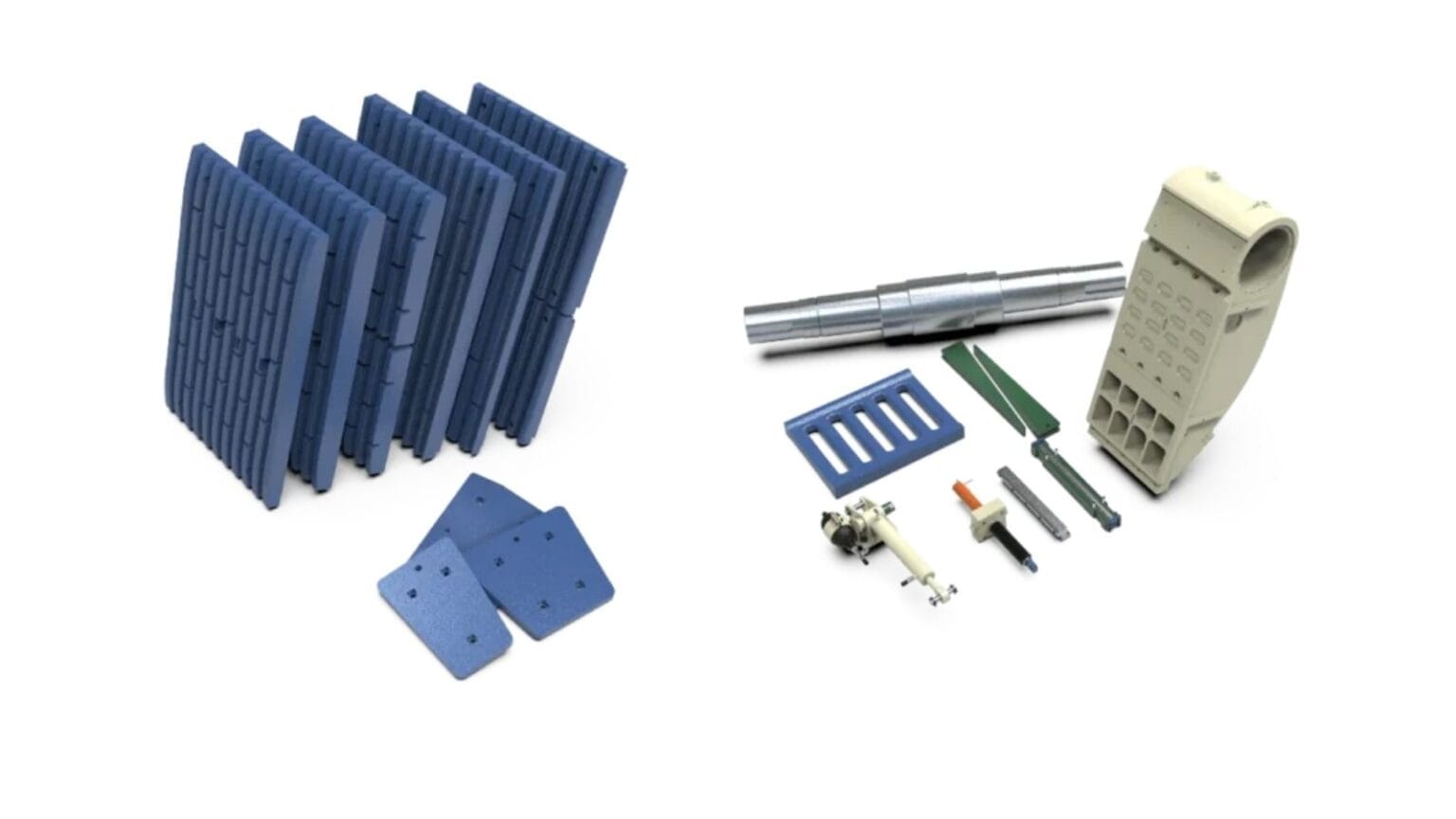
The custom jaw plates we engineer focus on the CSS (Closed Side Setting) impact. If wear is concentrated at the bottom, we “beef up” that zone. Custom cheek plate thickness can also prevent mainframe wear, a common OEM oversight.
4.2 Cone Crusher Mantles & Concaves
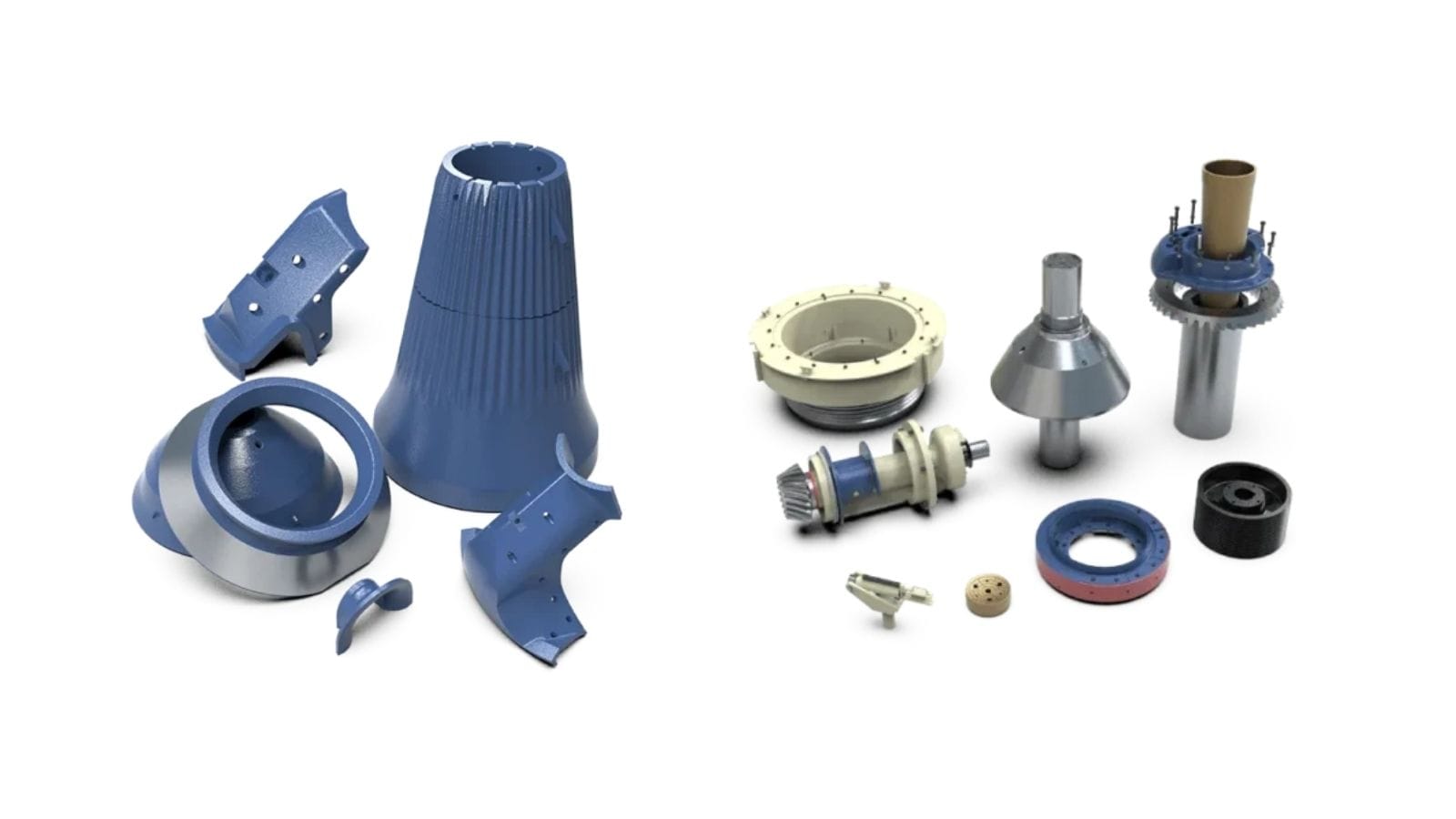 Precise fit is non-negotiable to prevent mantle spinning. By optimizing the crushing chamber geometry, we allow operators to control final product gradation, potentially increasing the yield of high-value aggregate sizes.
4.3 HSI Crusher Liners & Critical Spares
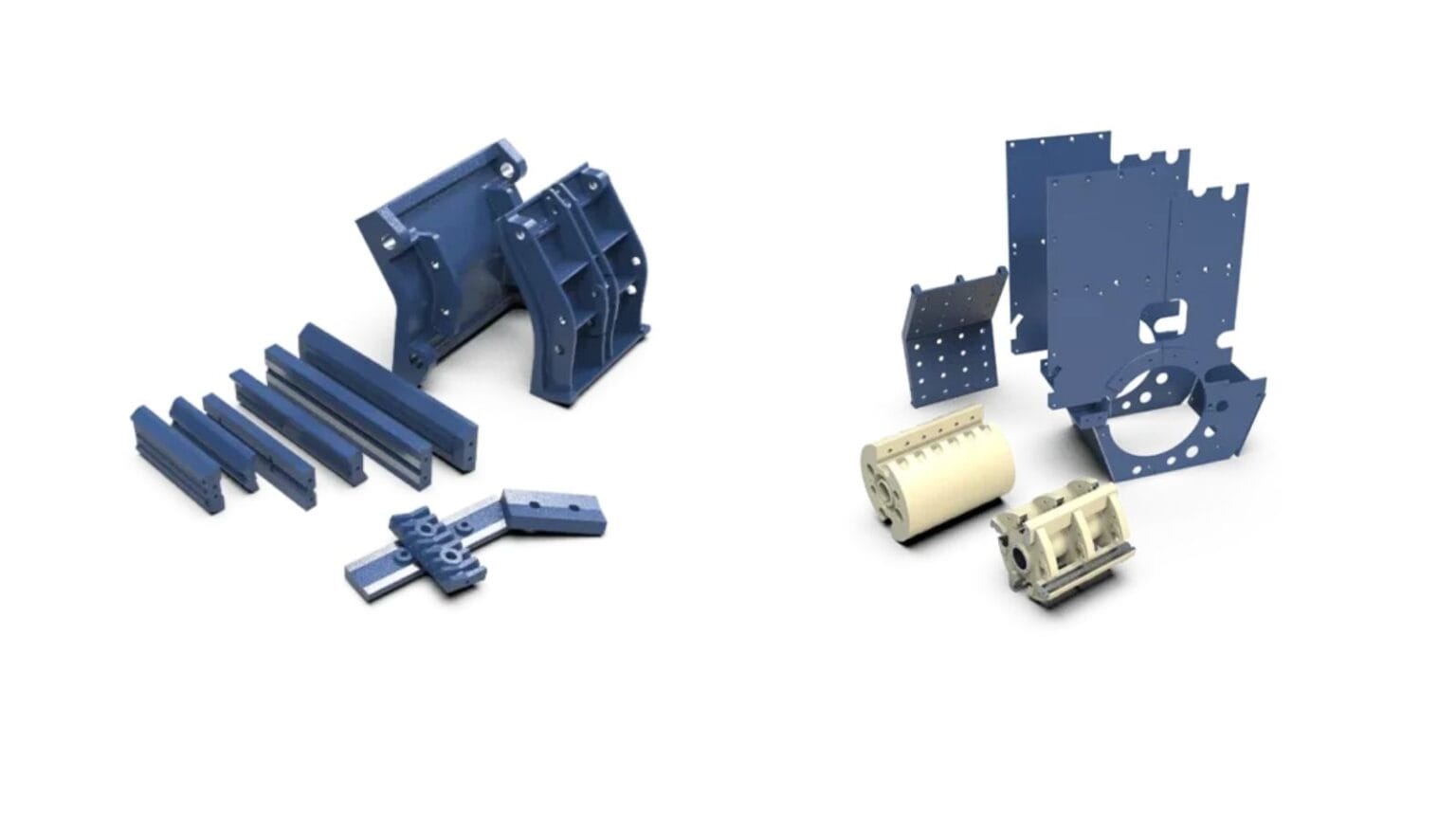 Our HSI crusher liners and spares provide a comprehensive protection system for your impactor, combining precision-cast side liners for superior chamber shielding with high-tolerance mechanical components like rotor assemblies and wedge sets to ensure perfect balance and peak operational performance in even the most abrasive environments.
5. OEM Crusher Parts Services: Foundry vs. Engineering Partner
A simple foundry takes a drawing and pours metal. A true OEM crusher parts service partner provides:
- Engineering Consultation: Asking what you are crushing before offering a quote.
- Drawing Validation: Digital modeling to check for interference and tolerance control.
- Continuous Improvement: Using wear data from the field to refine the next batch of custom casting manufacturer orders.
6. Sourcing Custom Crusher Parts from China: The Spectrum
The crusher parts manufacturer China landscape is a spectrum of quality. Tier-1 foundries in industrial clusters (like Zhejiang or Liaoning) focus on the aftermarket crusher parts supplier market for global Tier-1 brands.
How to Vet a Chinese OEM Manufacturer:
| Document | What to Look For |
|---|---|
| Material Certification | Batch-specific chemistry (Spectrometer reports). |
| Dimensional Reports | CMM or 3D scan validation against CAD. |
| Heat Treatment Logs | Time-temperature curves for quenching. |
| ISO 9001 | Third-party audited quality management systems. |
7. Common Pitfalls in Reverse Engineering
Chasing the lowest price often leads to the “lowest price trap.” Critical failures include:
- Shrinkage Miscalculation: Failing to account for the 2.4%-3% contraction of manganese during cooling, leading to parts that don’t fit the head seat.
- Inaccurate Pattern Development: Using wooden patterns that warp instead of CNC-machined aluminum or high-density foam.
- “Universal Alloy” Myths: Beware of suppliers claiming one alloy works for all rock types.
8. Transitioning from Original OEM to Custom Manufacturing
Don’t replace your entire liner set overnight. Scale gradually:
- Start with low-risk components: Cheek plates or toggle seats.
- Monitor wear life metrics: Measure thickness at set intervals.
- Track tons-per-hour: Ensure the new profile hasn’t reduced throughput.
- Compare cost-per-ton: This is the only metric that matters for ROI.
9. Cost Analysis: Custom vs. Original OEM
While the unit price of compatible crusher parts is often 30-50% lower, the true value lies in inventory risk reduction. Shorter lead times mean you don’t need to tie up millions in “just-in-case” stock. The lifecycle cost per ton is significantly lowered when metallurgy is tuned to your site’s specific rock hardness.
Industrial Intelligence: Crusher Wear Parts FAQ
Conclusion
In the end, a crusher is more than just a machine; it is a high-stakes investment where the components doing the work determine your ultimate profitability. Moving from a dependency on standard original parts to a strategy of custom engineering allows you to optimize your tool for your specific site conditions, turning a generic asset into a specialized competitive advantage.
At GUBT, we bridge the gap between traditional manufacturing and advanced engineering. As a leading OEM crusher parts service provider, we don’t just pour metal—we solve wear problems. By combining high-precision 3D scanning and rigorous reverse engineering with elite metallurgical control, GUBT ensures that every jaw plate, cone liner, and blow bar we produce matches or exceeds OEM standards for fit and durability. Whether you are looking to reduce your cost-per-ton or eliminate the “sinking feeling” of an 18-week lead time, GUBT is your technical partner in keeping your operation running at peak performance.
Latest Insights
Cone Crusher Liners vs Jaw Plate Parts: Wear Mechanism, Structure Differences & Replacement Cycles

Long Life Crusher Liners:Material Selection, Wear Optimization & Cost Reduction Guide
Mining Crusher Parts for Hard Rock: High-Performance Wear Solutions & Cost Optimization Guide