
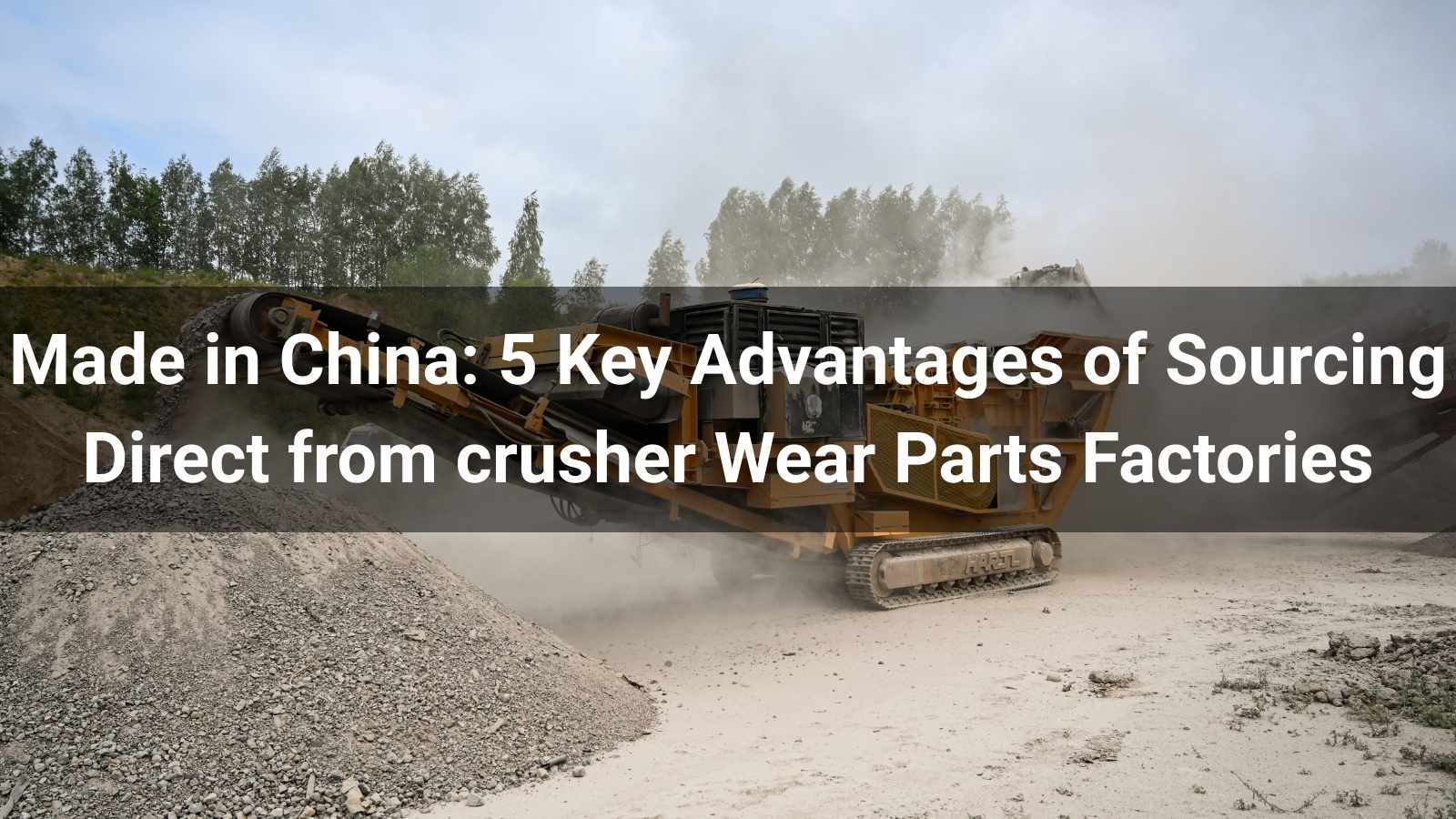
 The global aggregate and mining sectors are currently experiencing a silent pivot. As traditional OEM lead times fluctuate and price premiums for “genuine” parts reach unsustainable levels, the focus has shifted toward direct-to-factory sourcing in China. However, the search for a China crusher wear parts factory often yields a chaotic mix of shell trading companies and legitimate high-tier foundries. For a procurement professional, the challenge isn’t finding a supplier—it’s verifying the metallurgical integrity and the “Total Cost of Ownership” (TCO) that doesn’t appear on a proforma invoice.
For years, the conversation around industrial sourcing followed a predictable script: quality was reserved for Western brands, while cost-savings were synonymous with a “roll of the dice” in the East. That binary choice has vanished. Over the last decade, we have witnessed a massive shift in how heavy-duty wear parts are designed, cast, and shipped. The “factory floor of the world” has evolved into a center for metallurgical excellence, moving past “pirate castings” toward high-spec engineering that keeps crushers, grinders, and mills running in the harshest environments on earth.
The End of the Metallurgical Monopoly
There was a time when the specific recipes for high-performance manganese steel were closely guarded secrets held by a few legacy firms. That era is over. Professional metallurgy is no longer a monopoly. When analyzing data from modern China crusher wear parts factories, the technical precision is often indistinguishable from European or American counterparts. The top-tier facilities have mastered the work-hardening mechanics that allow these parts to survive abrasive rock, managing cooling rates and chemical compositions with automated precision.
I have spent significant time evaluating how different manganese levels—14%, 18%, and even 22%—behave under varying stress loads. Modern Chinese foundries aren’t just pouring molten metal into a mold; they are managing the austenitic grain structure. In the past, inconsistency was the primary risk. Today, with automated pouring and rigorous lab testing, the deviation in Brinell hardness or porosity is minimal. When you buy direct, you are accessing high-level science that was previously hidden behind an expensive OEM label.
Technical Insight: A legitimate factory must provide a Heating Curve Report and a Spectrometer Analysis for every heat number. If a supplier cannot produce these documents mapped to a specific batch, they lack oversight on the grain structure.
Table 1: Manganese Grade Performance Matrix (Chemical vs. Application)
| Material Grade | Manganese Content | Brinell Hardness (Initial) | Ideal Feed Material | Cost-Per-Ton Efficiency |
|---|---|---|---|---|
| Mn13 (Standard) | 11-14% Mn | 200 – 250 HB | Limestone, soft rock, high impact | Baseline |
| Mn18Cr2 | 17-19% Mn | 220 – 280 HB | Granite, River Pebble, Iron Ore | +25% Life vs Mn13 |
| Mn22Cr2 | 21-24% Mn | 240 – 300 HB | Basalt, Quartzite, Slag | +50% Life vs Mn18 |
| Composite (TiC) | Mn Base + Titanium Carbide | 60 – 65 HRC (Inserts) | Highly Abrasive / Recycled Concrete | Extreme Longevity |
Eliminating the “Brand Tax” and Middleman Overhead
The economic driver behind direct sourcing is often misunderstood. It isn’t merely about lower labor costs; it is about the fundamental “math of the middleman.” When you purchase from a global distributor or an international OEM, you are subsidizing their massive sales teams, regional marketing budgets, and multi-layered logistics margins. By going direct to the China crusher wear parts factory, you are effectively removing the players who add cost without adding metallurgical value.
Direct sourcing allows for better negotiation on shipping and lead times. When you deal with a factory, you are talking to the people who actually schedule the production runs. There is no game of “telephone” through a regional office. This clarity often leads to more favorable contract terms, especially for high-volume orders of jaw plates, cone liners, or VSI rotors. It makes the procurement budget more predictable—a necessity for modern financial oversight.
The 1050°C Rule: Verifying Heat Treatment
In the world of manganese steel, the casting is only as good as its quenching. Manganese steel in its “as-cast” state is brittle due to carbides at the grain boundaries. To achieve an austenitic structure—the property that allows the metal to work-harden—the parts must be heated to approximately 1050°C and then rapidly quenched in water. Low-tier shops often rush this to save energy. When vetting a factory, the “acid test” is asking for their water-circulation capacity and the maximum transfer time from furnace to tank. It should be under 60 seconds.
Engineering Agility: The Custom Alloy Advantage
One of the most frustrating aspects of working with legacy brands is trying to implement a design change. If a specific ore type is causing premature wear on a standard liner, getting a design iteration through a giant corporation is nearly impossible. They often won’t entertain modifications unless you are purchasing thousands of units.
The direct factory model operates differently. These engineering teams are often eager to iterate. If we observe a bowl liner failing at the bottom edge, we can communicate directly with the foundry engineers about thickening that section or adjusting the Chrome-to-Molybdenum ratio. This agility turns a supplier into a strategic partner. Instead of selecting a part from a generic catalog, you are optimizing the metallurgy for your specific pit’s geology. This is what actually reduces the cost per ton over a multi-year horizon.
Table 2: Sourcing Comparison — Factory Direct vs. OEM/Distributor
| Feature | Direct China Factory | Global OEM / Distributor |
|---|---|---|
| Pricing Structure | Production Cost + Casting Margin | Factory Cost + Brand Tax + Dealer Margin |
| Metallurgical Control | Direct oversight of EAF furnace heats | Third-party verification only |
| Design Flexibility | High; custom profiles available | Low; restricted to standard catalog |
| Lead Time | Directly tied to foundry schedule | Tied to global inventory allocation |
| Data Transparency | Raw Spectrometer & Heat Logs | Generic Quality Certificates |
The End of the “Pirate” Stigma
We must address the “pirate casting” label. For decades, OEMs used this term to instill fear, claiming that anything not in an original box was a risk to the machine. While low-quality “backyard” shops do exist, the leading manganese steel crusher liners factories in China now operate with transparency that rivals any Western facility. These factories are proud of their ISO 9001, 14001, and 45001 certifications. They utilize 3D Laser Scanning to ensure fitment tolerances within ±1.5%—often tighter than the original specs.
Transparency is the best defense against downtime. When you source direct, you can see the trail of raw materials, the heat treatment logs, and the final inspection reports. You aren’t looking for the cheapest part; you are looking for the best value. Value means a part that fits perfectly, lasts as long as it should, and arrives on time. By vetting a factory directly, you are taking control of your supply chain rather than hoping a third party did the vetting for you.
Logistics and the “Cost-Per-Ton” Logic
Sourcing from a Chinese facility—even those owned by global entities—is a way to navigate the shifting nature of international trade. Established exporters have become experts in navigating duty structures and shipping lanes. The scale of production in these hubs is massive; they have the capacity to maintain global demand even when other regions struggle with labor or energy issues.
The most sophisticated buyers have moved away from “Price per Kilogram.” If a premium-grade liner from a high-tier factory costs 20% more but offers 40% more wear life, the TCO becomes the winning metric.
- Reduced Change-outs: Lower labor and crane rental costs.
- Downtime Mitigation: Every hour a crusher is down can cost between $5,000 and $50,000 in lost production.
- Crushing Efficiency: High-quality castings maintain their profile longer, ensuring better product shape and lower energy draw.
Strategic Sourcing as an Asset
I don’t believe in “set it and forget it” procurement. Every site is unique, and every rock type has its own personality. However, if you aren’t at least evaluating the direct-from-factory options in China, you are likely leaving significant capital on the table and missing out on technical flexibility. It is about taking ownership of the process. When you bridge the gap between the mine site and the foundry, you gain more than a lower price—you gain a deeper understanding of the tools you use every day.
The era of the “cheap” stigma is dead; the era of the smart, direct, and technically proficient supplier is here. The transition from a buyer to a strategic partner involves a fundamental understanding of the friction between cost and chemistry. As the industry moves toward more abrasive and lower-grade ores, the reliance on high-performance wear parts will only intensify.
How does your current supplier’s heat treatment documentation align with the ASTM A128 standard, and what would a 15% increase in your wear-life-to-downtime ratio do for your quarterly bottom line?
Would you like me to develop a specific “Factory Audit Questionnaire” based on these metallurgical standards to help you vet your next supplier?
Industrial Intelligence: Crusher Wear Parts FAQ
The GUBT Advantage: Where Metallurgy Meets Global Reliability
While the broader market is flooded with middlemen, GUBT stands as a direct-to-factory powerhouse that bridges the gap between high-tier Chinese manufacturing and Western engineering standards. Specializing in high-manganese steel, high-chrome iron, and alloy steel casting, GUBT has spent over 20 years perfecting the “Total Cost of Ownership” model for the world’s most demanding mine sites.
✓ Technical Mastery & Scale
- 15,000+ Patterns: One of the world’s most extensive technical libraries, covering major brands like Metso®, Sandvik®, Nordberg®, and Symons®.
- Precision Heat Treatment: Fully automated, temperature-controlled quenching processes that guarantee an 100% austenitic structure.
- 3D Scanning & CMM: Advanced dimensional verification ensures 100% fitment accuracy, eliminating site-side installation delays.
✓ Global Trust Signals
- ISO Certified Excellence: Strict adherence to ISO 9001:2015 (Quality), 14001 (Environmental), and 45001 (Safety) standards.
- Procurement Transparency: Every shipment is accompanied by a full metallurgical report, spectrometer analysis, and hardness testing logs.
- Export Authority: Successfully serving Tier-1 mining and aggregate operations in over 100 countries.
Optimizing Your Cost-Per-Ton Starts Here
Stop paying the “Brand Tax” and start investing in metallurgical performance. Whether you need custom-alloy liners for highly abrasive quartz or high-volume standard manganese plates, our engineering team is ready to assist.
Latest Insights
Cone Crusher Liners vs Jaw Plate Parts: Wear Mechanism, Structure Differences & Replacement Cycles
Long Life Crusher Liners:Material Selection, Wear Optimization & Cost Reduction Guide
Mining Crusher Parts for Hard Rock: High-Performance Wear Solutions & Cost Optimization Guide