
Optimizing wear life in comminution circuits requires precise metallurgical alignment with crusher kinematics. While the Mn18Cr2 blow bar is the established standard for primary Horizontal Shaft Impactors (HSI) due to its superior impact toughness, secondary crushing and VSI applications often demand materials with higher initial hardness, such as high-chromium white iron or ceramic composites. This technical guide evaluates wear dynamics, comparing failure modes and metallurgical suitability for OEM-compatible replacements suitable for Metso, Sandvik, and other major impact crushers.
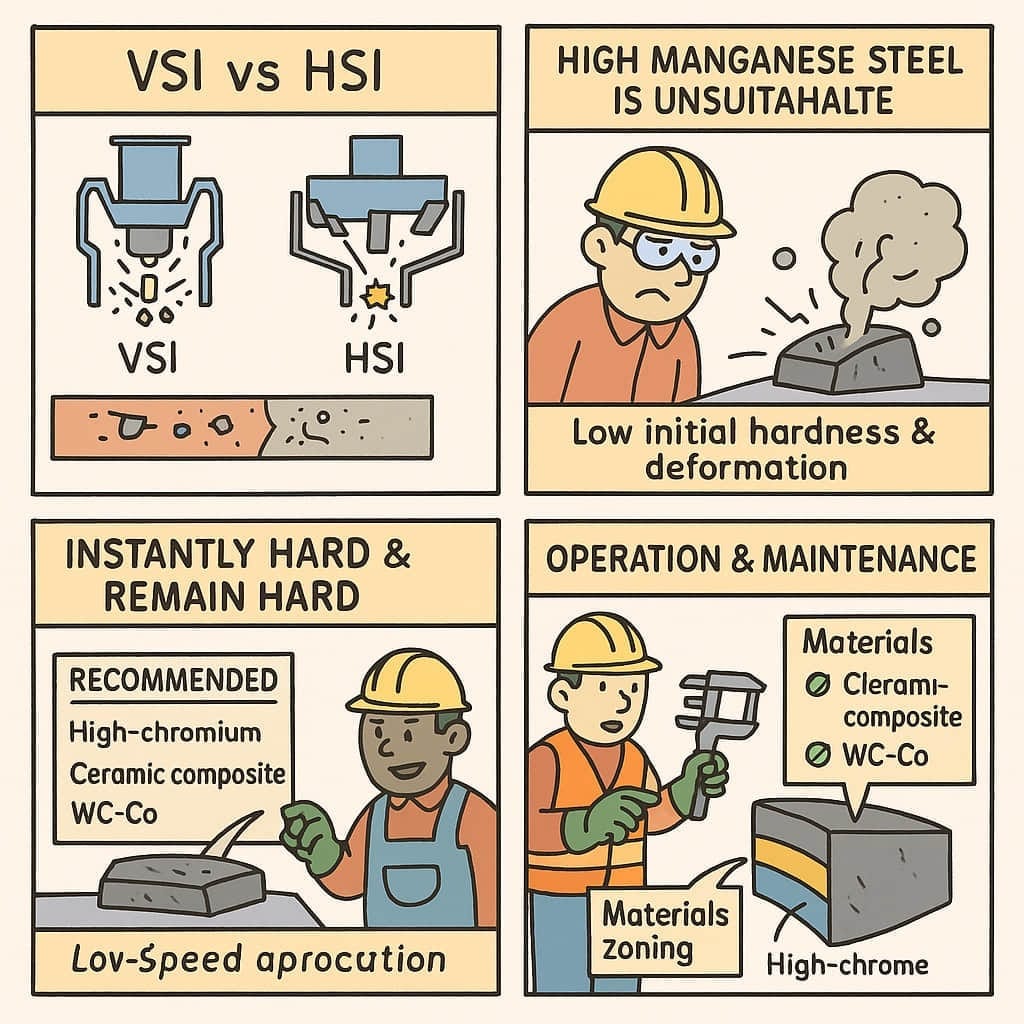
Working Principle and Kinematics
| Category | VSI ROS (Rock-on-Steel) | HSI (Horizontal Shaft Impactor) |
|---|---|---|
| Working Principle | High-speed vertical rotor accelerates material against stationary anvils | Horizontal rotor blow bars strike material against impact aprons |
| Typical Feed Size | ≤ 75 mm | Primary: ≤ 1 m; Secondary: ≤ 200 mm |
| Final Products | 0–10 mm manufactured sand, cubical aggregates | 0–40 mm aggregates and recycled concrete |
| Key Wear Parts | Rotor tips, anvils/anvil rings, wear plates | Mn18Cr2 blow bar, impact aprons, side liners |
| Wear Materials | WC-Co tips; Cr26 or Cr26 + ceramic anvils | Mn18Cr2, High-chromium iron, Martensitic steel |
Metallurgical Performance: Mn18Cr2 Blow Bar vs. VSI Liners
Insufficient Initial Hardness in VSI
Standard austenitic manganese steel (ASTM A128, Mn13Cr2, or Mn18Cr2) typically exhibits an as-cast hardness of ~185–220 HB (~10 HRC). While an Mn18Cr2 blow bar is effective in HSI crushers where impact forces are substantial, this low initial hardness is a liability in VSI applications. In VSI circuits, high-velocity sand scouring (erosion) removes material faster than the work-hardening threshold can be reached.
Work Hardening Limitations
The primary advantage of a manganese steel component lies in its ability to work harden from ~200 HB to >500 HB under heavy impact loading. This microstructural transformation requires significant kinetic energy (>250 MPa). In HSI applications, heavy rocks striking an **Mn18Cr2 blow bar** provide this energy. However, VSI feed material is often too fine; despite high rotor speeds, the particle mass is insufficient to trigger the austenitic-to-martensitic surface transformation, leaving the liner soft and vulnerable.
Erosion vs. Impact Resistance
Metallographic analysis confirms that Cr26 high-chromium white iron, containing hard M₇C₃ carbides (1050–1500 HV), offers superior resistance to sliding abrasion compared to unhardened manganese. For sand-making (VSI), carbide hardness is essential. Conversely, for primary crushing containing tramp metal, the high toughness of manganese steel prevents catastrophic fracture.
Plastic Deformation Risks
Under repeated stress without adequate work hardening, manganese steel is prone to plastic flow (spreading). In precision VSI rotors, this deformation causes fitment issues. In HSI rotors, a high-quality **Mn18Cr2 blow bar** is designed to withstand this stress without warping, provided the casting integrity is maintained through controlled heat treatment.
Operational Cost Efficiency
While manganese castings offer a lower initial price point, their wear rate in erosive applications increases the total cost per ton. GUBT leverages a 20,000-ton annual casting capacity to produce chemically stable, dimensionally accurate parts that ensure predictable maintenance schedules and reduced downtime.
Recommended Wear Materials: Beyond Manganese
| Component | Recommended Material | Hardness / Features | Best Use Case |
|---|---|---|---|
| Anvil / Anvil Ring | Cr26 High-Chromium Iron | 60–64 HRC; Carbides >1050 HV | Standard to high abrasion |
| Cr26 + Ceramic Composite | Surface >70 HRC; 1.5–2× lifespan | Very abrasive feeds (e.g., basalt) | |
| Rotor Tip | WC‑Co (Tungsten Carbide Bar) | 90–92 HRA; high toughness | Deep-cavity VSI, >70 m/s tip speed |
| HSI Blow Bar | Mn18Cr2 / Mn13Cr2 | ~220 HB; Work hardens >500 HB | Primary crushing, high tramp metal risk |
| Cr26 High-Chromium Iron | 60–65 HRC; Brittle nature | Secondary crushing, clean limestone | |
| Martensitic Steel | 45–55 HRC; Impact-tough | Recycled concrete with some rebar |
Strategic Selection: Manganese, Chrome, or Composite?
Engineers must classify the dominant wear mechanism: erosion (high-velocity fines), abrasion (silica content), or impact fracture (large feed). In VSI applications where erosion dominates, “always-hard” materials like Cr26 meet the requirement better than manganese.
However, for HSI applications coping with uncrushables such as rebar or tramp iron, an Mn18Cr2 blow bar is the safest choice. While high-chrome bars offer longer wear life in abrasive, clean feeds, they risk catastrophic brittle fracture upon impact with steel. In mixed applications, modified martensitic steel or ceramic-reinforced matrices provide a middle ground—offering better fracture toughness than Chrome and higher initial hardness than standard manganese. Decisions should follow Total Cost of Ownership (TCO) models, balancing casting lifespan against the risk of rotor damage.
GUBT ensures all replacement parts meet critical quality standards: (1) strict dimensional tolerances to prevent stress risers, (2) consistent quenching and tempering for uniform hardness, and (3) zoning strategies that utilize premium alloys only where necessary.
Operation & Maintenance Best Practices
-
Maintain a precise 35–45 mm gap between rotor exit and anvils in VSIs to optimize impact angles.
-
Deploy an Mn18Cr2 blow bar in HSI crushers whenever feed analysis covers uncertain tramp material or oversize primary rock.
-
Implement a zoning strategy: install ceramic composite parts in primary wear zones while utilizing standard alloy grades on peripheral edges to manage costs.
Conclusion: Metallurgy Matters
While an Mn18Cr2 blow bar is indispensable for primary HSI and jaw applications, traditional manganese metallurgy is generally unsuitable for VSI anvils due to:
-
Low initial hardness (180–220 HB) leading to rapid washout.
-
Insufficient impact energy in VSI to trigger work hardening.
-
Poor resistance to high-speed scouring erosion.
-
Risk of plastic deformation complicating maintenance.
Industrial performance data confirms that selecting the correct alloy—whether it be Cr26 high-chromium iron for abrasion or a robust Mn18Cr2 blow bar for impact—can deliver:
-
Extended wear life by 2–4×
-
Reduced frequency of maintenance intervals
-
Significantly lower cost per ton processed
Latest Insights
Cone Crusher Liners vs Jaw Plate Parts: Wear Mechanism, Structure Differences & Replacement Cycles

Long Life Crusher Liners:Material Selection, Wear Optimization & Cost Reduction Guide
Mining Crusher Parts for Hard Rock: High-Performance Wear Solutions & Cost Optimization Guide