VSI Crusher Parts Price 2026 – Quick Overview
Honestly, prices vary more than many buyers expect — and the range isn’t random. A set of rotor tips quoted at $180 from one supplier and $620 from another may sound like the same product on paper, but in practice they represent fundamentally different alloy compositions, casting processes, and expected wear lives. The unit price tells you almost nothing about the real cost of running your VSI crusher.
VSI (Vertical Shaft Impactor) crushers are high-speed, high-impact machines. The wear parts inside — rotor tips, anvils, wear plates, and rotor body components — face some of the most aggressive wear conditions in the crushing industry. Material quality and manufacturing precision matter more here than in almost any other crusher type.
This guide covers realistic 2026 price ranges for all major VSI wear parts, the factors that drive those prices, and how to calculate what you’re actually paying per ton of material processed — which is the only number that should drive your procurement decision.
| Part Category | Typical Price Range (2026) | Key Price Driver |
| Rotor tips (per set) | $150 – $800+ | Alloy grade and tungsten carbide content |
| Anvils (per set) | $200 – $1,200+ | Chrome content and casting geometry |
| Wear plates / table liners | $80 – $450 per plate | Thickness, alloy grade, plate dimensions |
| Rotor body / distributor plate | $400 – $2,500+ | Size, material, and OEM vs aftermarket |
| Feed tube / feed eye ring | $120 – $600 | Diameter, chrome content |
| Cavity wear plates | $60 – $350 per piece | Alloy and plate geometry |
| Complete wear parts kit | $1,200 – $6,000+ | Crusher size and alloy specification |
Key VSI Crusher Parts and Their Price Ranges
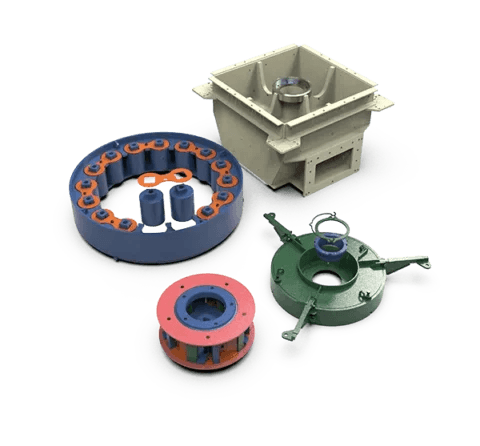
I’ve seen rotor tips wear out faster than expected when the material is subpar — not by a small margin, but by 50–60% shorter life than the spec sheet suggested. Each part in a VSI crusher has a specific function, and the pricing reflects both how quickly it wears and how much engineering goes into making it last.
Rotor Tips
Rotor tips are the primary impact point in a VSI crusher. They launch material at high velocity against the anvil ring or rock shelf, and they bear the most direct wear of any part in the machine. Tips are typically available in standard high-chrome alloy or with tungsten carbide inserts. Chrome tips cost less but wear faster. Carbide-tipped versions carry a significant price premium but can last 3–5 times longer in abrasive applications.
Anvils
Anvils form the outer impact zone — material ejected from the rotor strikes the anvil surface and fractures. In rock-on-steel configurations, anvils are the critical wear item. In rock-on-rock configurations, the anvil zone is lined with retained rock material, which reduces anvil wear significantly but changes the crushing dynamics. Anvil pricing varies widely based on the chrome content of the alloy and the precision of the casting geometry, which affects how evenly the wear distributes across the surface.
Wear Plates and Table Liners
Wear plates protect the rotor body and surrounding surfaces from abrasive contact with feed material. They’re replaced more frequently than structural components but are less individually expensive. The key variable is alloy grade — standard manganese or chrome-moly plates at the lower end of the price range, high-chrome or bi-metallic plates for harder, more abrasive feed materials at the upper end.
Rotor Body and Distributor Plate
The rotor body is a semi-structural component — it holds the tips and distributes feed material to the tip pockets. It wears more slowly than tips or anvils but requires replacement eventually, and the cost is substantially higher. Distributor plates, which direct feed from the center to the tip pockets, also see significant abrasion and are replaced more frequently than the rotor body itself.
VSI Crusher Parts Price Comparison Table (2026)
The table below covers typical price ranges for standard VSI crusher wear parts from aftermarket manufacturers in 2026. OEM pricing typically runs 30–70% higher across all categories. Prices assume standard crusher sizes (mid-range 1000–1500 series equivalent); larger crushers carry proportionally higher part costs.
| Part | Material / Grade | Price Range (per set/piece) | Typical Lifespan | Replacement Frequency |
| Rotor tips — standard | High chrome (Cr20–Cr27) | $150 – $320 per set | 80–200 hours | Every 1–3 months |
| Rotor tips — premium | Cr27 + tungsten carbide insert | $380 – $800+ per set | 300–600 hours | Every 4–8 months |
| Anvils — chrome alloy | High chrome Cr20–Cr26 | $200 – $550 per set | 200–500 hours | Every 3–6 months |
| Anvils — bi-metallic | Chrome matrix + carbide facing | $480 – $1,200+ per set | 500–1,000+ hours | Every 6–14 months |
| Table liners / wear plates | Mn13 or Cr15–Cr20 | $80 – $280 per plate | 100–300 hours | Every 1–4 months |
| Table liners — hi-chrome | Cr26–Cr28 | $180 – $450 per plate | 250–500 hours | Every 3–6 months |
| Distributor plate | High chrome or Mn18 | $150 – $500 per unit | 200–500 hours | Every 3–8 months |
| Feed tube / eye ring | High chrome Cr20+ | $120 – $420 per unit | 150–400 hours | Every 2–6 months |
| Rotor body | Alloy steel (wear-resistant) | $400 – $1,800 per unit | 1,500–4,000 hours | Every 1–3 years |
| Full wear kit (standard) | Mixed grades above | $1,200 – $3,200 | Varies by part | Planned shutdown kit |
| Full wear kit (premium) | High chrome + carbide tips | $2,800 – $6,500+ | Varies by part | Extended interval kit |
Note: Prices are indicative ranges for aftermarket parts from established manufacturers. Actual pricing depends on crusher model, order volume, alloy specification, and supplier. Always request batch-specific quotations and material certificates.
Factors Affecting VSI Crusher Parts Price
Material and Alloy Composition
Don’t be fooled by marketing claims — composition matters more than the label. ‘High chrome’ covers everything from Cr12 to Cr28, and the performance difference between those extremes is enormous. Higher chrome content generally means higher hardness and better abrasion resistance, but at the cost of some toughness. The right grade depends on your feed material: high-chrome, low-toughness alloys for abrasive, lower-impact feeds; more balanced grades for high-impact applications where brittleness would cause premature fracture.
Tungsten carbide inserts in rotor tips represent the most significant price jump in VSI parts. Carbide is substantially harder than any cast alloy and dramatically outperforms chrome in highly abrasive applications. The premium is real — but so is the wear life extension. In silica-rich feeds, carbide-tipped rotor tips can deliver 4–6x the service life of standard chrome tips.
| Alloy Type | Typical Hardness | Best Application | Price Premium vs Standard | Key Trade-off |
| Mn13 manganese | 180–220 HB (work-hardened to 500+) | High impact, lower abrasion | Baseline | Needs impact to work-harden; poor in low-impact zones |
| High chrome Cr20 | 600–650 HRC | Moderate abrasion, moderate impact | +20–40% | Good balance — most common VSI grade |
| High chrome Cr26–Cr28 | 650–700 HRC | High abrasion, lower impact | +40–80% | Brittle under extreme impact — check feed type |
| Bi-metallic (chrome + carbide) | Base: Cr20; Insert: 1,400–1,600 HV | High abrasion, mixed impact | +100–200% | Highest cost, highest performance in abrasive feeds |
| Tungsten carbide insert | 1,400–1,800 HV (insert) | Extreme abrasion (silica, granite) | +150–300% vs basic chrome | Very brittle under direct impact — tip geometry critical |
Manufacturing Process and Heat Treatment
I’ve seen identical specifications perform very differently depending on heat treatment quality. Two rotor tips with the same chrome content and the same quoted hardness can have a 40% variance in actual wear life if one was heat-treated with precise temperature control and the other was not. The casting process matters too — poorly controlled pouring temperature creates microstructural inconsistencies that accelerate fatigue and fracture.
Ask suppliers for their heat treatment cycle documentation: target austenitizing temperature, hold time, quench method, and final hardness verification method. A manufacturer who cannot provide these details is not controlling their process — they’re just casting and hoping.
OEM vs Aftermarket VSI Parts
Actually, aftermarket parts often outperform OEM if chosen wisely. This sounds counterintuitive, but OEM wear parts are designed to a specification that was set at the time the crusher was engineered — sometimes decades ago. Specialist aftermarket manufacturers have since developed alloy grades and casting geometries that improve on the original design for specific applications.
| Criterion | OEM Parts | Aftermarket Parts |
| Unit price | 30–70% premium over aftermarket | Lower — volume-dependent |
| Spec certainty | Exact fit guaranteed | Varies — verify dimensions carefully |
| Alloy innovation | Fixed to original design spec | Can offer improved grades vs OEM |
| Availability (current models) | Good | Good from established suppliers |
| Availability (older models) | Often discontinued | Often still available |
| Warranty coverage | Full OEM warranty | Supplier-dependent |
| Customization | Not available | Possible with right manufacturer |
| Best use case | Mechanical components, new equipment | Wear parts in proven operations |
Application and Usage Conditions
Application matters more than most buyers think when it comes to VSI parts pricing — because the right part for your application may not be the cheapest option, but it will be the lowest-cost option per ton processed. A high-chrome Cr26 tip at double the price of a standard Cr20 tip is the better value in a silica sand application if it lasts three times longer.
VSI Crusher Parts Price by Application
Real cost depends more on wear rate and downtime frequency than on purchase price. The same part will wear at completely different rates depending on what you’re processing — and that determines whether the cheap option or the premium option is actually cheaper in your operation.
| Application | Typical Feed Material | Abrasion Level | Recommended Tip Grade | Expected Tip Life | Relative Wear Cost |
| Silica sand production | High-silica sand, SiO2 >80% | Extreme | Carbide-tipped | 300–600 hrs | High unit cost, low frequency |
| Granite / hard rock quarry | Granite, quartzite, basalt | Very high | Cr26–Cr28 or carbide | 100–250 hrs | High unit cost, moderate frequency |
| Limestone aggregate | Soft to medium limestone | Moderate | Cr20–Cr24 | 200–400 hrs | Moderate unit cost, lower frequency |
| River gravel shaping | Rounded silica gravel | High | Cr24–Cr26 | 150–300 hrs | Moderate-high cost, moderate frequency |
| Concrete recycling | Crushed concrete with aggregate | Moderate-high + impact | Mn18 or Cr20 balanced | 100–200 hrs | Moderate cost, higher frequency |
| Soft aggregate (coal, gypsum) | Soft minerals <3 Mohs hardness | Low | Standard Cr20 | 400–800 hrs | Low cost, low frequency |
| Manufactured sand (Msand) | Mixed aggregates, variable | Moderate-high | Cr24 or carbide | 150–350 hrs | Moderate cost, regular cycle |
Cheap vs Premium VSI Parts: Cost per Ton Analysis
Sometimes the cheapest rotor tip is the most expensive choice in the long run. The logic is straightforward: a tip that costs half as much but lasts one-quarter as long costs twice as much per ton of material processed — and requires twice the number of shutdowns, twice the labor, and twice the production interruption.
| Part Tier | Unit Price (rotor tip set) | Typical Wear Life | Sets per Year (est.) | Annual Part Cost | Downtime Events/Year | Est. Annual Total Cost |
| Budget (Cr15–Cr18) | $150 – $250 | 60–100 hours | 10–16 sets | $1,800 – $3,600 | 10–16 shutdowns | $4,800 – $9,600+ |
| Standard (Cr20–Cr24) | $280 – $420 | 120–200 hours | 5–8 sets | $1,600 – $3,200 | 5–8 shutdowns | $3,600 – $7,200+ |
| Premium (Cr26–Cr28) | $480 – $700 | 200–350 hours | 3–5 sets | $1,800 – $3,200 | 3–5 shutdowns | $3,000 – $5,600+ |
| Carbide-tipped | $450 – $800 | 350–600 hours | 1–3 sets | $900 – $2,000 | 1–3 shutdowns | $1,600 – $3,400+ |
Note: Downtime cost estimated at $600–$1,000/hour lost production. Actual figures vary by operation size, throughput, and labor cost. These ranges assume a mid-size VSI crusher running 2,000–3,000 hours per year. Adjust the per-event shutdown cost to your operation before drawing purchasing conclusions.
| Cost Factor | Budget Parts | Premium / Carbide Parts |
| Parts cost per year | Higher total — more replacements | Lower total — fewer replacements |
| Shutdown frequency | High — unpredictable wear-out timing | Low — predictable wear intervals |
| Labor cost per year | High — more change-out events | Low — fewer change-out events |
| Production continuity | Disrupted — unplanned stops | Consistent — planned maintenance |
| Inventory requirement | High — large safety stock needed | Lean — predictable reorder points |
| Cost per ton processed | Often highest overall | Usually lowest over full production cycle |
How to Choose the Right VSI Crusher Parts Supplier
Don’t just go for the lowest quote. The supplier selection process for VSI wear parts should be treated the same way you’d treat a procurement decision for any critical production input — with documentation requirements, reference checks, and a trial period before volume commitment.
- Require alloy certification per batch — not a generic spec sheet. Ask for chemical composition certificates that are traceable to the specific production heat number. This is a basic capability for any serious manufacturer.
- Verify hardness testing results — surface hardness alone is insufficient. Ask for bulk hardness results from cross-section samples, which reveal whether the alloy is hard throughout or only on the surface layer.
- Check manufacturing capability directly — request photos of the foundry, heat treatment equipment, and QC lab. A supplier who cannot provide these images within 24 hours is almost certainly a trading company, not a manufacturer.
- Request application-specific references — ask for the names of operations running the same crusher model in a similar feed material. Contact them directly and ask about wear life consistency, delivery reliability, and problem resolution.
- Order a trial set before committing to volume — run the trial parts through a full wear cycle under your actual operating conditions. Track hours to replacement. Compare cost per hour and cost per ton against your current supplier.
- Compare cost per ton, not unit price — calculate the total cost including part price, installation labor, and an estimated value for production downtime per change-out. The supplier with the lowest cost per ton is the correct choice regardless of unit price.
- Assess lead time and stock reliability — ask for the on-time delivery rate from the past 12 months, not just a quoted lead time. Confirm which items are in stock and which are made to order.
Common Mistakes Buyers Make When Purchasing VSI Parts
I’ve seen entire batches fail within weeks due to these mistakes — and in high-throughput operations, a premature part failure doesn’t just cost the price of the part. It costs the production downtime, the emergency labor, and sometimes damage to adjacent components from an unplanned failure event.
- Choosing the cheapest option without calculating cost per ton — the single most common and most costly mistake. Unit price is irrelevant without knowing how many units you’ll consume per year.
- Accepting ‘high chrome’ as a specification — this is a marketing term, not a specification. Always require the exact chromium percentage, carbon content, and any carbide or alloy additions. Cr12 and Cr28 are both ‘high chrome’ and perform completely differently.
- Ignoring the application fit — a rotor tip specified for limestone will underperform severely in granite or silica sand. Always provide your feed material type, hardness, and size range when requesting a quotation.
- Skipping heat treatment verification — parts with the correct alloy composition but incorrect heat treatment will fail early and unpredictably. Ask for process records, not just a finished hardness number.
- Not testing before volume ordering — catalog claims and sample photos cannot predict real-world wear performance. Run a trial set through at least one full wear cycle before committing to a volume order from a new supplier.
- Purchasing from trading companies without knowing it — many VSI parts ‘suppliers’ do not manufacture anything. They source from whichever foundry is cheapest at the time of your order, resulting in batch-to-batch inconsistency even within the same part number.
- Holding insufficient safety stock — VSI rotor tips can wear out faster than expected in abrasive feeds. Running to zero stock before reordering risks an unplanned shutdown while waiting on a 4–6 week lead time from a manufacturer.
Final Thoughts: Balance Price, Quality, and Longevity
The cheapest quote rarely wins in real operations. It wins on the spreadsheet when you’re comparing quotations — and then it costs you when you’re tracking unplanned shutdowns, higher-than-expected replacement frequency, and the frustration of inconsistent batch quality.
The buyers who manage VSI wear parts costs most effectively are the ones who measure cost per ton processed — not cost per unit — and who build supply relationships with manufacturers who can demonstrate process control, not just list a price. That shift in how you evaluate supplier value changes every procurement conversation.
| Decision Factor | Wrong Focus | Right Focus |
| Primary evaluation metric | Unit price per set | Cost per ton of material processed |
| Alloy specification | Accept ‘high chrome’ as sufficient | Require exact Cr%, C%, and heat treatment records |
| Supplier verification | Trust the catalog and website | Verify foundry, request batch certs, call references |
| Trial process | Skip trial — order volume directly | Always run a full wear cycle trial before volume commitment |
| Inventory strategy | Reactive — reorder when near-empty | Planned — safety stock based on wear life predictability |
| Downtime accounting | Exclude from part cost comparison | Include downtime value in total cost of ownership calculation |
| Supplier relationship | Transactional — lowest quote wins | Long-term — stable quality and delivery over price variance |
Copywriting: Stop Overpaying for “Cheap” VSI Parts
In the crushing business, the “cheapest” rotor tip is often the most expensive mistake you can make. A low-grade alloy doesn’t just wear out faster—it steals your profit through constant downtime, emergency labor, and lost production hours.
At GUBT, we’ve redefined wear life for 2026. Our VSI components are engineered to help you stay operational when others are swapping parts.
- Engineered Durability: From Cr26-Cr28 High Chrome to premium Tungsten Carbide inserts, our parts last 3–5x longer in abrasive granite and silica applications.
- Precision Fit: 100% compatible with major brands like Barmac and Sandvik, ensuring zero-vibration performance.
- The Bottom Line: We don’t just sell castings; we provide a Cost-Per-Ton Analysis that proves GUBT parts reduce your annual maintenance spend by up to 25%.
👉 Get Your 2026 VSI Parts Quote Now Quality you can trace. Performance you can bank on.
Frequently Asked Questions
How often should VSI rotor tips be replaced?
This depends almost entirely on your feed material. In soft limestone or manufactured sand applications with moderate abrasion, rotor tips may last 200–400 hours. In high-silica or hard granite applications, standard chrome tips can wear out in 60–120 hours. Track operating hours and tons processed per set from the moment you install — this data is the only reliable basis for planning your replacement intervals and safety stock levels.
Are carbide-tipped rotor tips always worth the premium?
In highly abrasive applications — silica sand, granite, quartzite — yes, the wear life extension typically more than justifies the price premium. In lower-abrasion applications with softer feed materials, the premium may not be recovered through wear life extension. Calculate cost per ton with your actual throughput numbers before deciding. In some softer applications, Cr24–Cr26 tips deliver the best value without the carbide cost.
Can I use aftermarket VSI parts without voiding my crusher warranty?
In most jurisdictions, using compatible aftermarket wear parts does not void a crusher warranty under competition law — provided the parts meet the dimensional and material specifications of the original. However, if an aftermarket part causes damage to a mechanical component, the OEM may decline warranty coverage for that damage. Use aftermarket parts for wear items (tips, anvils, liners), and consider OEM for mechanical components during the warranty period.
What is the typical lead time for VSI wear parts?
Standard chrome rotor tips and anvils in common sizes are typically in stock with established suppliers — lead time of 1–2 weeks including shipping. Custom specifications, carbide-tipped parts, or larger crusher sizes may require 4–8 weeks for production. Always confirm current stock status at the time of ordering, not just a standard lead time. For high-throughput operations, negotiate a standing stock agreement with your preferred supplier.
How do I calculate how much safety stock to carry?
A practical formula: divide your average wear life per set (in hours) by your daily operating hours to get days per set. Multiply your supplier lead time (in days) by 1.5 for safety margin. The result is the minimum stock level in days — convert back to sets. For example, if tips last 150 hours, you run 20 hours per day, lead time is 21 days, your safety stock should cover approximately 32 days — meaning you should reorder when you have 2.1 sets remaining.
Authoritative Resources & Further Reading
The following sources cover VSI crusher technology, wear part materials, and procurement practice in commercial operations:
Material & Manufacturing Standards
- ASTM A532 — Standard Specification for Abrasion-Resistant Cast Irons — Covers high-chrome white iron grades used in VSI crusher wear parts. Use to verify supplier alloy claims against published standard compositions.
- ASTM A128 — Austenitic Manganese Steel Castings — Standard specification for manganese steel castings — relevant for VSI components specified in Mn grades.
- ISO 9001 — Quality Management Systems — Baseline quality management certification for manufacturers. Verify current certificate status independently before relying on supplier claims.
Industry & Technical Bodies
- Society for Mining, Metallurgy & Exploration (SME) — Professional body for mining and mineral processing engineers. Publishes technical papers on crusher wear, comminution efficiency, and wear part selection.
- Aggregates & Quarry Association — AggNet — Industry resource covering VSI crusher applications, wear part management, and equipment performance in quarry and aggregate contexts.
- Minerals Engineering International — Technical publication covering comminution and crushing technology, including VSI performance studies and wear material research.