
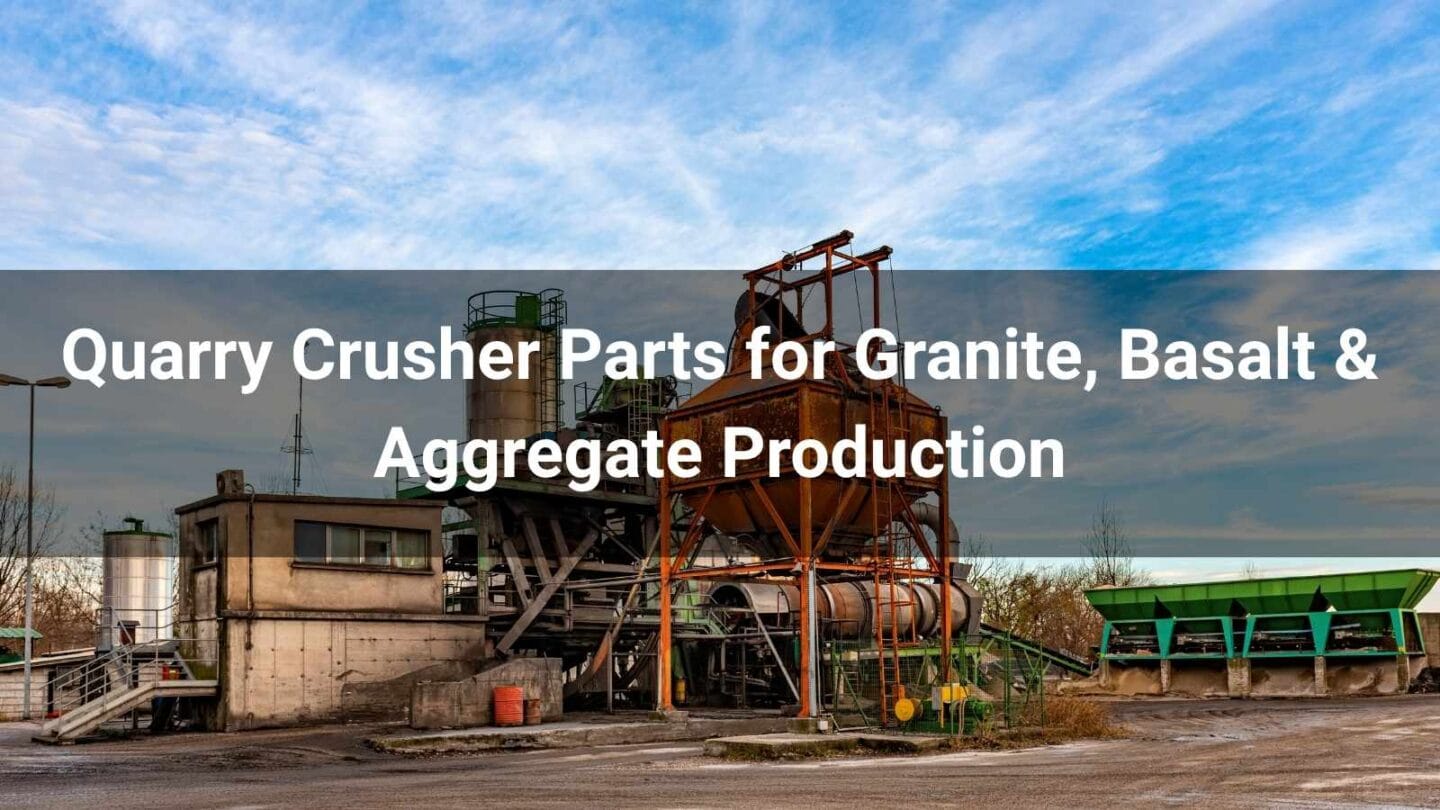
Why Wrong Crusher Parts Are So Costly
Honestly, I’ve seen plenty of quarries where wear parts alone consumed more than half the year’s profit. It’s not a rare situation. It’s almost the default for operations that haven’t thought carefully about quarry crusher parts selection.
The core problem is deceptively simple: granite and basalt are among the most abrasive materials on earth. Standard crusher wear parts — the kind that work acceptably on softer limestone or river gravel — can fail in a matter of weeks, or even days, when put against hard rock. The failure is rarely dramatic. It’s slow, quiet, and expensive. Liners wear unevenly. Throughput drops. Power consumption climbs. And then, usually at the worst possible moment, production stops.
“Most operations that overspend on crusher wear parts aren’t buying the wrong things — they’re buying the right things for the wrong material.”
Here’s the underlying logic this entire guide is built around: selecting the right quarry crusher parts matters more than upgrading equipment. A correctly specified liner in an aging cone crusher will outperform a mismatched liner in a brand-new machine. The physics don’t lie.
That said, the first instinct for most procurement teams is to push down price. It’s understandable. Parts look like a commodity. But that instinct is precisely where cost spirals begin. Cheaper parts, shorter life, more downtime, more replacement labor — the math rarely works out in favour of the lowest unit price.
This guide unpacks a better way to think about mining crusher parts selection, organized by material type, component function, and total economic outcome.
Granite, Basalt & Aggregate: Why Material Matters Most
Before you specify a single component, you need to know exactly what your crusher is eating. Not in general terms — specifically. Because granite crusher parts, basalt crusher parts, and aggregate crusher parts are not interchangeable, even when they look identical on a spec sheet.
The Three Material Profiles
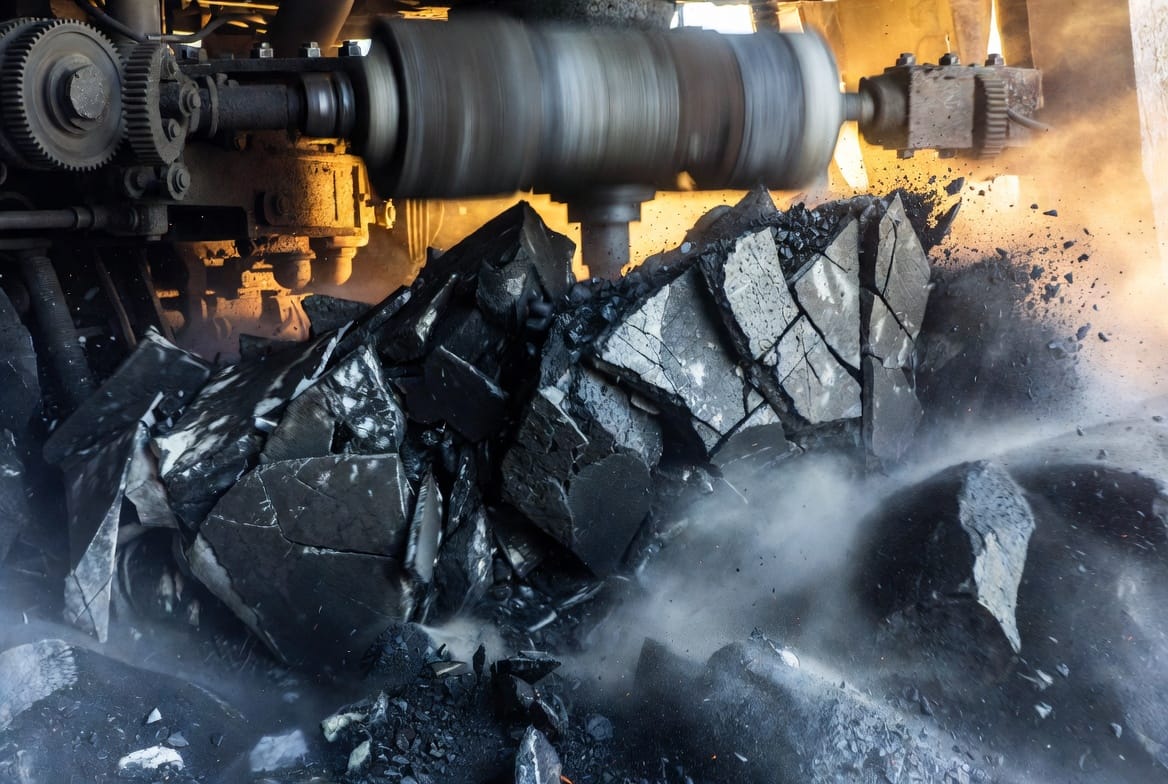
Granite: High hardness (Mohs 6–7), high silica content, and a very high Abrasion Index. Granite grinds. It wears liner surfaces steadily and relentlessly. The dominant failure mode is abrasive wear, not impact fracture.
Basalt: Dense, tough, and high in silica. Basalt delivers strong impact forces alongside significant abrasion. It is harder on structural components than granite. The failure mode is often a combination of surface wear and impact-induced cracking.
Aggregate: Highly variable. Limestone behaves very differently from a mixed river gravel feed. The challenge isn’t peak abrasion — it’s unpredictability. Parts need to handle a wide range of conditions without catastrophic failure.
“Granite grinds. Basalt hits and grinds. Aggregate is unpredictable. Each demands a different parts strategy.”
The technical measure that underlies this is the Abrasion Index (AI) — a standardized value describing how quickly a material removes metal from surfaces under impact and sliding contact. Granite typically has an AI of 0.3–0.5 or higher. Basalt sits in a similar or slightly elevated range, but its toughness means impact loads are more severe. Limestone may come in at 0.05–0.2.
Liner grade must be matched to Abrasion Index. A Mn14 manganese liner adequate for limestone will wear at two to three times the rate of a properly specified Mn18 or composite liner when used against granite. The Abrasion Index is the foundation of every parts selection decision.
Granite Crusher Parts Selection: Wear Resistance Is Everything
When it comes to granite crusher liners, wear resistance is the primary selection criterion. Not toughness. Not price. Wear resistance. The Abrasion Index of granite is punishing enough that any liner specification not optimized for abrasion will have a short and expensive life.
Jaw Plates: Corrugation Pattern Matters
For jaw crushers processing granite, the corrugation pattern on the jaw plate has a direct effect on both wear life and throughput efficiency. A coarse corrugation (deep, wide teeth) provides better grip on hard, blocky feed but concentrates wear at the tooth peaks. A fine corrugation distributes wear more evenly but can struggle with oversized or irregularly shaped granite blocks.
I’ve seen operations running standard corrugated jaw plates on granite quarries that were essentially burning through a set of plates every four to six weeks. Switching to a purpose-designed granite crushing jaw plate — with an optimized corrugation geometry and a higher manganese specification — extended service life to twelve weeks or beyond. Same crusher, same feed, radically different outcome.
“Using ordinary jaw plates on granite is essentially just burning money, one ton at a time.”
Cone Crusher Liners: Mn18 vs Mn22 vs MMC
For cone crushers in granite applications, the liner material grade is the critical variable. Standard Mn14 is not appropriate for high-abrasion granite feeds. The practical choices are compared in the table below:
| Grade | Mn Content | Granite Suitability | Notes |
| Mn14 | ~14% | Poor | Adequate for limestone/soft aggregate only |
| Mn18 | ~18% | Good | Standard choice for moderate granite abrasion |
| Mn22 | ~22% | Very Good | Preferred for high-AI granite; better work-hardening |
| MMC (Metal Matrix Composite) | Variable | Excellent | Hard carbide inserts in Mn matrix; highest wear resistance |
The best crusher liner for granite quarry operations under severe conditions is typically either Mn22 or an MMC (Metal Matrix Composite) design. MMC liners embed extremely hard carbide particles within a tough manganese matrix, giving you abrasion resistance approaching that of hard chrome while retaining enough toughness to handle impact loads inherent in any crushing operation.
A specialist granite crusher liners manufacturer with real quarry experience — such as GUBT Casting (gubtcasting.com) — can match liner specifications to your specific granite feed characteristics. Generic catalogue liners rarely deliver the same outcome as material-matched designs.
Basalt Conditions: The Double Challenge of Impact & Abrasion
Basalt is a different beast from granite, and it requires a different parts strategy. While granite primarily grinds, basalt combines high abrasion with substantial impact forces. Its density and toughness mean the crushing process generates higher peak loads per cycle than most other hard rocks.
Honestly, many materials that perform reasonably well on granite will fail within weeks — sometimes days — on a high-throughput basalt line. The failure mode is different too: rather than gradual surface wear, basalt can induce cracking or spalling in liners that are too brittle, even if they are nominally high wear resistance materials.
| Key Insight: Chasing maximum hardness for basalt applications often backfires. A liner that is extremely hard but relatively brittle will crack under basalt’s impact loads, failing suddenly rather than wearing gradually. Sudden failure is always more expensive than predictable wear. |
Jaw Plates for Basalt
For basalt jaw crushers, the plate specification needs to balance impact toughness and abrasion resistance. Pure high-chrome jaw plates — excellent for abrasion on slower-impact applications — can crack under sustained basalt impact. High-manganese grades (Mn18 or Mn22) with appropriate alloying for added hardness are typically the preferred solution.
Basalt jaw plate wear life is generally shorter than equivalent granite operation, not because basalt is necessarily harder, but because the combined abrasion-plus-impact mechanism accelerates material removal from both surfaces. Operations should plan replacement intervals accordingly.
Cone Crusher Liners for Basalt
The ideal cone crusher liner for basalt production is one that work-hardens rapidly under repeated impact while maintaining enough base toughness to resist cracking. Mn18 with appropriate chromium and molybdenum additions typically performs well. MMC designs are increasingly applied in severe basalt duty where wear life extension justifies the higher per-unit cost.
One practical note: cavity profile matters as much as material on basalt. An overly tight cavity that creates excessive recirculating load will accelerate liner wear regardless of material specification.
Aggregate Production: Stability Over Peak Wear Life
Aggregate production lines operate under a different economic calculus than primary hard rock crushing. The material may be less abrasive — limestone, mixed gravels, recycled concrete — but the production volumes are high, the lines run continuously, and the cost of unplanned downtime is severe.
“The thing aggregate lines fear most isn’t abrasion — it’s unexpected shutdown at 2 a.m. on a production deadline.”
This shifts the selection logic for aggregate crusher parts. You are no longer purely optimizing for maximum wear life. You are optimizing for predictable, consistent wear life that allows planned replacement on your schedule, not the crusher’s.
Selection Logic for Aggregate Parts
- Consistency of wear rate: A liner that wears at a predictable rate allows maintenance teams to plan shutdowns, pre-position spare parts, and avoid emergency replacements.
- Resistance to catastrophic failure: A liner that wears out is manageable. A liner that cracks, spalls, or loses a chunk is a production emergency.
- Maintainability: Aggregate operations typically run smaller maintenance teams. Parts that are easy to install, have clear wear indicators, and don’t require specialized equipment reduce both downtime and labor cost.
Aggregate Crusher Maintenance Tips
Track your wear curves carefully. If a liner that typically lasts six weeks starts showing 70% wear at week four, something has changed in the feed. Monitor feed gradation regularly. Maintain your crusher settings precisely — operating outside the designed closed-side setting accelerates liner wear disproportionately. Pre-position critical spare aggregate crusher parts on-site rather than relying on fast delivery when failure is imminent.
Key Components Explained: Jaw, Cone, HSI & VSI
One of the most common mistakes in crusher parts procurement is treating all crushers the same. They are not. Each crusher type has a fundamentally different crushing mechanism, and that mechanism determines which parts wear, how they wear, and what material properties matter most.
Jaw Crusher → Jaw Plates
Jaw crushers apply compressive force between a fixed and a moving jaw plate. Wear is primarily abrasive, concentrated in the lower third of the plates where material spends most time. Jaw plates are the primary crusher replacement parts for jaw crushers. Corrugation pattern, steel grade, and casting quality all significantly affect life.
Cone Crusher → Mantle & Concave
Cone crushers apply compressive force between a rotating mantle and a stationary concave (bowl liner). Both wear simultaneously. Mn18–Mn22 or MMC is standard for hard rock. Replacement typically requires planned downtime of several hours.
Impact Crusher (HSI) → Blow Bars
Horizontal shaft impactors use blow bars — high-speed rotating elements — to shatter rock by impact. Blow bars see extreme impact loads combined with abrasion from the fractured material stream. High performance crusher liners for HSI are often high-chrome white iron for abrasive feeds, or martensitic steel for feeds with higher impact content.
VSI Crusher → Tips, Anvils & Table
Vertical shaft impactors throw rock at high speed against anvils or a rock shelf. The wear components — tips, anvils, and the rotor table — are highly application-specific. VSI parts for granite or basalt require careful material selection; premature tip failure is a common and expensive problem.
Manganese vs High Chrome vs MMC: How to Choose Without Getting Burned
Three material families dominate crusher wear parts. Each has genuine strengths and real limitations. The key is understanding which properties actually matter for your specific application — and not getting distracted by material names or marketing claims.
| Material | Primary Strength | Primary Weakness | Best Application |
| Manganese Steel (Mn) | Excellent impact toughness; work-hardens under impact | Lower initial hardness; wears faster on pure abrasion | Impact-dominant applications; jaw crushers; primary crushing |
| High Chrome Iron | Very high hardness; excellent abrasion resistance | Brittle; susceptible to cracking under impact | Low-impact, high-abrasion; HSI blow bars on abrasive feed |
| MMC (Metal Matrix Composite) | Combines toughness of Mn with hardness of carbides | Higher cost; requires careful manufacturing | Severe duty; high-AI granite; basalt cone liners |
“The most expensive part is rarely the one with the highest unit price. It’s the one that fails at the wrong time for the wrong reason.”
For manganese crusher liners in jaw and cone applications on granite or basalt: Mn18 or Mn22 is the practical standard for hard rock. The higher manganese content provides better work-hardening response and longer wear life than standard Mn14, typically at a modest price premium that pays back quickly.
For high chrome crusher liners: excellent for HSI blow bars and impact plate applications where the feed is highly abrasive but not excessively impact-loaded. Not appropriate for primary jaw or cone applications on granite or basalt.
For abrasion resistant liners using MMC technology: the right choice when standard manganese grades aren’t delivering adequate life and the combined cost of frequent replacement exceeds the premium for MMC parts. Worth evaluating seriously on any application where you’re changing cone liners more than four to six times per year.
Spare Parts Inventory & Replacement Strategy
Parts selection strategy is only half the equation. The other half is having the right parts available when you need them — and that means weeks before the scheduled replacement interval, not the moment something breaks.
“I’ve seen an entire production line stopped for three days because one liner was missing from the warehouse. Three days. Because of one component.”
A sensible quarry crusher spare parts inventory plan has three layers:
- Running stock: Parts that wear on a predictable cycle — jaw plates, cone liners, blow bars — should always have at least one full set in the warehouse, ideally two. Order replacement stock when you install a new set, not when the installed set is exhausted.
- Critical spares: Components that rarely fail but cause total shutdown when they do — main shafts, eccentric assemblies, pitman arms — should be evaluated on a lead-time basis.
- Consumable buffer: For high-throughput operations processing granite or basalt, maintain a buffer of two to three replacement cycles for primary wear parts.
The discipline of planned replacement versus reactive replacement is one of the highest-leverage changes most quarry operations can make. Parts changed on your schedule cost labor and downtime. Parts changed because they failed cost labor, downtime, secondary damage, and often expedited freight on emergency spares.
Total Cost of Ownership: Stop Looking Only at Price
If there is one idea in this guide that will change how you manage crusher parts costs, it’s this: unit purchase price is the least important number in the total cost calculation.
The total cost of ownership (TCO) for quarry crusher parts includes:
| Cost Element | Often Ignored? | Typical Share of TCO |
| Part purchase price | No — everyone tracks this | 20–35% |
| Replacement labor | Sometimes | 10–20% |
| Production downtime cost | Often | 30–50% |
| Secondary component damage | Usually | 5–20% |
| Emergency freight on spares | Usually | Variable but significant |
Here’s a concrete illustration: Liner A costs $4,000 and lasts 8 weeks. Liner B costs $6,200 and lasts 16 weeks. At first glance, Liner A looks cheaper. But Liner A requires twice as many installations — twice the labor, twice the planned downtime, twice the logistics overhead. Over 32 weeks, Liner A costs $16,000 plus four replacement shutdowns. Liner B costs $12,400 plus two shutdowns. The “expensive” liner is actually 25% cheaper on a total cost basis.
| TCO Rule of Thumb: For every additional week of wear life a better liner delivers, estimate the value of 4–8 hours of production time saved. Multiply that by your plant’s hourly revenue rate. In most hard rock operations, that number will quickly justify meaningful premiums on high-performance parts. |
Every procurement decision for quarry crusher parts should be evaluated on a cost-per-tonne-crushed basis, not a cost-per-unit basis.
How to Choose a Reliable Quarry Crusher Parts Supplier
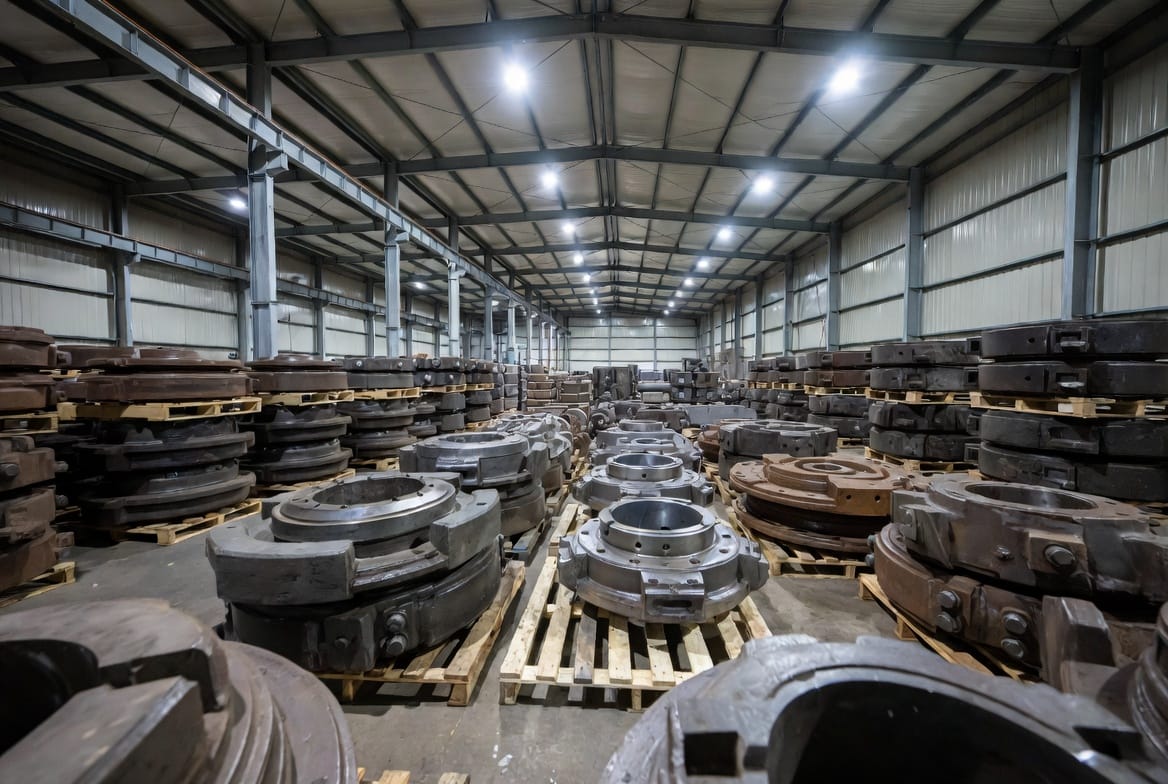
The parts selection logic in this guide is only as good as the supplier who can actually deliver on it. A supplier who describes the right specification but cannot consistently manufacture to it will deliver disappointing results regardless of what’s written on the order.
Real Site Experience
A supplier who has optimized liner specifications for granite quarries in varied geological conditions is fundamentally different from one who ships standard Mn14 liners to whoever orders them. Ask specifically: which quarries have they supplied? What were the material characteristics? What wear life did their parts achieve versus the previous specification?
Metallurgical Capability
A credible granite crusher parts manufacturer or basalt crusher parts manufacturer should have demonstrable metallurgical capability — including in-house testing, documented alloy formulations, and quality control processes that go beyond visual inspection.
Customization Capacity
Standard catalogue liners fit standard applications. Unusual cavity profiles, non-standard crushers, or feeds with extreme characteristics often require customized designs. A supplier without pattern-making and custom casting capability cannot serve these needs.
Technical Support
The best suppliers function as technical partners, not just parts vendors. They should be able to review your wear data, identify abnormal wear patterns, and recommend specification adjustments.
GUBT Casting (gubtcasting.com) operates as a specialist supplier for hard rock quarry applications — with focused capability in granite and basalt liner development, high-manganese and MMC casting, and site-specific wear optimization.
Conclusion: Different Quarries, Completely Different Selection Logic
If there’s a single lesson from everything covered in this guide, it’s this: there is no universal answer to crusher parts selection. The right specification depends on your material, your crusher type, your production requirements, and your economic priorities. Anyone selling you a one-size-fits-all solution is selling you something that fits nobody perfectly.
The framework, simplified:
- Granite: Prioritize abrasion resistance above all. Mn18–Mn22 minimum for cone liners. Optimized corrugation for jaw plates. Consider MMC for severe duty.
- Basalt: Balance impact toughness with abrasion resistance. Avoid brittle high-chrome for primary crushing. Mn18+ with appropriate alloying. Monitor for impact-induced cracking.
- Aggregate: Prioritize predictable wear life and stability over peak abrasion performance. Plan replacement intervals. Maintain adequate spare parts buffer. Minimize unplanned downtime.
Across all three: evaluate parts on total cost per tonne crushed, not unit purchase price. Maintain structured spare parts inventory. Work with suppliers who have demonstrable hard-rock quarry experience and genuine metallurgical capability.
The difference between a quarry that optimizes crusher parts selection and one that doesn’t shows up in cost per tonne, equipment availability, maintenance labor hours, and ultimately in annual profitability. The parts are small. The impact isn’t.
| Ready to optimize your quarry’s crusher parts? GUBT Casting specializes in granite, basalt, and hard rock liner solutions — designed for your specific material conditions. Visit gubtcasting.com to consult their technical team. |
Latest Insights
Cone Crusher Liners vs Jaw Plate Parts: Wear Mechanism, Structure Differences & Replacement Cycles
Long Life Crusher Liners:Material Selection, Wear Optimization & Cost Reduction Guide
Mining Crusher Parts for Hard Rock: High-Performance Wear Solutions & Cost Optimization Guide