With over two decades of experience in comminution engineering and wear-material science, I have seen firsthand how a single misinformed alloy choice can jeopardize a project’s bottom line. My focus isn’t just on selling hardware; it’s about application-specific engineering—balancing the delicate trade-off between fracture toughness and abrasive resistance to maximize operational uptime. In this guide, I share the technical frameworks and ROI-driven strategies I use to help global mining and aggregate leaders transition from ‘standard’ replacements to high-performance, long-life wear solutions.
Why Long Life Crusher Liners Are Not Simply About Choosing the Hardest Material
Honestly, when most buyers hear ‘long life crusher liners,’ they immediately think: harder material, more wear resistance, problem solved. That’s the most common misconception in crusher liner procurement — and it costs operations significantly more than the premium they were trying to avoid paying in the first place.
Hardness is one variable. The working conditions of the crusher — feed material hardness, particle size, impact loading, crusher speed, and closed-side setting — determine which property of the liner material actually governs wear life. A high-chrome liner with extreme hardness will outperform manganese steel in a pure abrasion application. That same high-chrome liner will fracture catastrophically in a high-impact application where manganese would have lasted twice as long. The material that delivers the longest service life is the one that matches the dominant wear mechanism of your specific application — not the one with the highest hardness number on the datasheet.
That said, selecting the right material for your conditions can genuinely double liner service life. Not as a marketing claim — as a measurable operational outcome that reduces annual parts cost, reduces downtime frequency, and lowers total cost of ownership substantially. This guide works through the materials, the performance comparison data, the wear rate factors, and the ROI calculation framework that makes this decision correctly.
| Common Assumption | Reality |
| Harder material = longer wear life | Hardness only governs wear in abrasion-dominant conditions; impact conditions favor toughness |
| Long life liners always cost more per unit | Higher unit cost is often offset by fewer replacements and less downtime — lower total annual cost |
| One liner grade works across all crusher types | Cone, jaw, and impact crushers have different loading modes — different materials excel in each |
| Wear life is primarily a material property | Operating conditions, feed management, and installation quality contribute equally to service life |
| The OEM specification is always optimal | OEM specs are baseline — application-optimized specifications can extend life significantly beyond OEM baseline |
What Are Abrasion Resistant Liners? Core Performance Metrics Explained
Before comparing materials, it helps to understand what the performance metrics actually mean in practice. Abrasion resistant liners — whether manganese steel, high-chrome alloy, or MMC composite — are evaluated on three primary dimensions. Getting the balance between these three right for your specific application is what determines whether a liner is a high performance crusher liner or an expensive disappointment.
Hardness: The Starting Point, Not the Whole Story
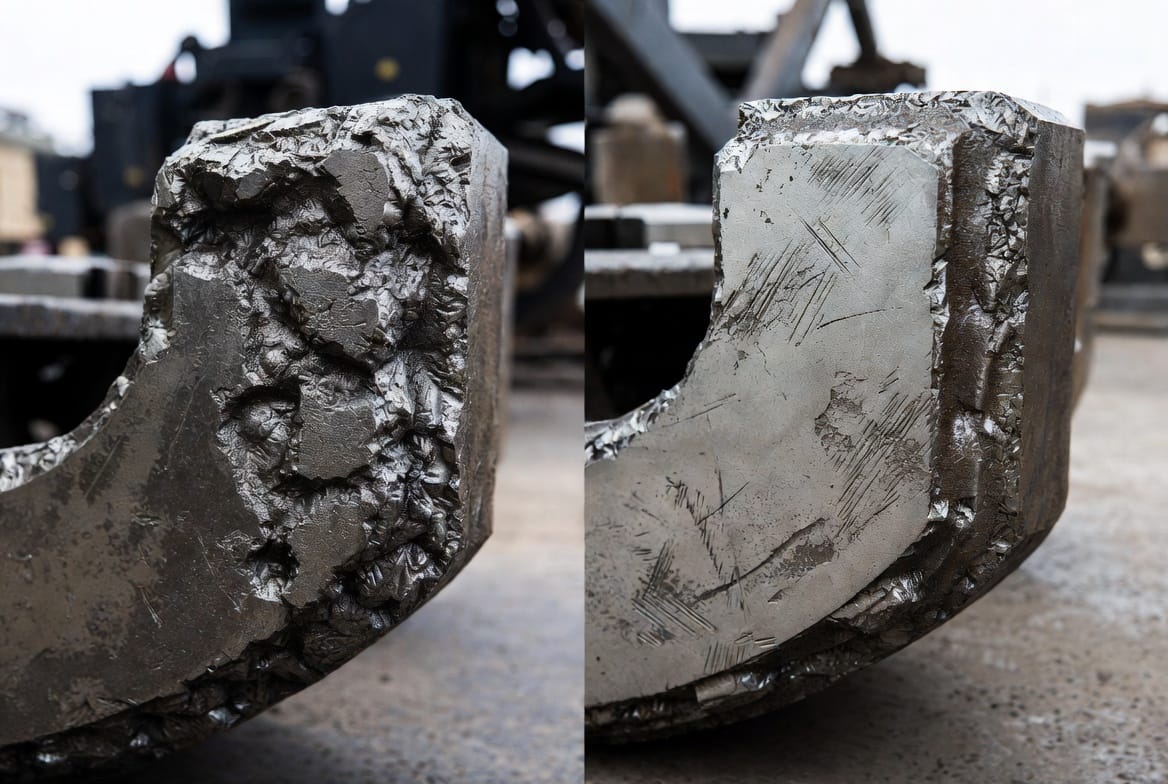
Hardness — measured in Brinell (HB), Rockwell (HRC), or Vickers (HV) depending on the method and material — quantifies the material’s resistance to surface indentation. In abrasion-dominant conditions, where sharp mineral particles are sliding or rolling across the liner surface, higher hardness directly translates to lower wear rate. This is why high-chrome alloys (600–700 HV as-cast) outperform manganese steel (180–220 HB as-quenched) in abrasion-dominated applications.
The critical caveat: hardness and toughness trade off against each other. A material hard enough to resist abrasion is typically more brittle — more susceptible to fracture under impact loading. I’ve seen operations select a liner purely on hardness, install it in a high-impact application, and watch it crack within weeks. The fragments created by fracturing liner material then accelerate wear of adjacent components in ways that compound the damage well beyond the cost of the liner itself.
Toughness: What Keeps the Liner in One Piece Under Impact
Toughness is the material’s ability to absorb energy during impact loading without fracturing. Austenitic manganese steel is the benchmark for toughness in crusher wear parts — its capacity to absorb repeated high-energy impacts without fracturing is why it dominates jaw crusher and primary cone crusher applications. The trade-off is moderate abrasion resistance relative to high-chrome alloys.
Work-Hardening: Manganese Steel’s Unique Property
Austenitic manganese steel has a property that no other wear material class offers: it work-hardens under impact. Starting at 180–220 HB as-quenched, manganese steel subjected to repeated impact loading in service develops a hardened surface layer that can reach 450–600 HB. This is why manganese jaw plates and cone liners, which seem soft at installation, deliver competitive abrasion resistance in high-impact applications — they become significantly harder as the crushing operation progresses.
| Performance Metric | High Manganese Steel | High Chrome Alloy | MMC Composite |
| Initial hardness (as-installed) | 180–220 HB — soft | 600–700 HV — hard from day one | 700–1,100 HV — hard from day one |
| In-service hardness (after work-hardening) | 450–600 HB (impact-dependent) | 600–700 HV (stable) | 700–1,100 HV (stable) |
| Toughness (impact absorption) | Excellent — best in class | Moderate — brittle under heavy impact | Good — better than chrome; less than Mn |
| Abrasion resistance — abrasion-dominant | Moderate — depends on work-hardening | Excellent — highest in class | Very good — consistent from day one |
| Fracture risk under impact | Very low | High in heavy-impact conditions | Low-moderate |
| Best wear mechanism | Impact-dominant or combined | Abrasion-dominant, low impact | Mixed abrasion + moderate impact |
High Chrome vs Manganese Crusher Liners: The Classic Material Comparison
Don’t let the phrase ‘high chrome is more wear-resistant’ mislead you into a specification error. That statement is true in one specific context — pure abrasion — and false or actively harmful in others. The high chrome vs manganese liners decision is an application question, not a quality question.
High Chrome Crusher Liners: Where They Excel and Where They Fail
High chrome crusher liners — typically Cr20 to Cr28 — deliver exceptional abrasion resistance from the moment they’re installed. In applications where the feed material produces a sliding or rolling abrasion wear mechanism — silica sand production, blast furnace slag processing, fine limestone aggregate at tertiary positions — high chrome liners significantly outperform manganese steel on a cost-per-ton basis. In purely abrasive conditions, high chrome can deliver 1.5–2.5x the wear life of standard manganese steel.
The limitation is brittleness. High chrome alloys have low fracture toughness — they resist indentation but are susceptible to cracking under sudden heavy impact. A single large, angular feed piece, a metal inclusion in recycled aggregate, or a feed surge that creates a momentary overload can fracture a high chrome liner in conditions that manganese would absorb without incident. In high-impact applications, the fracture risk eliminates the abrasion advantage entirely.
Manganese Crusher Liners: Work-Hardening Advantage in Impact Applications
Manganese crusher liners — Mn18Cr2 and Mn22Cr2 being the most common commercial grades — are the dominant specification for primary jaw crushing and primary cone crushing in hard rock applications. The reason is toughness. A primary jaw crusher processing granite or basalt with coarse, angular feed delivers impact loads that would fracture high chrome. Manganese absorbs these impacts, work-hardens progressively, and develops abrasion resistance through the hardening mechanism without the fracture risk.
The practical limitation of manganese: it starts soft. During the first 50–150 hours of service, the surface is still working toward its hardened state. This early-life period has the highest volumetric wear rate of the liner’s service life. In applications with very high abrasion and insufficient impact to drive work-hardening, manganese may never reach its full potential hardness — and in those conditions, it underperforms relative to a correctly-specified alternative.
| Application Scenario | High Chrome Liners | Manganese Liners | Recommended Choice |
| Primary jaw, hard granite, coarse feed, heavy impact | Risk of fracture under heavy impact — unacceptable | Work-hardens effectively — toughness dominant | Manganese (Mn22Cr2) |
| Secondary cone, limestone, moderate impact | Good abrasion resistance, acceptable impact | Adequate — work-hardens at moderate impact | High chrome or Mn18 — evaluate per application |
| Tertiary cone, fine feed, abrasion-dominant | Excellent — highest abrasion resistance | Underperforms — insufficient impact to harden | High chrome (Cr20–Cr24) |
| Blast furnace slag, abrasion-dominant | Excellent — correct for slag abrasivity | Underperforms in pure slag abrasion | High chrome (Cr24–Cr26) |
| C&D demolition waste — metal contamination risk | Fracture risk on metal inclusions | Correct — toughness handles metal inclusions | Manganese (Mn22Cr2) |
| Silica sand production, VSI secondary | Excellent — or carbide-tipped for extreme abrasion | Insufficient abrasion resistance without heavy impact | High chrome or carbide composite |
| Mixed feed — variable composition | Risk depends on metal contamination level | Versatile — handles variable conditions safely | Manganese or MMC depending on abrasion level |
Composite vs MMC Liners: Is the Upgrade Worth It?
I’ve seen MMC liners double service life in high-silica granite applications compared to standard manganese. The cost was 80% higher per set. The annual liner cost still went down, because the replacement frequency dropped by more than the cost increase. But I’ve also seen operations pay the MMC premium in applications where standard manganese would have performed nearly as well — and in those cases, the premium wasn’t recovered. The composite and MMC question is a ROI calculation, not a quality ranking.
What Makes MMC Different
Metal matrix composite (MMC) crusher liners use a metallic matrix — typically an iron or steel alloy — reinforced with hard particles distributed throughout the casting: tungsten carbide (WC), ceramic granules, or similar materials. The result is a material that offers higher hardness than manganese from day one (no work-hardening delay), combined with better impact tolerance than high chrome (the metallic matrix absorbs shock that would fracture a mono-alloy chromium casting).
In applications where the wear mechanism combines abrasion and moderate impact — secondary and tertiary crushing of hard rock, C&D demolition waste, slag processing with some metal content — MMC delivers the best balance of properties. It doesn’t match manganese in extreme impact tolerance, and it doesn’t match the abrasion ceiling of high-chrome in purely abrasive conditions. But in the large middle ground of combined wear applications, it frequently outperforms both on cost-per-ton processed.
| Liner Type | Unit Cost vs Mn18 Baseline | Wear Life vs Mn18 (combined wear) | Best Application | ROI Break-Even Condition |
| Mn18Cr2 (baseline) | 100% (baseline) | 100% (baseline) | High-impact primary crushing, mixed conditions | Always — this is the baseline |
| Mn22Cr2 | +20–30% | +15–30% in high-impact applications | Large primary jaw/gyratory, hard granite | High-impact conditions where extra toughness reduces fracture events |
| High chrome Cr20–Cr24 | +30–60% | +50–100% in abrasion-dominant conditions | Tertiary cone, slag, silica sand (controlled feed) | Abrasion-dominant applications where fracture risk is low |
| High chrome Cr26–Cr28 | +60–100% | +80–150% in extreme abrasion | Blast furnace slag, non-ferrous slag, fine tertiary | Extreme abrasion with very low impact loading |
| MMC (WC composite) | +80–180% | +80–200% in mixed abrasion+impact | Secondary cone, C&D demolition, steel slag | Mixed-wear applications where Mn under-hardens and chrome fractures |
| Bi-metallic (chrome + carbide) | +120–250% | +150–300% in high abrasion, low impact | Slag processing, silica processing, VSI secondary | Very high abrasion where impact is controlled — requires data to justify |
Long Life Cone Liners and High Performance Jaw Plates: Equipment-Specific Selection
The same material grade performs completely differently in a cone crusher versus a jaw crusher. The crushing mechanism — how force is applied to the material — determines the dominant wear mode, which in turn determines the correct material. I’ve seen the same Mn18 specification produce excellent results in a primary jaw and mediocre results in a secondary cone in the same quarry. Same material, same rock, different result — because the equipment changed the wear mechanism.
Long Life Cone Liners: Mantle and Concave Selection
Cone crusher liners — the mantle (inner liner) and concave (outer liner) — experience a predominantly compressive-gyrating loading mode. Material is crushed between the rotating mantle and the stationary concave in a continuous gyrating motion. This loading mode is different from the direct reciprocating impact of a jaw crusher: it’s less severe in peak impact magnitude but more sustained in loading duration.
For long life cone liners in primary positions processing hard igneous rock, Mn22Cr2 is the most commonly optimal specification — the sustained gyrating load drives Mn22 work-hardening effectively, and the toughness handles the occasional feed anomaly. In secondary and tertiary cone positions where feed is finer and the abrasion-to-impact ratio increases, high chrome or MMC liners often deliver better wear economics because the reduced impact loading means manganese no longer work-hardens effectively enough to justify the toughness premium.
High Performance Jaw Plates: Primary Position Selection
Jaw crusher plates — fixed and movable — experience direct, repeated high-energy impact loading on each closing cycle. This is the most impact-intensive loading mode in the crushing circuit, which is why manganese steel dominates jaw plate specifications across virtually all applications. The question in jaw plate selection is usually which manganese grade, not whether to use manganese.
For high performance jaw plates in primary crushing of hard rock, Mn22Cr2 is preferred over Mn18 when feed material is coarse and hard enough to drive Mn22 to its higher work-hardening ceiling. In softer rock or secondary jaw positions, Mn18Cr2 delivers equivalent or better results at lower cost. MMC jaw plates are appropriate in applications where feed abrasivity is extreme — very high SiO₂ content — but the heavy impact loading must be evaluated carefully against the MMC’s fracture tolerance limit.
| Equipment & Position | Dominant Wear Mode | First-Choice Material | Alternative if Abrasion Increases | Avoid |
| Primary jaw — hard granite/basalt | Heavy direct impact + abrasion | Mn22Cr2 jaw plates | MMC if SiO₂ >70% — verify impact tolerance | High chrome — fracture risk under primary jaw impact |
| Primary jaw — limestone/soft rock | Moderate impact + low abrasion | Mn18Cr2 jaw plates | Mn13Cr2 if abrasion is very low | Mn22 — over-specified; Mn18 sufficient |
| Primary cone — hard igneous rock | Sustained compressive + gyrating | Mn22Cr2 mantle & concave | MMC for secondary cone in high-abrasion | High chrome in primary — impact still present |
| Secondary cone — hard rock | Moderate impact + increasing abrasion | Mn18Cr2 or high chrome Cr20 | MMC for mixed conditions | Standard Mn13 — insufficient for hard rock abrasion |
| Tertiary cone — fine feed, abrasion-dominant | Low impact, high abrasion | High chrome Cr20–Cr24 | MMC for extended life | Mn18 — insufficient work-hardening in tertiary position |
| Gyratory — large primary | Very high sustained load | Mn22Cr2 — maximum toughness | MMC for secondary gyratory positions | High chrome in primary — fracture risk at scale |
High Abrasion Impact Crusher Liners: Choosing for the Dual Wear Challenge
Impact crushers — both horizontal shaft (HSI) and vertical shaft (VSI) — operate at high rotor speed and deliver extremely high-energy impact to the feed material. This creates the most aggressive combined wear environment in the crushing circuit: simultaneous high-velocity impact on rotor tips and blow bars, and high-speed abrasion on impact plates and wear liners. Choosing high abrasion impact crusher liners requires understanding which wear mechanism dominates in your specific application.
HSI Blow Bars and Impact Plates
In horizontal shaft impact crushers, blow bars are the primary wear item — they take direct high-velocity impact from feed material. Impact plates receive the secondary impact from material ejected at high speed from the rotor. For clean, consistent stone feed (limestone, soft aggregate), high-chrome blow bars and impact plates often deliver the best cost-per-ton because the abrasion resistance is high and the impact loading, while severe, is consistent and within the chrome alloy’s fracture tolerance.
For variable or contaminated feed — demolition concrete, C&D waste, recycled material — MMC blow bars are the more stable choice. The metallic matrix absorbs the impact spikes from unexpected inclusions that would fracture high-chrome, while the WC hard phase delivers meaningful abrasion resistance from day one.
| Impact Crusher Application | Blow Bar Grade | Impact Plate Grade | Key Wear Challenge | Watch For |
| Limestone HSI — clean consistent feed | High chrome Cr20–Cr24 | High chrome or bi-metallic | Abrasion-dominant — chrome’s strength | Feed consistency — any metal contamination risks chrome fracture |
| Granite HSI — hard angular stone | Mn22 or MMC | Mn22 or high chrome (secondary) | Combined impact + high abrasion | High impact energy — chrome fracture risk in primary position |
| Demolition concrete HSI | MMC or Mn22 | Mn22 | Variable + metal contamination risk | Rebar and metal inclusions — toughness is primary requirement |
| VSI rotor tips — silica sand | High chrome Cr26–Cr28 or carbide-tipped | High chrome | Extreme abrasion at high speed | Carbide tips for SiO₂ >80% — standard chrome wears fast |
| VSI anvils — rock-on-steel | High chrome Cr22–Cr26 | High chrome | High-velocity impact + abrasion | Anvil geometry precision — affects wear distribution pattern |
| Asphalt RAP impact crusher | Mn18 or MMC | Mn18 | Adhesion more than abrasion | Buildup management — more important than alloy grade in RAP |
Wear Rate Data: Why Liner Service Life Varies So Dramatically Between Operations
I’ve seen the same specification of Mn18Cr2 cone liners — same supplier, same alloy, same crusher model — last six months in one limestone quarry and six weeks in a granite operation with similar throughput. The material didn’t change. The conditions did. Wear rate data from your specific operation is the most valuable information in long life crusher liner procurement — more valuable than any manufacturer’s published lifecycle specification.
The Five Factors That Drive Wear Rate Variance
Feed material hardness is the most significant single variable. Silica (SiO₂) content is the most useful proxy for abrasive wear potential — limestone at 5–10% SiO₂ produces fundamentally different wear rates than granite at 60–70% SiO₂ content. A liner specification optimized for limestone will underperform in granite by a factor of 3–5x in terms of wear rate, not because the material quality changed but because the abrasive demand increased dramatically.
| Wear Rate Factor | Impact on Service Life | Operator Control? | How to Address |
| Feed material SiO₂ content | Very high — primary driver of abrasive wear rate | No — determined by source | Match liner alloy grade to measured or estimated SiO₂ content |
| Feed material hardness (Mohs) | Very high — harder rock abrades all liners faster | No — determined by source | Select higher abrasion resistance grade for harder feed materials |
| Feed particle size | High — larger particles deliver higher impact energy | Partial — scalping screen limits maximum feed size | Install scalping screen; run widest practical CSS |
| Closed-side setting (CSS) | High — tighter CSS = more crushing events = more wear per tonne | Yes — operating parameter | Run widest practical CSS; use secondary crushing for spec |
| Crusher speed (RPM) | Moderate — higher speed increases wear at impact points | Yes — some crushers adjustable | Consult OEM for speed optimization for your feed material |
| Feed rate consistency | Moderate — surge feeding creates impact spikes | Yes — feed control system | Use choke-feeding where possible; avoid surge feeding |
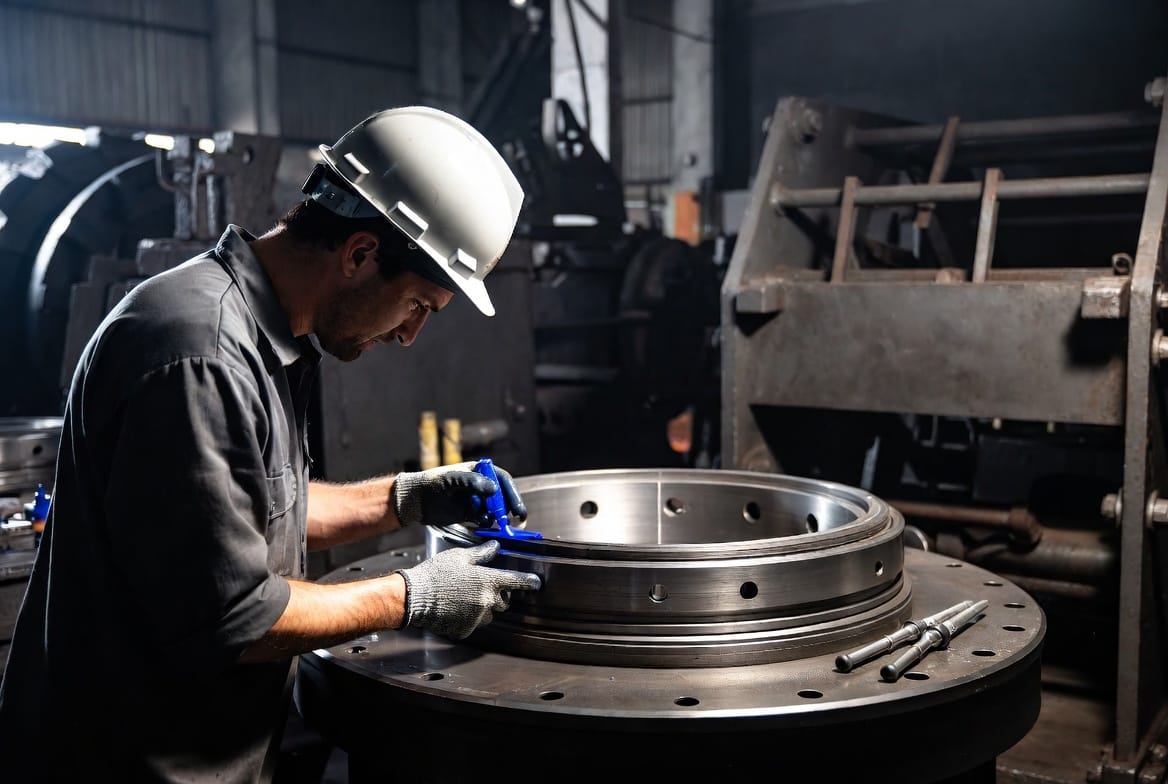
| Liner installation quality | Moderate — poor seating creates uneven wear patterns | Yes — maintenance practice | Verify seating with prussian blue; torque to specification |
| Operating hours between inspections | Moderate — undetected accelerated wear reduces total life | Yes — maintenance schedule | Inspect at planned intervals; catch abnormal wear zones early |
The practical implication: published wear life data from manufacturers is based on test conditions or reference operations that may not match yours. The most reliable wear rate data is your own — tracked systematically across replacement cycles. Operations that record installation date, operating hours, and tonnage processed per liner set converge on their true performance baseline within 3–6 cycles, and can then make specification decisions based on actual data rather than catalog estimates.
Crusher Liner ROI Calculation: Is a Long Life Liner Worth the Premium?
Don’t just look at unit price. That’s the most common and most expensive mistake in crusher liner procurement. The ROI calculation for long life crusher liners requires three numbers: unit cost, wear life (in hours or tonnes processed), and the operational cost of each replacement event — parts, labor, and lost production during downtime. The liner with the best ROI is the one with the lowest total cost per tonne processed, which is frequently not the one with the lowest unit price.
The Downtime Cost Reduction Calculation
Downtime cost reduction is the most underestimated benefit of extending crusher liner life. Each liner change-out event involves shutdown preparation, the change-out itself, restart, and ramp-up — typically 4–8 hours of lost production for a planned change-out, and 8–16 hours for an unplanned emergency change-out triggered by premature failure. At $500–$1,500 per hour of lost production (depending on crusher size and operation), the cost of each additional change-out event is substantial.
| ROI Scenario (Secondary Cone, Hard Granite, 3,500 hrs/yr, 200 t/hr) | Standard Mn18Cr2 | Premium Mn22Cr2 | High Chrome Cr22 | MMC Composite |
| Unit cost per set (indicative) | $1,200 – $2,000 | $1,500 – $2,600 | $1,800 – $3,200 | $2,500 – $5,000 |
| Wear life (hours) — hard granite | 350 – 550 hours | 450 – 700 hours | 600 – 900 hours | 700 – 1,200 hours |
| Tonnes processed per set (at 200 t/hr) | 70K – 110K tonnes | 90K – 140K tonnes | 120K – 180K tonnes | 140K – 240K tonnes |
| Sets per year (3,500 hr operation) | 6 – 10 sets | 5 – 8 sets | 4 – 6 sets | 3 – 5 sets |
| Annual parts cost | $7,200 – $20,000 | $7,500 – $20,800 | $7,200 – $19,200 | $7,500 – $25,000 |
| Change-out events per year | 6 – 10 events | 5 – 8 events | 4 – 6 events | 3 – 5 events |
| Annual downtime cost (est. $800/hr, 5hr/event) | $24,000 – $40,000 | $20,000 – $32,000 | $16,000 – $24,000 | $12,000 – $20,000 |
| Estimated annual total cost | $31,200 – $60,000 | $27,500 – $52,800 | $23,200 – $43,200 | $19,500 – $45,000 |
| Cost per 1,000 tonnes processed (midpoint) | $4.50 – $8.50 / 1K t | $3.80 – $7.50 / 1K t | $2.60 – $5.60 / 1K t | $2.00 – $4.80 / 1K t |
The ROI calculation consistently shows that downtime cost reduction is the dominant factor — often larger than the parts cost saving. An operation reducing from 8 change-out events per year to 4 saves four full shutdown events, each worth $4,000–$8,000 in lost production alone. The premium alloy often pays for itself in downtime reduction before the wear life extension is even counted.
Maintenance Tips for Long Life Crusher Liners: Extending Service Life Beyond the Material
Honestly, a lot of liners are not worn out — they’re operated out. The material may have significant life remaining, but uneven wear patterns from incorrect installation, feed surges from inadequate feed control, or premature removal triggered by an incomplete inspection have ended the liner’s service before its time. Maintenance practices can extend effective liner service life by 15–30% beyond what the alloy alone would achieve.
Installation Quality
- Verify seating before locking: use prussian blue compound to confirm full contact between the liner and the bowl or jaw frame. Gaps in the seating surface create point loading that accelerates wear in those zones.
- Torque fixings correctly: undertorqued liners move micro-fractionally during operation, accelerating wear at the contact points. Overtorqued liners can crack at installation, before service begins.
- Inspect mating surfaces: accumulated scale, old liner fragments, or deformation on the bowl or jaw frame creates irregular seating that causes abnormal wear from the first hours of service.
Feed Management
- Run the widest practical closed-side setting: tighter CSS increases the number of crushing events per tonne, directly increasing wear rate. Every additional 5mm of CSS can extend liner life by 10–20% in some applications.
- Avoid surge feeding: surge feeding creates impact spikes that exceed design loading and initiate fracture or accelerated wear at stress concentration points. Consistent choke-feeding distributes load evenly across the liner surface.
- Limit maximum feed size: oversized material delivers impact loads that are disproportionately high relative to the crushing energy contribution. A scalping screen that limits maximum feed size to the recommended maximum for the crusher model significantly reduces these impact spike events.
Inspection and Monitoring
- Inspect at planned intervals, not just at failure: catching an accelerated wear zone early — before it penetrates through the liner — allows the change-out to be planned and executed efficiently. Waiting until failure triggers an emergency shutdown that costs multiples of a planned event.
- Track wear life in hours and tonnes, not just months: monthly wear life estimates hide the variation in throughput that affects actual wear rate. Track operating hours and estimated tonnage per liner set to build a genuine wear rate baseline.
- Photograph liner condition at removal: a consistent photographic record of wear patterns reveals feed distribution problems, seating issues, or alloy mismatches that would otherwise be invisible in aggregate wear life data.
How to Choose a Reliable High Performance Crusher Liner Supplier
I look at whether the supplier has genuine application experience in conditions similar to mine — not how low their quote is. A supplier who asks about your feed material, your crusher model, your CSS setting, and your current wear life before making a recommendation is engaging with the actual problem. A supplier who quotes a catalog Mn18 or Mn22 without asking these questions is not.
What Separates a Qualified Supplier from a Catalog Reseller
- Batch-traceable material documentation: chemical composition certificates tied to the specific production heat number, heat treatment cycle records, and hardness test results from multiple sample points per batch. These documents verify that the liner delivered matches the specification ordered.
- Application engineering capability: the ability to recommend and produce alloy grades beyond the standard catalog — custom Mn or chrome compositions, MMC specifications, or hybrid designs — based on your specific feed material and crushing conditions.
- Reference operations in comparable applications: not just company name references, but contactable operations in similar rock types and crusher configurations that you can call to verify wear life performance.
- Trial order support: a qualified supplier of high performance crusher liners supports a 1–2 set trial under your actual conditions before volume commitment, without minimum order preconditions.
- Consistent batch-to-batch quality: wear life performance should be consistent across multiple orders, not just the first trial batch. Ask for the quality control process between batches — 100% individual testing is the standard for a serious manufacturer.
Recommended Supplier: GUBT Casting
For long life crusher liners across jaw, cone, gyratory, and impact crusher applications — including high-manganese, high-chrome, and MMC specifications — GUBT Casting (gubtcasting.com) is a manufacturer worth evaluating. The company provides application-specific alloy recommendations based on your feed material, crusher model, and current wear life data — not catalog-standard specifications supplied regardless of operating conditions.
- Long life cone liners: Mn18Cr2, Mn22Cr2, and MMC specifications for primary and secondary cone crusher applications — optimized for your specific feed and crusher model
- High performance jaw plates: Mn22Cr2 for primary hard rock crushing; Mn18Cr2 for secondary and softer rock applications; MMC for high-SiO₂ feeds requiring extended abrasion resistance
- High abrasion impact crusher liners: MMC and high-chrome blow bars and impact plates for HSI applications; high-chrome and carbide-tipped specifications for VSI
- Abrasion resistant liners for slag and silica applications: high-chrome Cr24–Cr28 and bi-metallic specifications for extreme abrasion environments
- Custom alloy specifications: if your application doesn’t fit standard catalog grades, GUBT Casting develops application-specific compositions based on your wear rate data and feed material analysis
Contact gubtcasting.com with your application details — crusher model, feed material type and SiO₂ content, current liner specification, and replacement interval — for an alloy recommendation and cost-per-tonne comparison against your current specification.
Final Summary: Long Life Crusher Liners Are About the Right Match, Not the Hardest Material
The actual situation is that there is no universally best long life crusher liner material. There is only the most appropriate material for a specific combination of feed material, crusher type, crushing position, and operating conditions. The operations that reduce their annual liner cost by 30–50% do so not by finding a cheaper supplier — they do it by finding a better-matched specification and running it with better feed management and installation practices.
The material selection logic is consistent across applications. For impact-dominant conditions — primary jaw crushing of hard rock, reinforced concrete demolition — manganese steel (Mn22) provides the toughness that no harder material can match without fracture risk. For abrasion-dominant conditions — tertiary cone crushing, silica sand production, slag processing — high chrome or MMC delivers the abrasion resistance that manganese cannot achieve without heavy impact to drive work-hardening. For mixed conditions that don’t cleanly fit either extreme — secondary crushing, C&D waste, variable feed — MMC composite delivers the best balance at a cost premium that the wear life extension typically justifies.
Calculate the ROI before making any specification change. Unit price is the least useful metric in this decision. Cost per tonne processed — including downtime cost reduction — is the only number that reflects actual operational value. Run the numbers with your specific throughput, downtime cost, and wear life data, and the correct specification decision becomes clear.
| Application Type | Dominant Wear Mode | Recommended Liner | Key Decision Criterion |
| Primary jaw — hard granite/basalt | Heavy impact + moderate abrasion | Mn22Cr2 high performance jaw plates | Toughness — fracture resistance from rebar/coarse feed |
| Primary jaw — limestone/soft rock | Moderate impact + low abrasion | Mn18Cr2 jaw plates | Cost-efficiency — Mn22 over-specified for soft rock |
| Primary cone — hard igneous rock | Sustained compressive + gyrating | Mn22Cr2 long life cone liners | Work-hardening ceiling — Mn22 justified by heavy sustained load |
| Secondary cone — hard rock, abrasion increasing | Lower impact + higher abrasion | Mn18Cr2 or high chrome Cr20 | Abrasion-to-impact ratio — evaluate per specific conditions |
| Tertiary cone — fine feed, abrasion-dominant | Low impact, high abrasion | High chrome Cr22–Cr26 | Abrasion resistance — Mn18 insufficient without impact hardening |
| HSI blow bar — variable/contaminated feed | High-velocity impact + abrasion | MMC composite | Fracture tolerance — chrome fractures on metal inclusions |
| Slag processing — extreme abrasion | Abrasion-dominant | High chrome Cr24–Cr28 or MMC | Abrasion resistance ceiling — Mn insufficient at slag abrasivity |
| Mixed/unknown feed — recycling applications | Variable — unknown composition | Mn22 or MMC — versatility over peak performance | Safety margin — toughness prevents catastrophic fracture |
Selecting the right material is only the first step; performance is ultimately proven in the pit. Whether you are managing primary impact in a jaw crusher or extreme abrasion in a tertiary cone, your equipment requires a precise metallurgical match. Explore our comprehensive range of Long Life Cone Liners
, High-Performance Jaw Plates
, and High-Abrasion Impact Crusher Liners to see how our application-specific alloys can reduce your cost-per-ton and minimize unplanned downtime
Frequently Asked Questions
How long do crusher liners last?
Crusher liner service life varies enormously — from as little as 200 hours in very abrasive applications (slag, quartzite, high-SiO₂ granite) to 2,000+ hours in softer rock at favorable operating conditions (limestone, secondary positions, wide CSS). For a hard granite primary jaw application with Mn22Cr2, 600–1,000 hours per set is a reasonable expectation from a quality manufacturer. For a tertiary cone in limestone with high-chrome liners, 1,200–2,000 hours is achievable. The best basis for setting realistic expectations is tracked wear life data from your own operation — published specifications are starting points, not guarantees.
Which liner material is best for high-abrasion applications?
For purely abrasion-dominant applications — slag processing, silica sand production, tertiary positions with very fine feed — high-chrome alloys (Cr24–Cr28) or MMC composites deliver the best wear life. High chrome offers the highest abrasion resistance ceiling but is brittle under heavy impact. MMC provides excellent abrasion resistance with better impact tolerance, making it the better choice when feed consistency is variable or contamination risk is present. Manganese steel, despite being the most common crusher liner material, is not optimized for pure abrasion — it requires impact loading to activate work-hardening, which isn’t present in fine, abrasion-dominant crushing positions.
How does downtime cost affect the total cost of long life crusher liners?
In most operations, downtime cost reduction from fewer change-out events is larger than the parts cost saving from extended wear life. A planned liner change-out in a medium-size cone crusher typically involves 4–6 hours of lost production — worth $3,000–$8,000 at typical production rates. Reducing from 8 change-out events per year to 4 saves four of these events — $12,000–$32,000 in production value before the parts cost saving is even counted. This is why the ROI calculation for premium liner specifications — which have higher unit cost but fewer change-outs — almost always shows positive returns in high-throughput applications.
Can I use the same liner specification for different positions in my crushing circuit?
Generally not recommended. Each position in a crushing circuit has a different loading mode, different feed size, and a different abrasion-to-impact ratio. Specifying the same liner across primary, secondary, and tertiary positions optimizes for none of them. A practical approach: use the toughest specification (Mn22) in primary positions; move to Mn18 or high chrome in secondary depending on rock type; use high chrome or MMC in tertiary positions where abrasion dominates. The additional complexity of managing multiple specifications is offset by the wear life improvement in each position.
How do I know if my current liner specification is optimal?
Track three metrics: wear life in hours per set, wear pattern at removal (photograph the worn liner), and the cost per tonne processed for each set. If wear life is consistent and the wear pattern is even across the liner surface, the specification is working. If wear life is shorter than comparable operations or shorter than the manufacturer’s published data, and the wear pattern shows accelerated wear in specific zones, the alloy may be under-specified for the abrasion level or the installation/feed management may need review. Comparing your cost per tonne against the options in the ROI table in this guide will indicate whether a specification upgrade would pay for itself.
Authoritative Resources & Further Reading
The following sources provide technical depth on crusher liner materials, wear testing standards, and application engineering:
Material Standards
- ASTM A128 — Austenitic Manganese Steel Castings — Primary US standard for high manganese steel — covers composition grades for all Mn13 through Mn22 grades used in long life crusher liner applications.
- ASTM A532 — Abrasion-Resistant Cast Iron — Standard for high-chrome alloy grades used in abrasion resistant crusher liners — reference for composition and hardness specifications.
- ASTM G65 — Dry Sand/Rubber Wheel Abrasion Test — Standard abrasion test method used to characterize and compare abrasion resistance of different crusher liner materials.
Industry and Technical Bodies
- Society for Mining, Metallurgy & Exploration (SME) — Publishes peer-reviewed technical papers on comminution, crusher wear, and wear material performance in commercial mining operations.
- AggNet — Aggregates & Quarrying Industry — Industry resource covering crusher liner selection, wear management, and maintenance practices in quarry and aggregate production.
- International Mining Magazine — Crushing & Comminution — Trade publication covering crusher liner technology and wear material performance comparisons in commercial mining applications.
Latest Insights
Cone Crusher Liners vs Jaw Plate Parts: Wear Mechanism, Structure Differences & Replacement Cycles
Mining Crusher Parts for Hard Rock: High-Performance Wear Solutions & Cost Optimization Guide

Crusher Parts for Recycling:Applications:Concrete, Asphalt & Demolition Waste Selection Guide