

Horizontal Shaft Impact (HSI) crushers are the workhorses of the aggregate and recycling industries. Known for their ability to produce high-quality, cubical-shaped products, these machines rely heavily on the durability and precision of their internal components.
When searching for HSI Crusher Parts, HSI Crusher Spare Parts, or HSI Crusher Replacement Parts, understanding the synergy between the rotor, blow bars, and impact plates is essential for maximizing uptime and minimizing cost-per-ton.
What is an HSI Crusher?
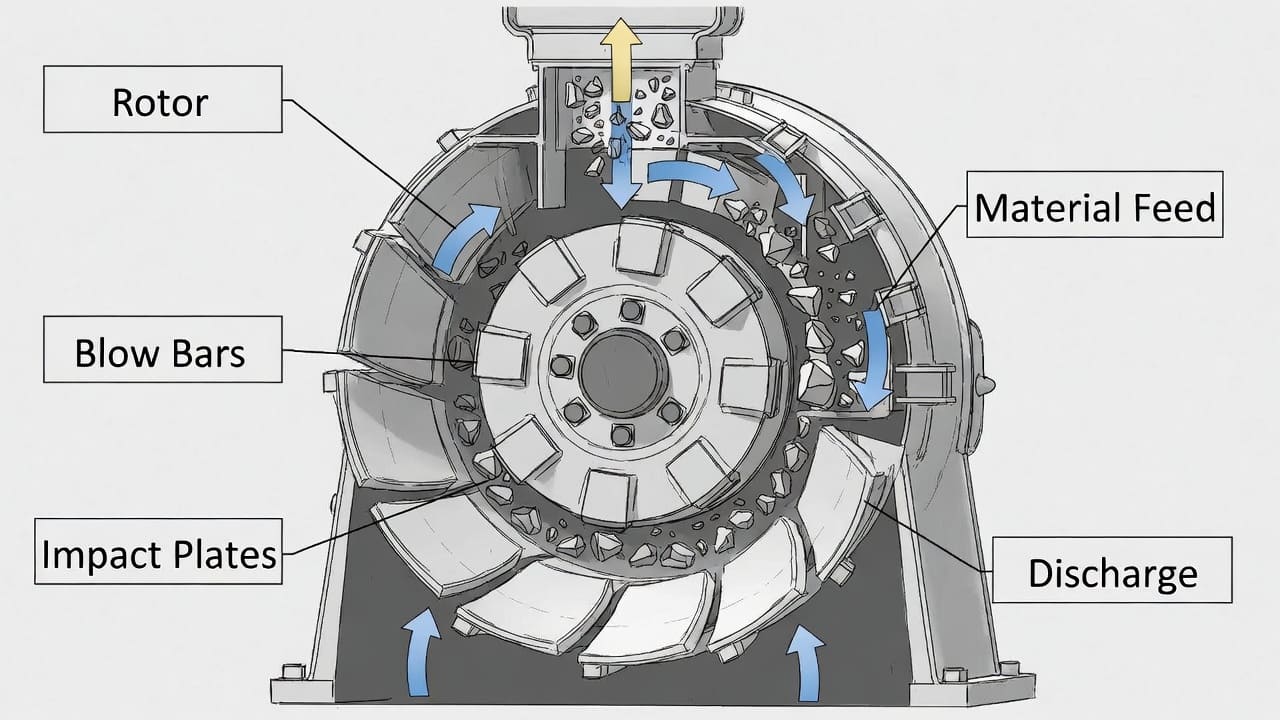
A Horizontal Shaft Impact (HSI) crusher is a type of crushing equipment that utilizes impact energy rather than compression to break down material. Unlike jaw or cone crushers, which “squeeze” rock, the HSI crusher uses high-speed kinetic energy to shatter it.
How it Works: The Impact Principle
- Feed Entry: Material enters the crushing chamber and is immediately met by high-speed rotating blow bars.
- Primary Impact: The blow bars strike the material, shattering it upon contact.
- Secondary Impact: The accelerated material is thrown against impact plates (also known as aprons) mounted on the chamber walls.
- Recirculation: The material bounces back into the path of the blow bars, repeating the process until it is small enough to pass through the discharge opening.
Why HSI Wear Parts are Critical
In the world of material processing, HSI crushers are considered “high-wear” machines. Choosing high-quality HSI Crusher Replacement Parts is vital because it ensures production consistency, machine longevity, and lower operating costs.
Core Components of an HSI Crusher
- Blow Bars: The primary wear medium that provides the initial impact.
- The Rotor: The “heart” of the crusher that holds the blow bars and provides the required velocity.
- Impact Plates (Apron Liners): Act as an “anvil” for the material thrown by the blow bars.
How Does an HSI Crusher Work?
Understanding the mechanical process of a Horizontal Shaft Impact (HSI) crusher is the first step in recognizing why high-quality HSI Crusher Parts are vital. The HSI crusher relies on high-velocity impact to reduce material size.
The Step-by-Step Crushing Process
- Material Entry: Large rocks enter the crushing chamber and are directed into the path of the HSI Rotor Assembly.
- Primary Impact: The rotor rotates at high linear speeds (30–80 m/s). The material is struck by the blow bars—the primary High Impact Crusher Parts—shattering it along natural cleavage planes.
- Secondary Impact & Attrition: The blow bars propel the fractured material toward the impact plates (breaker plates) at high speed.
- Final Discharge: The process continues until the material passes through the gap between the blow bars and the impact plates.
Technical Performance Indicators
| Feature | Technical Detail | Impact on Production |
|---|---|---|
| Rotor Speed | 30–80 m/s | Controls fineness and wear rate. |
| Crushing Principle | Impact Crushing | Ensures superior particle shape control. |
| Adjustable Chamber | Gap adjustment | Maintains sizing as HSI Crusher Spare Parts wear down. |
Primary Application Industries
- Quarrying & Aggregates
- Mining
- Recycling (Concrete, Asphalt, Glass)
Main Types of HSI Crusher Parts
To effectively manage a crushing plant, it is essential to distinguish between the various components that keep a machine running. Generally, HSI Crusher Spare Parts are categorized into two primary groups based on their function and life expectancy: Wear Parts and Mechanical Parts.
1. Wear Parts (High Consumption)
Crusher Wear Parts are the components that come into direct contact with the feed material. Because they are subjected to constant high-velocity impact and abrasion, they have a limited lifespan and require frequent replacement. Common examples include blow bars, impact plates, and side liners.
2. Mechanical Parts (Structural)
Crusher Mechanical Parts refer to the internal and external skeleton of the machine. These are designed for long-term use and do not touch the material being crushed. These include the rotor assembly, main shaft, bearings, pulleys, and hydraulic adjustment systems. While they last significantly longer, their maintenance is critical to prevent catastrophic equipment failure.
Why Wear Parts Decide Production Efficiency:
The condition of your wear parts directly impacts the “crushing profile” of the machine. When blow bars or impact plates become rounded or worn, the crushing energy is distributed unevenly. This leads to increased power consumption, a decrease in the percentage of cubical product, and a higher volume of unwanted “fines.” Maintaining high-quality HSI Replacement Parts is the most direct way to control your cost-per-ton.
HSI Crusher Wear Parts (High Wear Components)
In a Horizontal Shaft Impact crusher, the wear environment is aggressive. Identifying the high-wear components and understanding their replacement cycles is vital for planning maintenance schedules and reducing downtime.
Core Wear Components
- HSI Blow Bar Parts: These are the most critical Crusher Wear Parts. Mounted on the rotor, they provide the primary impact force. Blow bars are usually made from high-chrome iron, manganese steel, or ceramic composites to withstand extreme shock.
- Impact Plate Parts (Breaker Plates): These act as the secondary crushing surface. Material thrown by the blow bars hits the impact plates and shatters. They must be thick and made of Abrasion Resistant Liners to handle the constant bombardment.
- Side Liners (Frame Liners): These protect the interior housing of the crusher from flying debris. While they don’t participate in the actual crushing, they prevent the machine’s frame from wearing through.
Causes of Wear and Replacement Cycles
The wear rate is primarily determined by the abrasiveness and moisture content of the feed material. For example, crushing limestone (low abrasion) will yield a much longer life for blow bars compared to crushing recycled concrete with high sand content (high abrasion).
| Component | Primary Wear Cause | Replacement Indicator |
|---|---|---|
| Blow Bars | High-velocity impact & shearing | Rounded edges or 50% mass reduction. |
| Impact Plates | Rebound impact & sliding abrasion | Thinning of the plate or visible cracks. |
| Side Liners | Sliding abrasion from fines | Holes or thinning near the discharge zone. |
Impact on Production Costs
Neglecting HSI Blow Bar Parts maintenance often results in a “snowball effect” of costs. Worn parts require the motor to work harder to achieve the same reduction ratio, leading to higher electricity bills. Furthermore, delayed replacement can lead to the blow bar breaking, which often causes severe damage to the rotor—a much more expensive HSI Replacement Part to repair.
HSI Blow Bar Parts (Impact Hammers)
The blow bar is the most critical component among all HSI Blow Bar Parts. These heavy, thick slabs of metal are securely slotted into the rotor. As the rotor spins at high speeds, the blow bars strike the incoming feed material with massive kinetic energy, providing the primary crushing force.
Selecting the right material for Blow Bar Parts is essential to balance wear life and cost. Different materials are chosen based on the abrasiveness and toughness of the feed:
- High Chrome (Cr15–Cr27): These High Chrome Crusher Liners offer excellent wear resistance for hard, abrasive materials like granite and basalt. However, they are brittle and can break if large uncrushable objects (like tramp iron) enter the chamber.
- Manganese Steel (Mn13–Mn18): Common Manganese Crusher Parts are highly “work-hardening.” They are ideal for high-impact applications like concrete recycling where rebar or metal may be present, as they toughen under stress rather than cracking.
- MMC (Metal Matrix Composite): These MMC Crusher Parts combine ceramic inserts with a metal matrix, offering the hardness of chrome with the toughness of alloy steel—perfect for extending the interval between change-outs.
Common Applications: Limestone (Chrome/MMC), Granite (High Chrome), and Concrete Recycling (Manganese).
HSI Impact Plate and Breaker Plate
The HSI Impact Plate and HSI Breaker Plate are secondary crushing surfaces fixed to the interior of the crusher housing. After the blow bars strike the material, it is thrown with extreme force against these plates.
Key Roles and Technical Features:
- Secondary Crushing: The impact plate acts as an anvil, shattering the material further upon contact.
- Particle Size Control: Most modern HSI crushers feature an adjustable gap between the blow bars and the Breaker Plate Parts. By narrowing this gap, operators can produce finer material.
- Impact Angle: These High Performance Crusher Liners are designed with specific angles to ensure the material bounces back into the path of the rotor for maximum efficiency.
How to Extend Life: Regularly checking and adjusting the apron settings ensures that the Impact Plate Parts wear evenly. If the gap is too wide, the material may cause “sliding” wear rather than “impact” wear, which consumes the metal faster.
HSI Crusher Liners and Protective Plates
While blow bars and impact plates do the heavy lifting, HSI Crusher Liners (often called side liners or wear liners) serve a vital protective role. These Abrasion Resistant Liners are bolted to the internal walls of the crusher frame to shield the housing from the constant bombardment of crushed stone.
Material Composition:
- High Chrome & Alloy Steel: Used in high-impact zones where the material ricochets most aggressively.
- AR Steel (Abrasion Resistant): Standard High Impact Crusher Parts for side walls to prevent the frame from thinning over time.
The Advantage of Custom HSI Liners:
Using Custom HSI Liners allows for a more precise fit than generic replacements. A tighter fit prevents “fines” from slipping behind the liner and eroding the main crusher housing, which is an extremely expensive repair. Custom designs can also be reinforced in specific high-wear zones identified through operational history.
HSI Crusher Mechanical Parts
While wear parts are replaced frequently, HSI Crusher Mechanical Parts form the structural foundation of the machine. These components are designed for longevity, but because they handle the immense kinetic energy required to shatter rock, their maintenance is non-negotiable for site safety and operational continuity.
The HSI Rotor Assembly is the most critical mechanical component. It must be massive enough to maintain momentum during impact while remaining precisely engineered. Proper rotor balance is essential; even a slight imbalance can cause severe vibrations that damage the entire crusher frame. High-quality HSI Rotor Parts are precision-machined to ensure smooth rotation at high RPMs, and robust locking systems ensure that blow bars remain securely wedged during operation to prevent catastrophic ejections.
Supporting this assembly are the HSI Shaft Parts and HSI Bearings, which translate the motor’s power into crushing force. The main shaft, forged from high-strength alloy steel, is built to withstand heavy shaft loads and torsional stress without bending. Meanwhile, the heavy-duty spherical roller bearings require strict bearing lubrication schedules. Contaminated or dry bearings are the leading cause of unplanned crusher downtime, making proactive monitoring of heat and vibration a priority for any professional operator.
Unlike wear parts, if a mechanical part fails, it often results in weeks of downtime and expensive repairs. Regular inspections of the rotor’s structural integrity and the shaft’s alignment are vital to prevent the “snowball effect” of mechanical failure.
Other Important HSI Crusher Components
Beyond the primary crushing elements, several auxiliary Crusher Maintenance Parts and Crusher Repair Parts are necessary to fine-tune performance and ensure a smooth flow of material through the machine.
The adjusting device, whether hydraulic or manual, serves as the primary tool for controlling particle size. By moving the impact plates closer to or further from the rotor, operators can compensate for the natural wear of the blow bars and maintain a consistent output. In certain HSI configurations, feed tube parts work in tandem with these adjustments to guide material directly into the optimal “impact zone,” preventing uneven wear on the center or edges of the blow bars.
Structural stability within the chamber is maintained by curtain rods and suspension systems. These rods support the heavy impact curtains (aprons), providing enough strength to hold them in place while allowing them to retract if an uncrushable object, like tramp iron, enters the chamber. Even small Crusher Repair Parts like lifting bolts and shims play a role in increasing production efficiency; using the correct grade of hardware ensures that liners and plates remain securely fastened under intense vibration, preventing internal rattling that saps energy and reduces throughput.
By keeping the adjusting devices well-lubricated and the feed tubes clear, operators can adjust the crushing chamber effectively, ensuring the crusher maintains its maximum throughput and produces a consistent, high-value cubical product.
Applications of HSI Crusher Parts

The versatility of the Horizontal Shaft Impact crusher makes it a staple in various heavy industries. By utilizing specialized Quarry Crusher Parts and Aggregate Crusher Parts, operators can tailor their machines to handle materials ranging from soft limestone to medium-hard basalt.
In the Mining Crusher Parts sector, HSI units are frequently used for secondary and tertiary crushing to produce finely graded ore. However, the most significant growth for HSI technology is in the circular economy. For Concrete Recycling Parts and Asphalt Recycling Parts, the HSI crusher is the preferred choice because the impact principle effectively separates rebar and wire mesh from concrete, a task that often jams jaw or cone crushers.
In the Demolition Crusher Parts market, these machines excel at processing construction waste into high-quality road base. The ability of the HSI crusher to handle “contaminated” feed—such as concrete containing wood or plastic—while still producing a cubical final aggregate makes it indispensable for modern recycling yards that prioritize high-volume throughput and product purity.
How to Choose the Right HSI Crusher Parts
Selecting the correct components requires a balance between initial cost and long-term durability. The primary selection criteria should always be based on your specific feed material hardness and the abrasion level of the rock. For instance, high-abrasion silica requires Heavy Duty Crusher Parts with ceramic inserts, while softer limestone can be efficiently processed with standard alloy steel.
When sourcing, you will typically choose between OEM HSI Parts and high-quality Aftermarket HSI Parts. OEM parts offer guaranteed OEM compatibility and peace of mind, but premium aftermarket suppliers often provide Custom Crusher Parts that are redesigned to solve specific wear patterns observed on your site. The key is to ensure that the metallurgy matches your application; a blow bar that is too hard may crack under high impact, while one that is too soft will wear down prematurely, increasing your cost-per-ton.
Maintenance Tips for HSI Crusher Wear Parts
Proactive maintenance is the only way to minimize unplanned downtime and extend the life of your Heavy Duty Crusher Parts. A daily inspection of the blow bars is the most critical task; you should monitor for rounding of the leading edges and flip or replace them before the wear reaches the rotor’s locking system. Neglecting this can lead to the blow bar becoming loose, causing catastrophic internal damage.
Beyond the wear components, rotor balance inspection should be performed weekly. If a blow bar has chipped or worn unevenly, the resulting vibration will rapidly degrade your Crusher Repair Parts and bearings. Liner wear monitoring is also essential to ensure that the crusher housing remains protected. Finally, establishing a strict schedule for bearing lubrication with high-quality, heat-resistant grease will prevent the most common cause of mechanical failure. By keeping a small stock of essential Crusher Maintenance Parts on-site, you can perform these routine swaps quickly, ensuring your production line stays active and profitable.
FAQ
Latest Insights
Cone Crusher Liners vs Jaw Plate Parts: Wear Mechanism, Structure Differences & Replacement Cycles

Long Life Crusher Liners:Material Selection, Wear Optimization & Cost Reduction Guide

Mining Crusher Parts for Hard Rock: High-Performance Wear Solutions & Cost Optimization Guide