
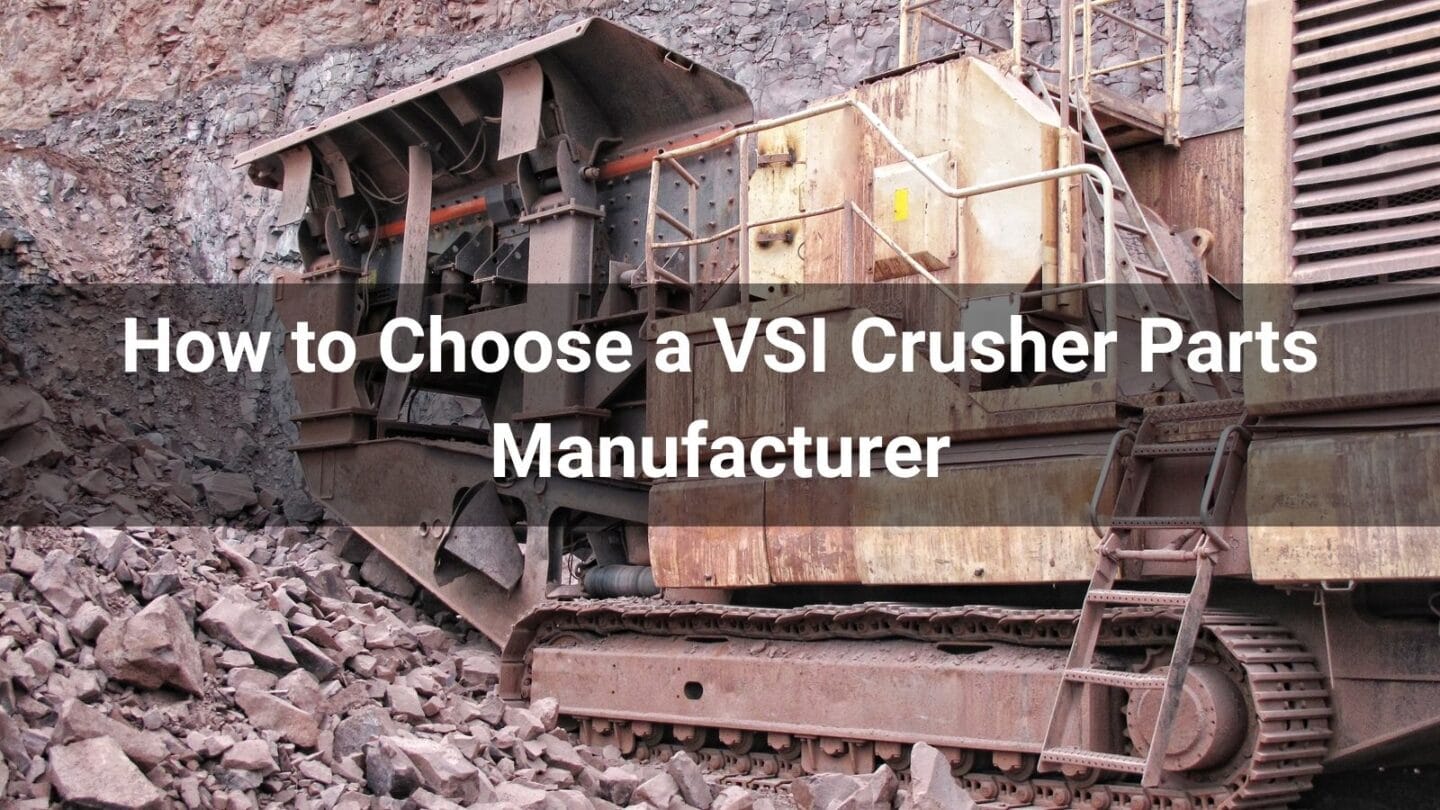
Why Choosing the Right VSI Crusher Parts Manufacturer Matters
Honestly, the gap between a good VSI parts manufacturer and a poor one shows up faster than in almost any other crusher type. VSI machines run at high speed, under constant impact — the wear parts are working hard every hour the machine is running. I’ve seen operations achieve 300+ hours per set of rotor tips with the right manufacturer, and the same crusher model wearing through tips in under 80 hours with a cheaper alternative. Same machine. Different parts.
The actual situation is this: purchase price tells you very little. What matters is cost per ton of material processed — which accounts for how long the part lasts, how many production shutdowns it causes, and what the labor cost of each change-out adds up to over a year. A tip set that costs $180 and lasts 80 hours is more expensive per ton than one costing $480 and lasting 300 hours. But real-world results often differ from spec sheet claims, and that gap comes almost entirely from the manufacturer’s material control and process discipline.
This guide covers how to identify manufacturers who actually deliver on specification — and how to avoid the ones who don’t.
| What Depends on Manufacturer Choice | Poor Manufacturer | Strong Manufacturer |
| Wear life consistency batch-to-batch | High variance — unpredictable | Consistent within ±10–15% of spec |
| Alloy composition accuracy | Claimed grade vs. actual grade often differ | Batch-traceable chemical certs provided |
| Heat treatment process control | Variable — no documented cycle | Documented cycle, hardness verified per batch |
| Delivery reliability | Lead times frequently missed | On-time delivery rate above 90% |
| Cost per ton processed | Often highest — short wear life | Lowest over full production cycle |
| Unplanned downtime risk | High — parts fail without warning | Low — predictable wear intervals |
Key VSI Crusher Parts to Consider
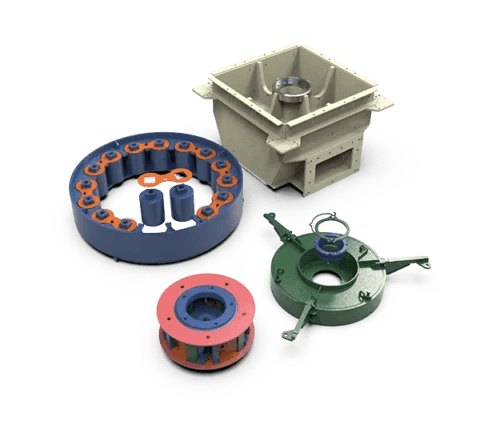
Don’t be fooled by cheap quotes on any of these items — every part in a VSI crusher is directly in the wear path, and every one of them affects operational uptime. I’ve seen rotor tips wear faster than expected, and I’ve seen anvils fracture prematurely because a supplier cut corners on alloy chromium content. Here’s what each part does and why the material specification matters.
Rotor Tips
The rotor tip is the primary wear item in a VSI crusher. It’s the point from which material is launched at high velocity toward the anvil ring. Tips experience simultaneous abrasion and impact — the most aggressive wear combination in the machine. Standard high-chrome tips work well in moderate abrasion applications. In high-silica or hard rock feeds, tungsten carbide-tipped variants are the only way to get economical wear life. The quality difference between a well-cast Cr26 tip and a poorly heat-treated one with the same spec sheet can be 30–50% in actual wear life.
Anvils
In rock-on-steel configurations, anvils take the full impact of material ejected from the rotor at high speed. They wear in a predictable arc pattern, and that wear pattern tells you a lot about whether your crusher is operating correctly and whether the alloy is distributing load evenly. Anvil geometry precision — how accurately the casting matches the design — affects both wear distribution and crushing efficiency. A supplier who prioritizes dimensional accuracy alongside alloy grade is worth more than one who only competes on price.
Wear Plates and Table Liners
Wear plates protect the rotor body and surrounding crusher chamber surfaces. They’re replaced more frequently than structural components but are individually lower cost. The risk here is underspecifying — fitting a standard Mn13 plate where a high-chrome Cr20+ plate is needed for the feed material. The plate fails fast, the replacement cycle accelerates, and the total annual cost ends up far higher than the premium plate would have cost.
Rotor Assembly Components
The rotor body itself, the distributor plate, and the feed eye ring are semi-structural wear components. They wear more slowly than tips and anvils, but replacement costs are substantially higher. Rotor body failures are often caused not by normal wear but by premature fatigue cracking — a casting defect that a quality manufacturer would catch in inspection. This is one area where supplier QC processes matter as much as alloy grade.
| Part | Primary Wear Mode | Critical Material Property | Failure Risk with Poor Supplier |
| Rotor tips | Abrasion + impact (simultaneous) | Hardness balanced with toughness | 50–60% shorter wear life; occasional fracture |
| Anvils | High-velocity impact | Alloy consistency + casting geometry | Uneven wear pattern; early replacement |
| Table liners / wear plates | Abrasion (sliding contact) | Hardness and alloy grade vs. feed material | Rapid wear; frequent replacement cycles |
| Distributor plate | Abrasion + centrifugal impact | Hardness + dimensional accuracy | Balance issues; premature wear on one side |
| Feed tube / eye ring | Abrasion (feed contact zone) | Alloy grade | Fast wear in high-feed-rate applications |
| Rotor body | Fatigue + abrasion (secondary) | Casting quality + structural integrity | Cracking under cyclic load; costly failure |
OEM vs Aftermarket VSI Crusher Parts
Actually, aftermarket parts often outperform OEM if chosen wisely. That’s not a sales pitch — it’s a reflection of how the industry has developed. OEM wear parts are designed to a specification set when the crusher was engineered, sometimes 15–20 years ago. Specialist aftermarket manufacturers have since developed alloy grades, carbide insertion techniques, and heat treatment protocols that improve on those original specifications for specific applications.
However, the word ‘aftermarket’ covers a wide range. At one end, there are engineering-led manufacturers with foundry control and documented QC. At the other end, there are trading companies sourcing from whoever is cheapest that week. The difference in output quality is enormous — and from the outside, both might look similar on a quotation form.
| Criterion | OEM Parts | Quality Aftermarket | Low-Cost Aftermarket |
| Unit price | Highest — 30–70% premium | Moderate — competitive | Lowest — undercuts OEM by 50–70% |
| Alloy specification | Fixed to original design | Can match or exceed OEM grade | Often below stated spec |
| Batch consistency | High — controlled production | High — if manufacturer-owned foundry | Low — sourced from variable foundries |
| Dimensional accuracy | Guaranteed — OEM tooling | High — verified against OEM drawings | Variable — limited inspection |
| Innovation vs original spec | None — fixed to original | Can improve on OEM for specific feeds | None — copies only |
| Parts availability (legacy models) | Often discontinued | Often still produced | Often available but quality unknown |
| Technical support | Strong — OEM application data | Good from established suppliers | Minimal |
| Best use case | Mechanical components; warranty period | Wear parts in proven, high-throughput ops | Trial only — verify before volume order |
The practical approach: use OEM for mechanical components (bearings, shaft assemblies) where dimensional precision is structurally critical. Use well-qualified aftermarket for consumable wear parts where you can verify material quality through documentation and trial testing.
Material, Alloy, and Heat Treatment: What Actually Determines Performance
I’ve seen identical specifications behave completely differently depending on heat treatment quality. Two sets of Cr26 rotor tips from two different suppliers — same stated hardness, same chromium content on paper — with a 40% difference in actual wear life. The difference was not the alloy. It was the heat treatment cycle and how consistently it was applied.
Material selection is about matching the alloy’s mechanical properties to your feed material’s wear mechanism. High-chrome alloys resist abrasion but sacrifice some toughness. Manganese steel resists impact and work-hardens under load. Choosing the wrong grade for your application — even a premium-priced wrong grade — delivers poor results. And choosing the right grade from a manufacturer who doesn’t control their heat treatment delivers equally poor results.
| Alloy Grade | Chrome % | Hardness (HRC / HB) | Best Application | Weakness |
| High chrome Cr20 | 18–22% | 58–62 HRC | Moderate abrasion, mixed impact | Brittle in extreme impact applications |
| High chrome Cr26 | 24–28% | 62–65 HRC | High abrasion, lower impact | More brittle — fracture risk in heavy impact |
| Mn18Cr2 manganese | 2% Cr addition | ~200 HB (500+ work-hardened) | High impact, lower abrasion | Soft initially — needs impact to harden |
| Bi-metallic chrome + carbide | Cr20 base + WC insert | Base: 60 HRC; Insert: 1,400+ HV | Extreme abrasion (silica, granite) | High cost; carbide brittle under pure impact |
| Chromium-moly alloy | Variable Cr + Mo | 55–62 HRC | Mixed wear conditions | Less predictable than pure high-chrome grades |
What to Ask About Heat Treatment
Any manufacturer serious about quality can answer these questions immediately. If they cannot — or if the answers are vague — that tells you something important about their process control.
- What is your austenitizing temperature range for this alloy, and how do you control it?
- What is the hold time at temperature before quench?
- What quench method do you use — water, air, or oil — and why for this grade?
- How do you verify final hardness — surface only, or cross-section bulk hardness?
- Can you provide heat treatment cycle records for the specific batch we’re ordering?
Supplier Selection Checklist
We recommend treating VSI wear parts procurement the same way you’d treat any critical production input — with documented qualification requirements, not just a price comparison. The cheapest quote is rarely the right decision. But don’t just pick the lowest quote — here’s a structured checklist for evaluating any new or existing supplier:
| Evaluation Area | What to Verify | How to Verify | Minimum Standard |
| Material certification | Chemical composition per batch | Request mill certificate (heat traceable) | Batch-specific cert, not generic spec sheet |
| Hardness verification | Bulk hardness, not surface only | Request cross-section hardness test results | Multiple sample points per batch |
| Manufacturing status | Own foundry vs trading company | Request foundry photos + heat treatment equipment | Should respond within 24 hours with evidence |
| Production capacity | Can fulfill your volume on schedule | Request current backlog and on-time delivery rate | OTD rate above 90% over past 12 months |
| Application references | Other operations in similar applications | Request names and contact information | Minimum 2–3 references in similar feed material |
| Sample trial capability | Willingness to supply trial set | Request 1–2 sets before volume commitment | Should offer trial with no preconditions |
| Customization capability | Can produce to your spec, not catalog only | Request capability statement for custom alloy/geometry | Should be able to quote custom spec within 3–5 days |
| After-sales support | Response process for quality issues | Ask for warranty terms and claims process in writing | Written warranty with defined response time |
Common Mistakes When Purchasing VSI Parts
I’ve seen entire batches fail within weeks because of these errors. Not occasionally — regularly, across different operations and different crusher models. The mistakes are consistent, and they’re avoidable.
- Choosing on unit price alone. The cheapest rotor tip set is almost never the cheapest option when you calculate what it costs per ton of material processed over a year.
- Accepting vague alloy descriptions. ‘High chrome’ is not a specification. Cr20 and Cr26 perform completely differently. Always require the exact chromium percentage, carbon content, and any secondary alloy additions.
- Skipping heat treatment verification. The alloy composition can be correct and the finished part can still underperform by 40% if the heat treatment cycle was not properly controlled. Ask for cycle records.
- Not testing before volume ordering. A supplier’s sample and a supplier’s production batch are not always the same thing. Run a full wear cycle trial under your actual conditions before committing to volume.
- Mistaking a trading company for a manufacturer. Many VSI parts ‘suppliers’ own no production equipment. They source from whichever foundry is cheapest at the time — which means batch-to-batch consistency is impossible to guarantee.
- Ignoring application fit. A wear plate grade correct for limestone will underperform in granite or silica sand by a significant margin. Always specify your feed material type and hardness when requesting a quotation.
- Underestimating safety stock requirements. If your supplier has a 5-week production lead time and your tips wear out in 8 weeks, you need to reorder long before you think you do. Model your stock levels against realistic wear rates, not optimistic ones.
Cost vs Longevity: How to Calculate Real Value
Honestly, the cheapest rotor tip is often the most expensive over time. The math is straightforward — but it requires tracking data that many operations don’t collect. Here’s the framework and a worked example.
Cost per Ton Formula
Cost per ton = (Part cost + Change-out labor) / (Tons processed per set)
If you don’t track tons processed per set, use operating hours multiplied by your average throughput rate. Once you have this number for your current supplier, you have a genuine benchmark to evaluate alternatives against.
| Scenario | Tip Set Price | Wear Life (hours) | Throughput (t/hr) | Tons per Set | Labor per Change-out | Cost per 1,000 Tons |
| Budget Cr18 tips | $200 | 70 hours | 120 t/hr | 8,400 tons | $150 | $4.17 |
| Standard Cr22 tips | $380 | 140 hours | 120 t/hr | 16,800 tons | $150 | $3.15 |
| Premium Cr26 tips | $580 | 240 hours | 120 t/hr | 28,800 tons | $150 | $2.54 |
| Carbide-tipped | $720 | 400 hours | 120 t/hr | 48,000 tons | $150 | $1.81 |
The budget tips cost $200 per set — but $4.17 per thousand tons. The carbide tips cost $720 per set — but only $1.81 per thousand tons. At 300,000 tons annual throughput, that difference is $708 per year in parts and labor costs alone, before accounting for the value of fewer production shutdowns. The numbers change with your actual throughput and wear life — but the direction almost never changes.
| Annual Cost Component | Budget Parts (Cr18) | Premium Parts (Cr26) | Carbide-Tipped |
| Sets per year (300,000 tons) | 35–36 sets | 17–18 sets | 6–7 sets |
| Annual parts cost | $7,000 – $7,200 | $9,860 – $10,440 | $4,320 – $5,040 |
| Annual labor (change-outs) | $5,250 – $5,400 | $2,550 – $2,700 | $900 – $1,050 |
| Downtime events per year | 35–36 shutdowns | 17–18 shutdowns | 6–7 shutdowns |
| Est. production loss value | $17,500 – $18,000 | $8,500 – $9,000 | $3,000 – $3,500 |
| Estimated total annual cost | $29,750 – $30,600 | $20,910 – $22,140 | $8,220 – $9,590 |
Note: Production loss estimated at $500/shutdown event. Adjust to your actual downtime cost. These figures assume consistent wear life — actual results depend on feed material, crusher speed, and part quality consistency.
Matching VSI Parts to Your Application
Application matters more than most buyers account for when specifying VSI wear parts. The same alloy grade performs very differently across feed materials, and choosing the right grade for your specific conditions is as important as choosing the right manufacturer.
| Application | Feed Material | Wear Mechanism | Recommended Tip Grade | Anvil Grade | Key Risk of Wrong Spec |
| Silica sand production | High-silica sand, SiO2 >80% | Extreme abrasion | Carbide-tipped | Bi-metallic or Cr26 | Standard chrome wears out in weeks |
| Hard rock quarry | Granite, basalt, quartzite | High abrasion + heavy impact | Cr26 or carbide | Cr24–Cr26 | Underfspec fails fast; overspec fractures |
| Limestone aggregate | Soft limestone | Moderate abrasion | Cr20–Cr22 | Cr20 | Over-specifying wastes money |
| River gravel shaping | Rounded silica-rich gravel | High abrasion, variable impact | Cr24–Cr26 | Cr22–Cr26 | High SiO2 destroys standard chrome fast |
| Concrete recycling | Crushed concrete + rebar fragments | Moderate abrasion + metal impact | Mn18 or balanced Cr20 | Cr20 | Metal contamination fractures brittle alloys |
| Manufactured sand (M-sand) | Variable aggregate blend | Moderate-high abrasion | Cr24 or carbide | Cr22–Cr24 | Inconsistent feed demands versatile grade |
Conclusion: What to Look for in a VSI Crusher Parts Manufacturer
The core conclusion is simple. Material matters. Process control matters. And the supplier’s ability to prove both — through documentation, references, and a trial set — is what separates manufacturers worth working with from ones who will cost you more than you saved.
Evaluate OEM versus aftermarket based on your application and the specific part type, not on a blanket policy. For consumable wear parts, the right aftermarket manufacturer can match or exceed OEM performance at lower cost. For structural and mechanical components, OEM remains the safer choice during equipment warranty periods.
Long-term durability over initial price is not just a procurement principle — it’s the only framework that reflects what wear parts actually cost in a running operation. The cheapest supplier rarely becomes a long-term partner. The most reliable one almost always does.
Some specialized manufacturers focus specifically on VSI wear part longevity and application optimization — developing alloy grades and part geometries tailored to specific crusher models and feed materials rather than supplying generic catalog parts. Working with a manufacturer at that level of application focus consistently delivers lower total cost of ownership than sourcing from the lowest-price option.
| Selection Criterion | What It Means in Practice |
| Material specification | Require exact alloy grade with batch-traceable chemical composition certificate — not ‘high chrome’ |
| Heat treatment documentation | Ask for cycle records: temperature, hold time, quench method, final hardness verification |
| Manufacturer verification | Confirm foundry ownership with photos of equipment — rule out trading companies early |
| Reference operations | Contact references running the same crusher in similar feed material — ask about batch consistency |
| Trial before volume | Always run a full wear cycle trial before committing to volume — catalog claims are not field data |
| Cost per ton calculation | Calculate part cost + labor / tons processed — this is the only valid basis for comparing suppliers |
| Delivery reliability | Request on-time delivery rate for past 12 months — not just a quoted lead time |
| Long-term relationship value | A supplier who optimizes for your application over time is worth more than one who only competes on price |
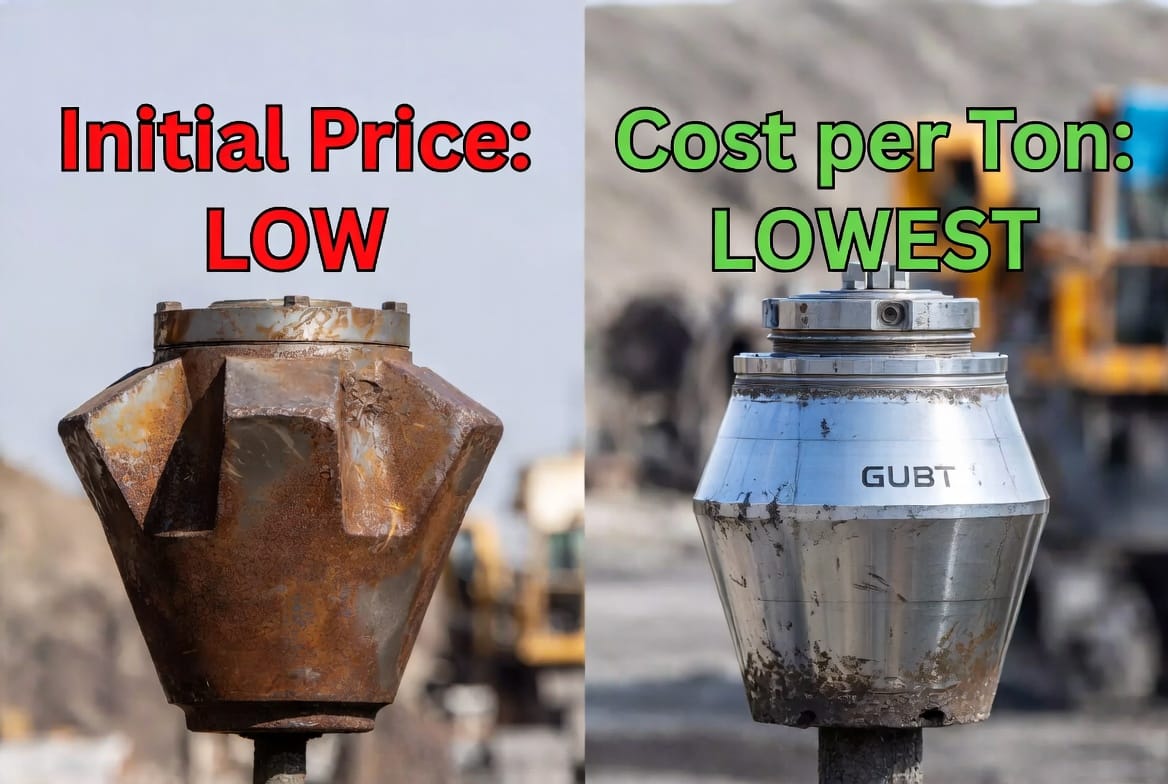
Is your VSI crusher underperforming due to “budget” parts? At GUBT, we help you shift the focus from the price tag to the bottom line. Our VSI Crusher Spares are engineered to deliver a lower Cost per Ton, ensuring your operation stays profitable.
Frequently Asked Questions
How do I verify a VSI parts supplier is a real manufacturer and not a trading company?
Ask for photos of their foundry, their heat treatment furnace, and their quality control lab. A real manufacturer can provide this within 24 hours — they own the equipment. A trading company will redirect, stall, or send photos of a foundry they don’t own. Additionally, ask for heat treatment cycle records for a recent production batch. A manufacturer controls this process and documents it. A trading company cannot provide it because they don’t run the process.
What is the minimum documentation I should require before placing a volume order?
At a minimum: a chemical composition certificate traceable to the specific production heat number, a hardness test report with multiple sample points (not just surface hardness), and dimensional inspection records against the drawing. For a new supplier, add a reference list and a trial set before volume commitment. These requirements are standard for any serious commercial manufacturer and should take no more than a few days to compile.
How long should a VSI rotor tip trial last before I make a volume decision?
Run the trial through at least one complete wear cycle — from installation to replacement threshold. Track operating hours and tonnage processed. Do not make a volume decision based on visual inspection alone or on partial wear data. A single full cycle gives you enough data to calculate cost per ton and compare against your baseline. If the trial set wears unevenly or shows early edge cracking, that is disqualifying regardless of price.
Should I use the same grade for rotor tips and anvils?
Not necessarily. The two parts experience different wear modes — tips see simultaneous abrasion and impact at the launch point, while anvils see high-velocity impact at the receive point. In most applications, a slightly higher-chrome grade on tips than anvils is appropriate, since tips are the primary abrasion surface. Your supplier should be able to recommend grade pairings based on your crusher model and feed material — if they can’t, that’s a signal they’re not application-engineering their products.
What lead time should I plan for VSI wear parts?
Standard-size chrome rotor tips and anvils in common configurations are typically stocked by established suppliers, with 1–2 week delivery. Carbide-tipped variants, custom dimensions, or large-crusher sizes generally require 4–8 weeks from a manufacturer. Always confirm current stock status at order time — ‘standard lead time’ and ‘current lead time’ are not the same thing. For critical operations, negotiate a buffer stock agreement with your primary supplier so you’re never ordering under pressure.
Authoritative Resources & Further Reading
The following sources provide technical depth on VSI crusher technology, wear material standards, and commercial procurement practice:
Material & Manufacturing Standards
- ASTM A532 — Abrasion-Resistant Cast Iron Specification — Standard specification for high-chrome white iron grades used in VSI wear parts. Use to verify supplier alloy claims against published composition ranges.
- ASTM A128 — Austenitic Manganese Steel Castings — Standard specification for manganese steel castings — relevant for VSI components specified in Mn grades for high-impact applications.
- ISO 9001 — Quality Management Systems Standard — Baseline quality management certification. Verify current status directly with the registrar — not from a supplier-provided certificate copy.
Industry & Technical References
- Society for Mining, Metallurgy & Exploration (SME) — Professional body for mining engineers. Publishes peer-reviewed technical papers on comminution, crusher wear, and wear material selection in commercial operations.
- AggNet — Aggregates & Quarrying Industry Resource — Industry resource covering VSI crusher performance, wear part management, and supplier evaluation in quarry and aggregate contexts.
- Minerals Engineering International — Technical publication covering comminution and crushing technology, including VSI-specific performance studies and wear material research.
Latest Insights
Mn18 vs Mn22 Crusher Parts:How to Choose the Right Manganese Steel for Maximum Wear Life

How to Choose the Right Screening &Feeder Parts Manufacturer Complete Buyer’s Guide

Screening & Feeder Parts Price 2026:Screens, Grizzly Bars & Components Cost Guide