Why Cone and Jaw Wear Parts Cannot Be Managed Identically
To be honest, I’ve seen many site managers treat Cone Crusher Liners and Jaw Crusher Parts as the same category of consumables. This is a classic misconception. While both serve the purpose of size reduction, their mechanical DNA is worlds apart.
1. Structural Logic: Compression vs. Gyratory Motion
The fundamental difference lies in how they apply force. A Jaw Crusher is essentially a “mouth” that uses a repetitive crushing motion, whereas a Cone Crusher acts more like a “grinder” using an eccentric gyratory motion.
Jaw Crusher Parts: Consist of a Fixed Jaw and a Swing Jaw. The material is crushed in a V-shaped chamber through direct, periodic compression. It is a “point-to-surface” impact.
Cone Crusher Liners: Consist of a Bowl Liner (Concave) and a Mantle. The material is squeezed and rolled simultaneously within a circular chamber. This involves not just compression, but significant attrition and friction.
2. The Wear Logic: Impact vs. Rubbing
Because the physics differ, the wear patterns are unique:
Jaw Wear: Highly localized. The heaviest wear occurs in the bottom third of the jaw plates (the discharge zone).
Cone Wear: More distributed but highly sensitive to “inter-particle crushing.” If the feed isn’t consistent, the liners suffer from localized “ringing” or uneven wear, which immediately degrades the final product shape (increasing flakiness).
3. Comparison of Performance Metrics
Once you understand these structural differences, managing replacement cycles becomes a science rather than guesswork.
| Feature | Jaw Crusher Parts | Cone Crusher Liners |
|---|---|---|
| Primary Stress | High-intensity impact | Compression + High-friction rubbing |
| Material Focus | Toughness (to prevent cracking) | Hardness & Work-hardening (to resist abrasion) |
| Replacement Trigger | Teeth flattening or base metal exposure | Adjustment ring reaching its limit |
| Efficiency Tip | Can be “flipped” to extend life | Requires “Choke Feeding” for even wear |
4. Strategic Cost Implications
In the world of Wear Parts Comparison, the goal for Jaw plates is often surviving the impact of primary boulders. For Cone liners, however, the goal is consistency.
Because a Cone Crusher is usually a secondary or tertiary stage, worn liners don’t just slow down production—they ruin the quality of your final aggregate. Investing in high-quality Mn18Cr2 or specialized alloys for a Cone Crusher often yields a much higher ROI than simply looking for the cheapest price per kilogram.
Summary: Treating these parts the same is like wearing sprinting spikes for a marathon. One is built for explosive impact; the other is built for sustained endurance and friction.
Structural Differences: Operating Principles of Cone vs. Jaw Crushers
To understand why you can’t manage these wear parts with the same logic, you first have to look at the “chassis” of the machines. Even though they both fall under the category of compression crushing, their mechanical DNA is completely different.
In plain English: one is about “continuous grinding,” while the other is “repetitive clamping.”
1. Jaw Crusher: The “Nutcracker” Logic
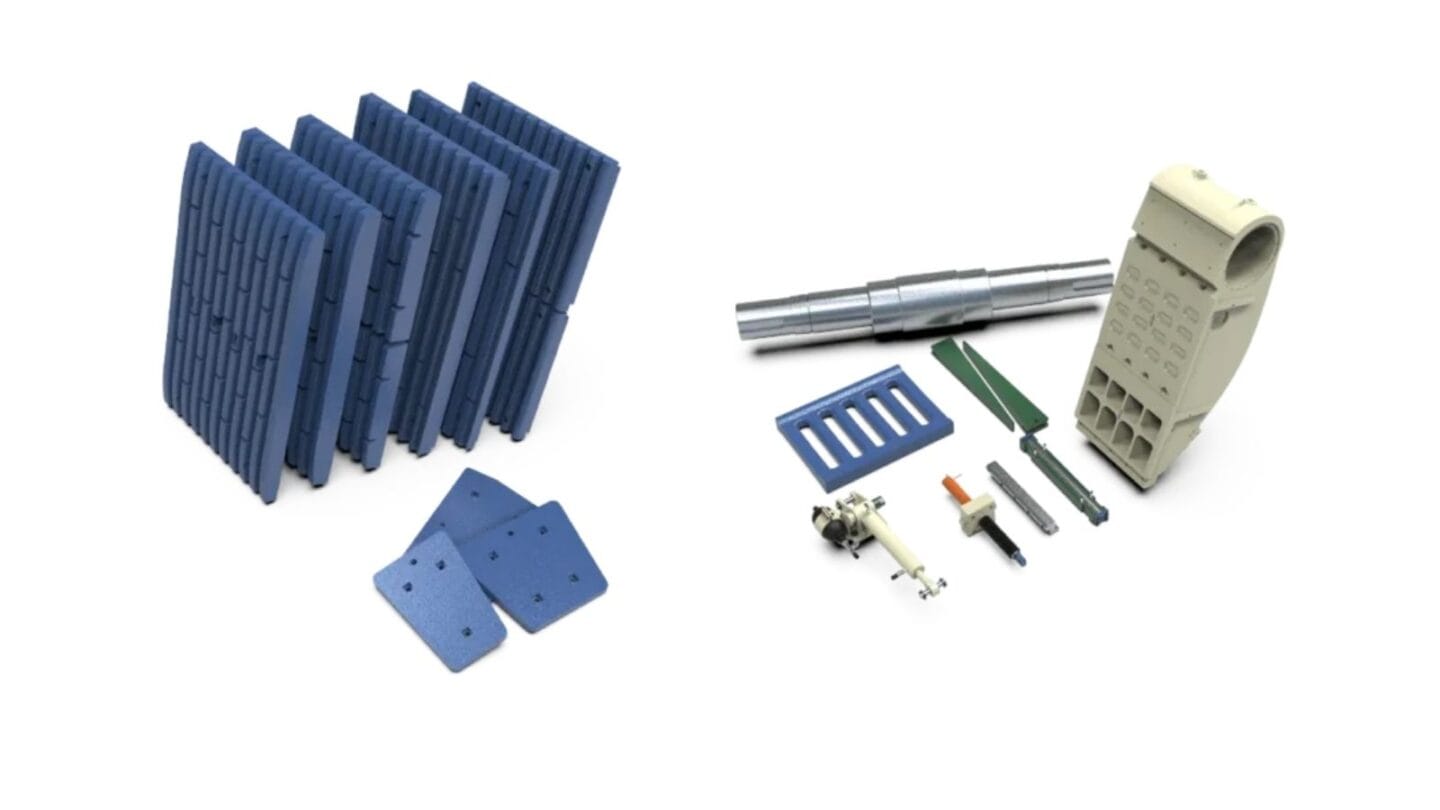
The core mechanism of Jaw Crusher Parts is based on simple leverage. An eccentric shaft drives the swing jaw plate in a reciprocating motion—much like a human jaw chewing food.
Operational State: Intermittent crushing. When the swing jaw moves toward the fixed jaw, the rock is “crunched.” When it moves away, the crushed material falls through the discharge opening via gravity.
Key Components: Primarily the two Jaw Plates (Fixed and Swing). They stand face-to-face like rows of teeth, absorbing direct, linear impact and high-pressure compression.
Mechanical Profile: Simple, robust, and designed to handle massive primary boulders.
2. Cone Crusher: The “360-Degree Gyratory” Motion
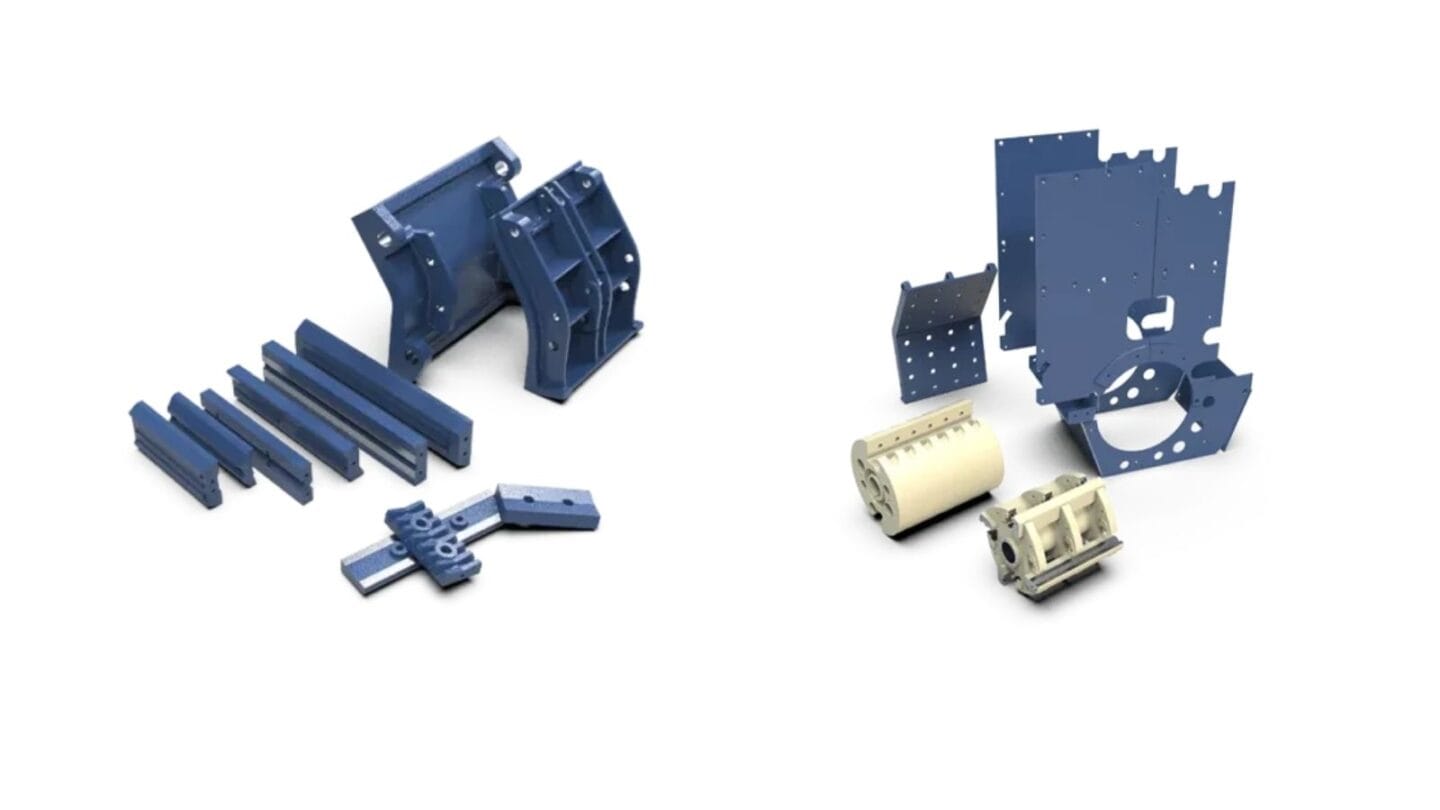
By contrast, Cone Crusher Parts operate with far more mechanical complexity. It utilizes an eccentric bushing to drive the mantle in a gyratory motion within the bowl liner.
Operational State: Continuous crushing. Because the crushing cone swivels around a center line, one side of the chamber is always compressing while the opposite side is discharging. This means the machine is “working” every single second it’s running.
Key Components: The core Crusher Mechanical Parts here are the Mantle and the Concave (also known as the Bowl Liner). These two parts fit together like nested umbrellas.
Mechanical Profile: Beyond simple compression, the cone crusher introduces a “rubbing” or “attrition” action, making it incredibly efficient for secondary and tertiary fine crushing.
Comparison of Mechanical Logic
| Feature | Jaw Crusher | Cone Crusher |
|---|---|---|
| Motion Logic | Reciprocating (Linear) | Gyratory (Rotational) |
| Action Type | “Clamping” or Biting | “Grinding” and Squeezing |
| Core Wear Parts | Jaw Plates | Mantle & Concave |
| Crushing Style | Periodic Impact | Continuous Pressure + Attrition |
Why This Dictates Wear Patterns
Because the structures differ, the stress points are worlds apart. A Jaw Plate is like a shield being hit by a sledgehammer—it needs to withstand impact. A Cone Liner is like a grindstone—it needs to withstand constant abrasion and friction.
If you apply the material logic of a Jaw Crusher to a Cone Crusher, you’ll quickly find that a material built for impact might wear down at an alarming rate when subjected to the continuous “rubbing” of a cone. This brings us to our next critical point: the fundamental difference in wear logic.
Wear Mechanism Comparison: Mantle vs. Jaw Plate
If you want to master maintenance, you have to stop looking at how much metal is left and start looking at where the metal has gone. The way Crusher Liners lose mass tells the story of your machine’s efficiency.
The wear pattern, more than the total thickness, is what ultimately determines the lifespan of your parts.
1. Jaw Plate Parts: The “Sweet Spot” Problem
In a jaw crusher, wear is almost never uniform. Because the material is crushed as it moves down the V-shaped chamber, the pressure increases toward the discharge opening.
Concentrated Wear: Most operators see the fastest wear in the bottom third of the plates. However, feeding issues can cause bizarre results.
The Experience: “I’ve seen Jaw Plate Parts where the top half is worn nearly smooth while the bottom looks brand new. This usually happens when the feed is too large for the ‘nip angle,’ causing the rocks to bounce and grind at the top without ever being properly gripped.”
The Waste: If you don’t rotate (flip) your jaw plates in time, you end up throwing away 50% of the manganese you paid for just because one section reached the limit.
2. Cone Mantle vs. Jaw Plate Wear: The 360° Grind
Unlike the “clamping” of a jaw, the cone mantle vs. jaw plate wear comparison highlights a continuous, rotational struggle.
Ideally Uniform: Since the mantle rotates 360 degrees, the wear should be even across the entire circumference.
The “Ringing” Risk: If the crusher isn’t “choke-fed” (kept full), the material hits the same spot on the mantle over and over. This creates a deep groove—or “ring”—halfway down. Once that ring is deep enough, your throughput drops, and you have to replace the liner even if the rest of it is still thick.
Attrition Power: Because a cone crusher involves more “rubbing” (attrition), the liners are subjected to much higher temperatures and surface friction than jaw plates.
Wear Mechanism Breakdown
| Feature | Jaw Plate Wear | Cone Mantle Wear |
|---|---|---|
| Wear Distribution | Localized (Vertical) | Circumferential (Horizontal) |
| Primary Cause | High-pressure impact/crushing | Continuous friction + compression |
| Critical Failure | Thinning at the bottom or “cupping” | “Ringing” or uneven grooves |
| Optimization Goal | Proper “Flip” timing | Maintaining a “Choke Feed” |
Why “Wear Pattern” is Everything
If you treat Crusher Liners as a “set and forget” component, you are leaving money on the table. A jaw plate that wears out only at the bottom is a sign that your CSS (Closed Side Setting) or your feed size needs adjustment. A mantle that wears out in a “wavy” pattern suggests your feed is hitting one side of the hopper harder than the other.
Pro Tip: Don’t wait for the part to break. If your product shape starts getting “slabby” or “flaky,” your wear pattern has likely already shifted, even if the liners still look thick.
Performance Under Different Working Conditions: Finding the Right Fit
The reality is, no single piece of equipment is a “one-size-fits-all” solution. Your Crusher Wear Parts will behave like heroes or villains depending entirely on the “diet” you feed them. Whether you are crushing limestone or basalt, the environment dictates the survival of your Crusher Components.
1. Large Boulders and Primary Stress: Jaw Crusher’s Home Turf
When you are dealing with massive, oversized material straight from the blast site, the Jaw Crusher is the undisputed king.
Impact Resilience: Jaw plates are designed to take the “punch” of a half-ton rock. The mechanical design allows the machine to stall or the toggle plate to break before the main frame does.
The Limitation: While great for size, if the rock is extremely hard and abrasive (like high-silica granite), a jaw crusher will “consume” its liners at an expensive rate if used for fine crushing.
2. Hard, Abrasive Rock: Where the Cone Crusher Shines
Once the material is reduced to a manageable size, the Cone Crusher takes over, especially when the rock is tough.
Hard Rock Advantage: Because of the gyratory motion, the Cone Crusher is much more efficient at handling hard rock. It uses “inter-particle crushing” (rock crushing rock), which actually protects the Crusher Wear Parts to some extent.
Precision: If you need a specific cubical shape in hard-rock applications, the cone is your best bet.
Material Selection: The Silent Game Changer
However, in high-abrasion environments, material selection is often more critical than the equipment itself. You can have the best Cone Crusher in the world, but if you’re using standard manganese on high-silica ore, you’ll be changing liners every week.
| Condition | Best Machine | Critical Wear Part Factor |
|---|---|---|
| Large, Blocky Feed | Jaw Crusher | High Toughness (Mn13 or Mn18) |
| Hard, Abrasive Rock | Cone Crusher | High Hardness (Mn18Cr2 or Mn22) |
| Sticky/Wet Material | Jaw Crusher | Tooth Profile (to prevent clogging) |
| Fine Aggregate Goals | Cone Crusher | Liner Profile & Cavity Design |
The “Metallurgy” Pivot
Even within the same machine, changing the alloy of your Crusher Components can double your uptime.
Standard Manganese (Mn13): Great for low-abrasion, high-impact.
High Manganese with Chrome (Mn18Cr2): The industry standard for a reason—it balances toughness with enough hardness to resist “scuffing.”
Premium Alloys (Mn22): For the absolute nastiest, hardest rocks that eat steel for breakfast.
Bottom Line: Don’t blame the machine for high wear costs until you’ve audited the metallurgy of the parts you’re putting inside it.
Replacement Intervals: Why the Massive Gap?
When it comes to crusher spare parts replacement intervals, there is no “golden rule.” In fact, the discrepancy between how long a mantle lasts versus a jaw plate can be staggering, often leaving procurement teams scratching their heads.
The reality is: I’ve seen some customers run a set of jaw plates for two months, while others are calling for replacements in just two weeks.
1. Cone Liners: The Predictable Workhorse
Generally speaking, Crusher Spare Parts for cone crushers offer a more stable and predictable lifespan. Because the cone is typically used in the secondary or tertiary stages, the feed material has already been “pre-conditioned.”
Stable Wear: Since the feed size is controlled and the machine is (ideally) choke-fed, you can often predict down to the week when a mantle will need changing based on tonnage.
Gradual Degradation: You’ll notice the closed-side setting (CSS) slowly creeping open, giving you ample warning before the part is “done.”
2. Jaw Plates: The “Wild Card”
In contrast, Crusher Replacement Parts for jaw crushers are subject to extreme volatility. This is where the two-week vs. two-month scenario happens.
Feed Size Volatility: If your primary blast produces “oversized” rocks, the jaw plates spend more time slipping and rubbing against the stone rather than gripping it. This “slippage” generates heat and localized wear that can eat through manganese in days.
The “Nip Angle” Factor: If the material is too rounded or too hard for the current jaw profile, it bounces in the chamber. This creates a “hammering” effect that accelerates wear far beyond normal compression.
Why the Intervals Vary So Much
The lifespan of your Crusher Spare Parts isn’t just about the steel; it’s about the Operational Variables:
| Variable | Impact on Jaw Plates | Impact on Cone Liners |
|---|---|---|
| Feed Size | High Impact: Large rocks cause slippage. | Low Impact: Usually pre-screened. |
| Fines Content | Moderate: Fines can “cushion” the blow. | High Impact: Excessive fines cause “packing.” |
| Moisture/Clay | High: Causes “pancaking” on plates. | Moderate: Can clog the discharge. |
| Operator Skill | Critical: Managing the feed rate is key. | Critical: Must maintain “Choke Feeding.” |
The Power of Predictive Replacement
Because the differences are so vast, you cannot rely on a calendar. You must rely on data.
Measurement is King: Regularly measure the thickness of your Crusher Replacement Parts and track the tonnage processed.
Visual Cues: For Jaws, watch for the “teeth” disappearing. For Cones, watch for the adjustment ring movement limits.
The Cost of Waiting: Running a liner until it breaks or “bows” doesn’t just cost you a part; it risks damaging the Crusher Spare Parts that aren’t meant to be replaced, like the head or the bowl seat.
Summary: A cone liner is a marathon runner—it’s about pace and consistency. A jaw plate is a heavy-weight boxer—it’s about how many big hits it takes before it goes down.
Key Factors Affecting the Lifespan of Wear Parts
When we talk about mechanical parts durability, most people immediately jump to the quality of the steel. While metallurgy is huge, it isn’t the whole story.
To be honest, I’ve seen many wear parts that weren’t “worn out”—they were “used out” due to poor operational habits or installation errors.
If you want to maximize the life of your Crusher Maintenance Parts, you need to look at these three pillars of durability.
1. Material Selection (The DNA)
Not all manganese is created equal. The alloy must match the rock’s “crushability” and abrasiveness.
The Mismatch: Putting a high-chrome, high-hardness liner into a primary jaw crusher dealing with massive tramp iron is a recipe for disaster. It will crack before it wears.
The Sweet Spot: Use Mn13 for high-impact/low-abrasion, and move up to Mn18 or Mn22 as the silica content (and the rubbing action) increases.
2. Operational Conditions (The Environment)
This is where most “premature deaths” of Crusher Maintenance Parts happen.
Choke Feeding: In a cone crusher, if the cavity isn’t full, the rock hits the mantle with uneven force, causing “ringing” and destroying mechanical parts durability.
Fines in the Feed: If you don’t screen out the “dirt” or undersized material before it hits the crusher, it creates a “packing” effect. This puts immense hydraulic pressure on the liners, often causing them to bow or even crack the mainframe.
3. Installation & Maintenance (The Foundation)
You can buy the most expensive liner in the world, but if it isn’t seated correctly, it’s garbage.
Backing Compound: In cone crushers, failing to use high-quality backing material creates “voids.” These voids lead to localized flexing, which eventually cracks the liner.
Bolting & Wedging: For jaw plates, if the wedges are loose, the plate will “clatter” against the pitman. This vibration leads to work-hardening in the wrong places and can snap the mounting bolts.
Practical Judgment Logic: Is it a “Wear” or “Usage” Issue?
Use this quick checklist to diagnose why your Crusher Maintenance Parts are failing early:
| Observation | Likely Cause | Diagnosis |
|---|---|---|
| Deep grooves or “rings” | Uneven feeding or empty cavity | Usage Problem |
| Cracks or large chunks missing | Tramp iron or wrong alloy (too brittle) | Material/Operational |
| Pancaking (metal flowing over edges) | Extreme pressure/Over-crushing | Operational Problem |
| Shiny spots on the back of the liner | Loose installation/No backing | Maintenance Problem |
The “Durability” Mindset
Improving mechanical parts durability isn’t just about finding a cheaper supplier; it’s about auditing your entire process. A liner that is replaced every 400 hours because of “wear” is an expense; a liner replaced at 200 hours because it cracked is a failure of maintenance.
Pro Tip: Always check your “Tramp Release” system. If your cylinders are constantly firing, your liners are taking 10x the stress they were designed for.
H2 Material Selection: Manganese Steel, High Chrome, and Composites
When it comes to Crusher Castings, the market is flooded with technical data sheets and “miracle” alloys. But let’s get one thing straight: Don’t get blinded by material specs—actual field performance is the only metric that matters.
Selecting the right Crusher Consumables is a balancing act between hardness (to resist wear) and toughness (to resist breaking). Then again, the most expensive material isn’t always the most suitable.
1. Manganese Steel (The Standard)
Manganese (Mn13, Mn18, Mn22) is the “king” of Crusher Castings because of its unique ability to work-harden.
How it works: Under heavy impact, the surface of the manganese becomes extremely hard, while the interior remains tough and flexible.
Best for: Jaw crusher plates and primary cone liners where large rocks provide the impact needed to “activate” the hardening process.
The Trap: If you use high-manganese steel on soft, non-impact material, it will never work-harden, and it will wear away like butter.
2. High Chrome Iron (The Specialist)
High chrome is significantly harder than manganese but lacks the “give” or toughness.
How it works: It provides a very high resistance to sliding abrasion. It doesn’t need impact to be hard; it’s hard right out of the mold.
Best for: Highly abrasive but smaller material. It is more common in blow bars for impactors, but specialized high-chrome inserts are sometimes used in specific Crusher Consumables.
The Risk: It is brittle. If a piece of tramp iron (like a loader bucket tooth) enters the chamber, high chrome parts are likely to shatter rather than dent.
3. Composite Materials (The Hybrid)
Modern Crusher Castings now feature “MMC” (Metal Matrix Composites), which typically involve ceramic inserts embedded in manganese or alloy steel.
How it works: You get the toughness of the steel “skeleton” with the extreme wear resistance of ceramic “veins.”
Best for: Applications where you have a “Goldilocks” problem—manganese wears too fast, but chrome is too brittle.
The ROI: These parts have a much higher upfront cost, but if they double your uptime, the labor savings on fewer change-outs make them a steal.
Comparison of Material Logic
| Material Type | Impact Resistance | Abrasion Resistance | Typical Application |
|---|---|---|---|
| Manganese (Mn) | Excellent | Moderate | Primary Jaws, Large Cones |
| High Chrome | Poor | Excellent | Abrasive Fines, VSI Parts |
| Composite (Ceramic) | Moderate/High | Superior | High-Silica Secondary Cones |
Finding Your “Perfect” Alloy
Choosing the right Crusher Consumables is about matching the metallurgy to the “VSI” (Velocity, Size, and Impact) of your specific rock.
The Budget Strategy: If your stone is limestone (soft), Mn13 is perfectly fine.
The Performance Strategy: If you’re crushing basalt or quartzite, you almost certainly need Mn18Cr2 or a composite to avoid changing liners every few days.
Pro Tip: Always ask for a “scrap analysis.” Looking at the worn-out part will tell you if the material was too soft (deep gouges) or too brittle (micro-cracks).
H2 Cost vs. Downtime: The Hidden Price Tag of Wear Parts
When a procurement manager looks at a quote for Crusher Service Parts, the eye naturally drifts to the bottom line—the price per piece. However, in the crushing industry, cheap wear parts are often the most expensive mistake you can make.
To truly understand your “cost-per-ton,” you have to look beyond the invoice and account for the “hidden” expenses that occur every time a machine stops.
1. The Real Math: Parts vs. Production
The cost of Crusher Repair Parts is only one sliver of the total operational expense. The real “budget killer” is the lost opportunity cost during maintenance.
Direct Cost: The price of the mantle, concave, or jaw plate + the shipping.
Hidden Cost: The labor for the maintenance crew, the rental of cranes for heavy lifting, and—most importantly—the zero-revenue hours while the crusher is silent.
The Example: If a high-quality liner costs 20% more but lasts 30% longer, you aren’t just saving 10% on steel; you are eliminating an entire day of downtime every few months. In a high-volume plant, that one extra day of production can pay for the entire set of liners ten times over.
2. The Domino Effect of Poor Quality
Using “budget” Crusher Service Parts doesn’t just mean more frequent changes; it increases the risk of mechanical failure in the rest of the machine.
Sub-standard Fit: If a jaw plate isn’t machined to precise tolerances, it won’t sit flush against the pitman. This creates vibrations that can shake loose bolts and eventually crack the expensive frame of the crusher.
Unpredictable Failure: Premium Crusher Repair Parts wear down predictably. Cheap castings often have internal “blowholes” or impurities that cause them to snap unexpectedly, potentially turning a routine maintenance stop into an emergency rebuild.
Comparison: Cheap vs. Premium Investment
| Factor | Economy Wear Parts | Premium Service Parts |
|---|---|---|
| Upfront Cost | Low | Moderate/High |
| Change-out Frequency | High (Every 2-3 weeks) | Low (Every 5-6 weeks) |
| Labor Costs | Doubled over time | Optimized |
| Machine Health | Risk of vibration/cracking | Smooth operation/Protects head |
| Total Cost Per Ton | High | Low |
Strategic Maintenance: “Don’t Save Pennies to Lose Dollars”
The goal of professional maintenance is to align your Crusher Repair Parts schedule with your planned site shutdowns.
Synchronized Changes: If your jaw plates last 300 hours but your conveyor belts need service at 400 hours, you have a mismatch. Finding a higher-grade alloy that stretches that 300 hours to 400 allows you to fix everything at once.
Predictable Inventory: High-quality Crusher Service Parts allow you to keep less “safety stock” because you know exactly when they will fail.
Summary: Buying a wear part is like buying an insurance policy for your uptime. If you buy the cheapest policy available, don’t be surprised when it doesn’t cover the “claims” of a broken production schedule.
Spare Parts Management: How to Prevent Stockout Downtime
In the crushing business, the most expensive part is the one you don’t have. I’ve seen a single missing liner bring an entire production line to a halt for a day—the resulting loss in revenue far exceeded the cost of the spare part itself.
Effective management of Crusher Spare Parts is about moving from “reactive panic” to “proactive planning.” To keep your plant running 24/7, you need a strategy that balances capital tied up in inventory with the risk of catastrophic downtime.
1. The “Safety Stock” Formula
You shouldn’t just guess how many Crusher Accessories to keep in the warehouse. Your safety stock should be calculated based on your “Lead Time” and your “Burn Rate.”
Lead Time: How long does it take from the moment you call the supplier to the moment the part arrives at your gate? (Don’t forget customs and inland transport).
Burn Rate: How many tons of rock does it take to wear out a set of liners?
The Rule of Thumb: Always have at least one full set of “Critical Wear Parts” (Mantle, Concave, or Jaw Plates) on-site at all times, plus the Crusher Accessories required for the change-out, such as bolts, wedges, and backing compound.
2. Predictive Cycle Forecasting
Instead of waiting for a part to break, use your historical data to predict its “End of Life.”
Tonnage Tracking: If you know your Mantle lasts for 100,000 tons, set an automated “Reorder Trigger” at 70,000 tons.
Seasonal Adjustments: Remember that harder ore or wetter weather can accelerate wear. Your Crusher Spare Parts consumption in the winter might be 20% higher than in the summer.
3. Essential Inventory Checklist
Managing Crusher Accessories isn’t just about the big steel castings. Often, it’s the small items that cause the most delay.
| Category | Must-Have On-Site Items |
|---|---|
| Major Castings | Mantles, Bowl Liners, Fixed & Swing Jaw Plates |
| Fasteners | Wedge Bolts, Mantle Bolts, Lock Nuts |
| Sealing/Protection | Dust Seals, O-Rings, U-Seals |
| Installation Kit | Backing Compound, Zinc/Epoxy kits, Torch Ring |
4. Strategic Supplier Partnerships
You don’t have to carry the burden of inventory alone. A smart management strategy involves your supplier in the loop.
Consignment Stock: Some premium suppliers of Crusher Spare Parts will keep inventory at your site or in a nearby hub, only charging you once the part is actually installed.
Annual Contracts: By committing to a year’s worth of parts, you ensure the manufacturer reserves production capacity for you, shielding you from global supply chain spikes.
Summary: Treat your warehouse like an insurance policy. The goal of Crusher Accessories management is to ensure that a 24-hour maintenance window doesn’t turn into a 7-day waiting game for a shipping container.
How to Choose a Reliable Wear Parts Supplier
With so many foundries claiming to offer the “best” steel, picking a partner can feel like a gamble. To be honest, I care much more about whether a supplier has real-world application experience than whether they offer the lowest price. A cheap casting that fails prematurely is a liability, not a saving.
When evaluating a partner for your Crusher Wear Parts, you need to look for a manufacturer that treats your operation as a science, not just a commodity.
1. Material Competence & Long-Life Design
A reliable supplier doesn’t just sell “Manganese”; they sell a solution tailored to your rock’s mineralogy. Look for a partner that offers specialized alloys like Mn18Cr2 or high-titanium composites.
The Hallmark of Quality: Do they have their own foundry and internal R&D? You want a supplier that understands the metallurgy behind long-life designs, ensuring the part maintains its shape as it wears down, which preserves your crusher’s throughput.
2. Customization & Engineering Prowess
Every quarry is different. A “standard” liner might be fine for a generic setup, but a top-tier supplier can provide customized liner profiles.
Real-World Case Studies: Ask for examples where they modified a jaw plate tooth profile or a mantle’s thickness to solve a specific “ringing” or “slippage” problem. If they can’t show you data on how they’ve optimized wear for others, they are just a middleman.
3. Comprehensive Solutions for Cone and Jaw
Managing multiple vendors is a headache. The most efficient operations choose a supplier that provides a complete solution for both Cone and Jaw crushers. This ensures consistency in quality across your primary and secondary stages and simplifies your logistics.
The GUBT Edge: Expertise You Can Trust
If you are tired of inconsistent lifespans and unpredictable downtime, it’s time to look at a specialist. GUBT stands out in the global market because they don’t just manufacture parts—they engineer performance.
Proven Experience: With thousands of successful applications worldwide, they understand the friction between the rock and the steel better than anyone.
Full-Spectrum Support: From Mantles and Concaves to Jaw Plates and all the essential accessories, they provide a one-stop-shop for your crushing needs.
Long-Life Commitment: Their parts are built for the long haul, reducing your change-out frequency and lowering your total cost-per-ton.
Upgrade your performance today: Explore the full range of premium solutions at https://gubtcasting.com/ and see how the right Crusher Wear Parts can transform your uptime.
Summary: Why Structure and Cycle Strategy Trump Material Choice
At the end of the day, the math is simple, but the execution is where most people stumble. The reality is, understanding the mechanics of wear is far more critical than blindly picking the most expensive material on the market. You can put the highest-grade alloy into a machine, but if the crushing chamber geometry is wrong or your feeding habits are poor, you are essentially throwing money into the primary hopper.
The Holistic Logic of Wear Management
To truly optimize your plant, you have to follow the chain of cause and effect. It isn’t just about buying a part; it’s about managing a process:
Structure: Recognize that Jaw Plate Parts and Cone Crusher Liners operate on different physical planes—one is about high-impact “clamping,” while the other is about continuous “rotational grinding.”
Wear: That structural difference dictates the wear pattern. Jaws suffer from localized thinning at the discharge; Cones suffer from circumferential “ringing” and attrition.
Cycle: Understanding these patterns allows you to predict the replacement interval. Instead of reactive maintenance, you move to a scheduled strategy that aligns with your site’s uptime goals.
Cost: When the structure, wear, and cycle are aligned, the “Cost Per Ton” naturally drops. This is where the true profit of your operation is found.
Final Wear Parts Comparison
| Factor | Jaw Crusher Strategy | Cone Crusher Strategy |
|---|---|---|
| Focus | Managing Impact & “Flipping” Timing | Maintaining Choke Feed & Cavity Profile |
| Wear Signal | Teeth Flattening / Slabby Product | CSS Creep / Ringing Grooves |
| Key Goal | Preventing Cracks and Base Metal Wear | Maximizing Uniformity and Product Shape |
Don’t Guess—Consult the Experts
Choosing between standard manganese, high-chrome, or composite inserts shouldn’t be a shot in the dark. A successful Wear Parts Comparison requires looking at your specific tonnage, rock hardness, and historical downtime data.
If you’re ready to stop guessing and start optimizing your wear cycles, reach out to a team that understands the “why” behind the wear. Whether you need custom-engineered Cone Crusher Liners or heavy-duty Jaw Plate Parts, the right advice can save you thousands in avoided downtime.
Ready to lower your cost-per-ton? Contact our technical team today for a comprehensive audit of your crusher liners and a customized maintenance strategy designed for your specific site conditions.
Latest Insights

Long Life Crusher Liners:Material Selection, Wear Optimization & Cost Reduction Guide
Mining Crusher Parts for Hard Rock: High-Performance Wear Solutions & Cost Optimization Guide

Crusher Parts for Recycling:Applications:Concrete, Asphalt & Demolition Waste Selection Guide