
VSI Crusher Spares
Overview
The Vertical Shaft Impact (VSI) Crusher utilizes high-speed centrifugal force to accelerate material particles, enabling efficient crushing through either particle-on-particle impact (ROR mode) or impact against durable wear-resistant liners (ROS mode). This distinctive mechanism significantly enhances crushing efficiency and produces high-quality output. With its compact design and low energy consumption, the VSI crusher is especially well-suited for manufactured sand production and aggregate shaping. It delivers consistently graded, angular, and cubical-shaped particles, meeting the stringent specifications required for high-performance concrete, road construction, and modern aggregate applications. Additionally, it excels in handling abrasive materials, offering extended wear life and reduced operating costs.
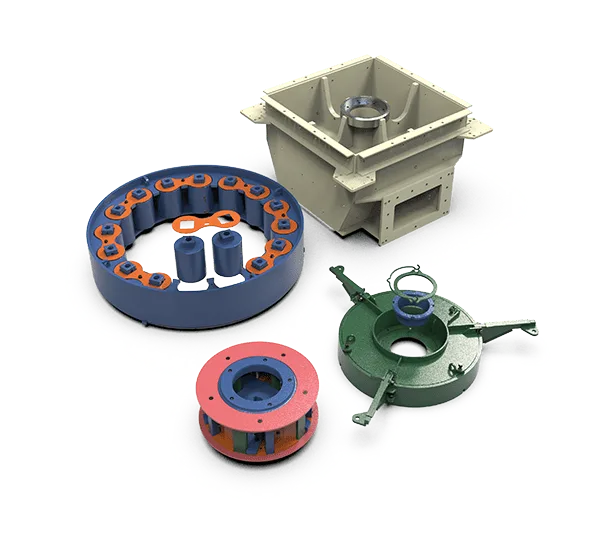
VSI Crusher Parts Categories
| Category | Products |
|---|---|
| Rotor & Wear Parts | Rotor tips, Upper and lower wear plates, Distributor plate, Trail plate, Feed eye ring, Rotor body, Back-up tips, Complete rotor assemblies (3–6 ports) |
| Chamber & Liner Parts | Chamber liners (cavity rings), Anvil rings (ROS), Rock boxes (ROR), Wear skirts, Chamber shields, Cascade port shields, Gusset wear castings |
| Shaft Assembly & Drive Parts | Shaft line assemblies / bearing cartridges, Bearings, Seals, Drive belts and pulleys, Taper locks |
| Feeding & Discharge Parts | Feed tubes, Feed control plates / gates, Spreader plates, Discharge chutes, Feed hoppers |
| Safety, Hydraulic & Control Parts | VSI Operation Control System (VOCS) transmitters & sensors, Safety interlock components (locks, keys, switches, solenoids), Hydraulic cylinders, pumps, hoses, seals, Automatic lubrication system components, Electric motors |
| Structural & Auxiliary Parts | Support frames / crusher bases, Roof assemblies, Inspection doors and hatches, Grease hoses, Water-spray system parts, Roof lifter parts |
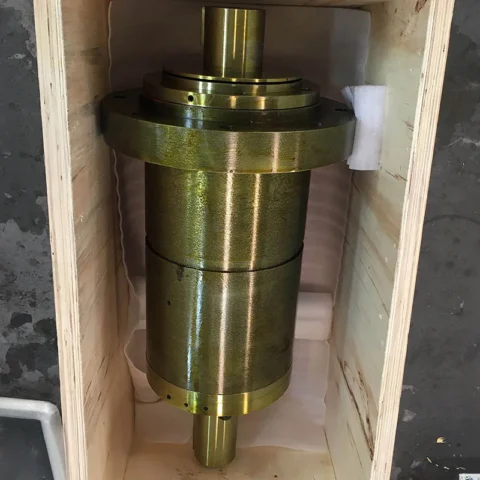
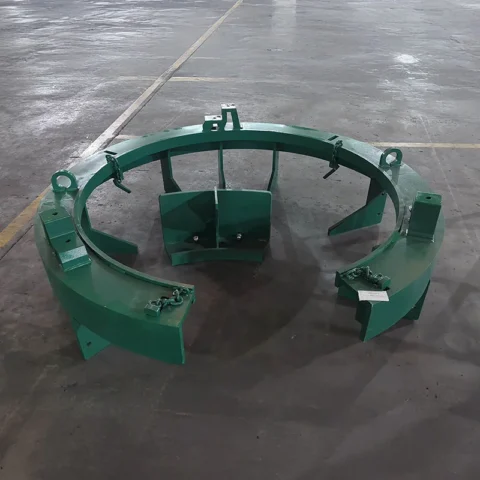
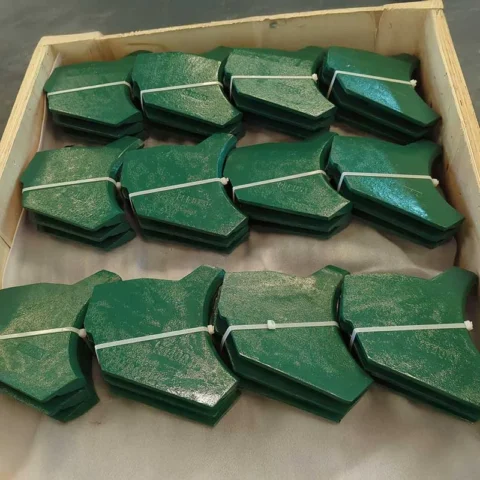
ROR & ROS
Rock-on-Rock (ROR)
- Principle: Particles accelerated by the rotor impact a self-formed rock layer (rock box), crushing each other through grinding and compression.
- Features: Minimal metal wear; ideal for high-abrasion feeds (>15% silica/Al₂O₃). Produces premium cubical aggregates with lower maintenance costs.
Rock-on-Anvil (ROS)
- Principle: High-speed particles strike fixed metal anvils, fracturing upon impact.
- Features: High reduction ratio (up to 16:1); suited for soft to medium-hard, low-abrasion materials (≤15%). Reversible anvils extend service life and optimize cost per ton.
Crusher Models Supported
| Brand | Models |
|---|---|
| Atairac | VSI700 |
| Bailike | 7000 |
| Barmac | B5100, B6100, B6150, B7100, B7150, B9100, B9600 |
| Canica | VSI1400, VSI2000 |
| Cemco | MR7, Multirok 9 |
| Chyi Meang | V810 |
| ISC | 103, 77, 90 |
| Kemco | 1000S |
| KPI-JCI | 2500, 4500 |
| Liming | VSI9532 |
| Magotteaux | 2400 |
| Metso | VI1665, VI200, VI2080, VI300, VI400 |
| Minyu | MIV800 |
| Nakayama | SR100C |
| Ore Sizer | OM100 |
| Pioneer | 4500 |
| Remco | 250, 300, 400, 500, 500S, 800 |
| Sandvik | CV100, CV105, CV115, CV117, CV129, CV200, CV215, CV217, CV218, CV228, CV229, 73EP, 73LP, 85HP |
| Shaorui | SV10D R500 |
| Trio | TV85, TV95 |
Technical Glossary
- Rotor: The central, high-speed component that projects material outward.
- Rock Box: A layer of material built up within the chamber in ROR configurations to serve as a wear surface.
- Anvil: A fixed, hardened metal surface used in ROS configurations for impact crushing.
- VOCS (VSI Operation Control System): A system of sensors and transmitters for online monitoring and control of crusher performance.
- Wear Plate / Liner: Replaceable components that protect the chamber and rotor from abrasion and impact.
Frequently Asked Questions
- What is a Vertical Shaft Impact (VSI) Crusher?
A VSI Crusher is equipment used to crush and/or screen rock, ore, recycled materials, or any other crushable substances. It is typically used in the final stages of a multi-stage crushing circuit. VSI crushers can handle a wide range of feed sizes and produce various product gradations, including high-quality sand.
- What are the typical hazards when operating a VSI Crusher?
Common hazards include: bite, nip, and pinch points; poor housekeeping; working at heights or in confined spaces; lifting heavy loads; crane risks; sharp edges; high-pressure hydraulics; electrical dangers; unintended start-up; toxic exposure; rotating parts; hot surfaces; conveyor entanglement; dust; noise; and unsafe work methods.
- How can safety be ensured during VSI Crusher operation and maintenance?
Ensure staff are trained using the manual, follow safety regulations, never disable guards or alarms, keep the area clean and well-lit, wear PPE, perform lockout/tagout, use proper rigging methods, and proactively manage known hazards.
- What types of safety devices are built into a VSI Crusher?
Devices include: E-Stop buttons/pull-cords, interlock systems on doors, alarm lights and sounds, and access walkways with handrails.
- What safety considerations are necessary during maintenance and repair?
Lockout/tagout all energy sources, confirm all parts have stopped, depressurize hydraulics, apply fire safety if welding, use permits for chamber access, and perform preventive maintenance regularly.
- What are the effects of dust and noise on operators?
Dust may cause chronic lung damage—use sprays and respirators. Noise levels often exceed 100 dB—hearing protection is mandatory above 85 dB.
- How can portable VSI Crushers be transported safely?
Chock wheels, check tires and brakes, follow axle load limits, use blocking materials, drive within speed limits, test all lights, and verify route clearance and bridge ratings.
- What is the relationship between product gradation and drive power?
Gradation depends on drive power and feed size. Higher power supports larger feed and more throughput (TPH). For example, 500 HP with 1” feed producing ½” product typically yields ~240–250 TPH.