
Screening & Feeder Parts
Overview
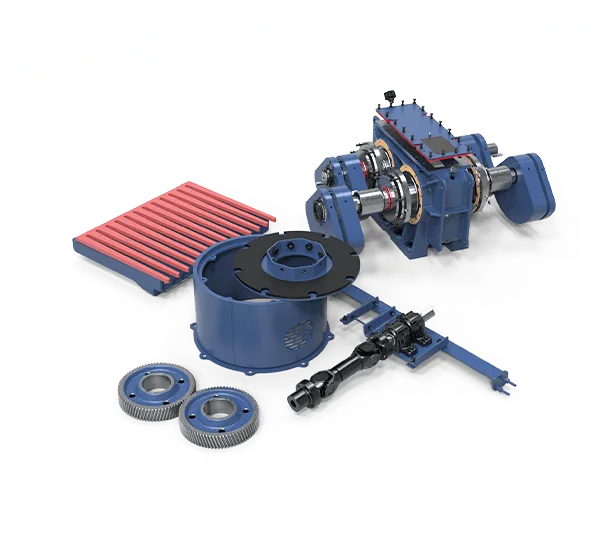
Feeder and screening assemblies consist of eight main categories of components that work together to ensure uniform material feeding, precise stratification, and efficient screening in industries such as mining, construction, and metallurgy. These components include the feeder body/frame, vibrator assembly, suspension assembly, drive system, feeder deck/grizzly sections, wear liners, fasteners and small parts, and various auxiliary devices. Proper selection, installation, and maintenance of each category are critical for reliable operation and long service life.
Materials
Key materials are chosen for their strength, wear resistance, and vibration performance:
| Component Category | Materials | Function |
|---|---|---|
| Feeder Body / Frame | Carbon steel, alloy steel | Structural support; bears material load and vibration |
| Vibrator Assembly | Hardened steel shafts, bearings, seals | Generates controlled linear/circular/elliptical vibration |
| Suspension Assembly | Steel coil springs, rubber springs | Isolates vibration; limits displacement |
| Drive System (Belt & Hydraulic) | Rubber V-belts, steel pulleys, hydraulic motors | Transmits power to the vibrator |
| Feeder Deck / Grizzly Sections | High-manganese or alloy steel bars; wear liners | Feeds and stratifies material; screens oversize |
| Wear Components / Liners | Rubber, polyurethane (PU), ceramic inserts, UHMWPE | Protects contact surfaces from abrasion and impact |
| Fasteners & Small Parts | High-grade bolts, nuts, washers, pins, seals | Connects, seals, and secures assemblies |
| Other Components | Sensors, guards, auto-grease units | Safety, monitoring, and lubrication support |
Feeding & Screening Mechanisms
- Vibratory Feeding
Vibrators—either electromagnetic or mechanical with eccentric shafts—produce linear, circular, or elliptical motions that propel material along the feeder pan at adjustable amplitude and frequency. - Gravity Feeding
Inclined or apron feeders rely on gravity across a sloped surface, allowing bulk or hot materials to advance uniformly without vibration. - Grizzly Scalping
Grizzly sections, made of parallel steel bars or punched plates, remove oversized rocks and debris at the feeder inlet to protect downstream equipment. - Stratification & Screening
Screening decks—inclined, horizontal, or multi-slope—use vibration and slope to layer particles by size; fines pass through apertures while coarse particles travel over the deck. - Flow Control
Feed rate and stratification can be adjusted via variable-frequency drives on vibrators, amplitude settings, or changes in deck inclination to meet processing requirements.
Technical Glossary
- Feeder Body / Frame: Welded steel structure supporting all feeder components.
- Vibrator Assembly: Unit generating vibration, composed of eccentric shafts, gearbox, bearings, and housing.
- Suspension Assembly: Springs or rubber elements isolating the vibrating frame from the support structure.
- Drive System: Power transmission via V-belt or hydraulic motor to the vibrator assembly.
- Feeder Deck / Grizzly: Panels or bar sections where material is fed and initially screened.
- Liner Assembly: Wear-resistant panels protecting high-impact and high-abrasion areas.
- Wear Plate: Removable panels made of rubber, PU, ceramic, or UHMWPE to shield equipment surfaces.
- Lubrication System: Components such as grease fittings and auto-grease units ensuring proper oil or grease delivery.
- Stroke: Peak-to-peak displacement of a vibrating component.
- Stratification: The layering effect in screening where finer particles migrate downward.
- Counterweight: Masses on vibrator shafts creating unbalanced centrifugal force.
- Parallel Key: Keyed connection transmitting torque between shafts and pulleys.
- Coupling: Device joining two shafts for power transmission.
- Hydraulic Drive Unit: Vibrator drive option using a hydraulic motor and manifold.
- Breather: Vent device on gear housings to prevent pressure build-up.
- Lockout & Tagout: Safety procedure to prevent accidental equipment startup during maintenance.
- Material Flow: Movement and path of material through feeding and screening equipment.