
Cone Crusher Liners
Overview
GUBT manganese cone crusher liners—including cone crusher mantles, bowl liners, and concaves—are engineered for outstanding wear resistance and long service life in demanding crushing applications. Produced from premium manganese‑steel alloys, they resist extreme abrasion while maximizing throughput and lowering operating costs. Our cone crusher liners fit leading global crusher brands, making GUBT a trusted supplier of high‑quality crusher wear parts for the mining and aggregates markets.
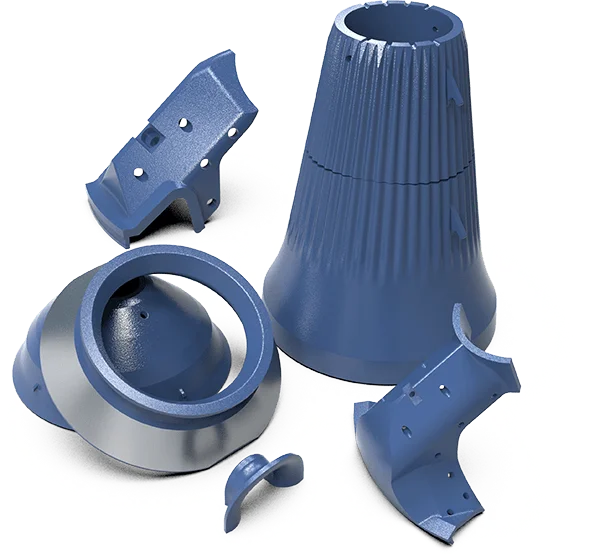
Manganese Steel Materials
Manganese Steel Materials for Cone Crusher Liners
GUBT utilizes several manganese steel alloys, carefully selected based on application requirements and material properties. These alloys are known for their excellent work-hardening capabilities, becoming harder and more durable under impact, which is ideal for crushing applications.
| Material | Nominal Composition | Key Performance Attributes | Applicable Working Conditions |
|---|---|---|---|
| Standard Manganese Steel | ~13% Manganese | Good toughness and work hardening. A general-purpose alloy. | Suitable for various applications, particularly where impact is high but abrasion is moderate. |
| High Manganese Steel | ~18% Manganese, ~2% Chrome | Improved wear resistance and longer life compared to standard manganese, especially in more abrasive conditions. Higher work hardening. | Recommended for secondary and fine crushing of medium to difficult abrasive materials. |
| Very High Manganese Steel | ~22% Manganese, High Chrome | Offers the highest wear life among common manganese alloys. Excellent for highly abrasive materials. | Ideal for demanding, highly abrasive applications, often used in smaller crushers or specific applications where allowed. |
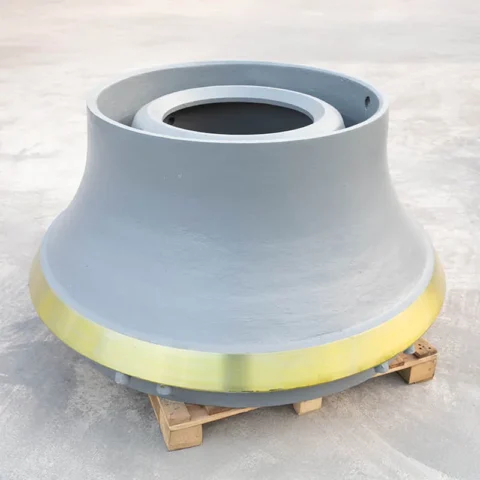
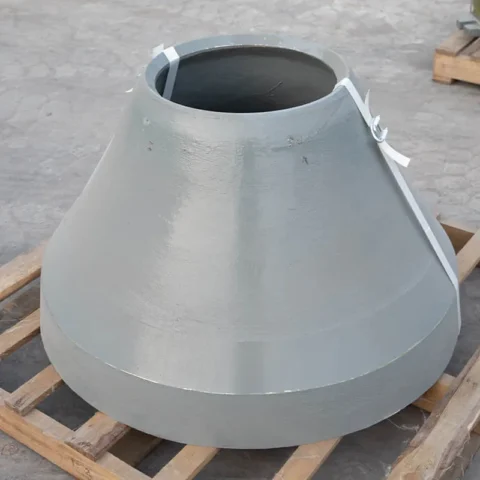
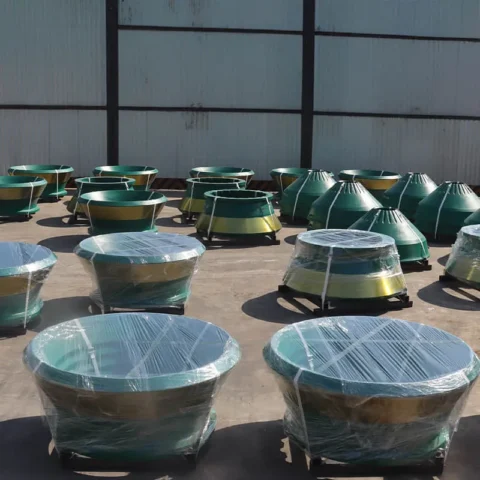
Core Compatibility & Chamber Types
GUBT produces manganese cone crusher liners compatible with a wide array of cone crusher models and chamber configurations from major manufacturers. Below is a general overview of typical models and chamber types we support. The specific chamber configuration (defined by the mantle and concave profile) influences the crushing action, product shape, and capacity, and should be selected based on the feed material, desired product size, and application.
| Brand | Typical Models | Common Chamber Types Supported |
|---|---|---|
| Symons Cone | 4ft, 4.25ft, 5.5ft, 7ft | Standard, Short Head, Coarse, Medium, Fine, Extra Coarse, Extra Fine |
| Metso HP | HP100, HP200, HP300, HP400, HP500, HP700, HP800 | Standard, Short Head, Extra Fine, Fine, Medium, Coarse, Extra Coarse, Super Coarse |
| Metso GP Fine | GP100, GP200, GP300, GP330, GP550, GP11F, GP220 | EF, F, MF, M, C, EC |
| GP Secondary | GP100S, GP200S, GP300S, GP500S | M, C, EC |
| Sandvik CH | CH420, CH430, CH440, CH540, CH550, CH660, CH860i, CH865i, CH870i, CH890i, CH895i | Standard, EC, CX, C, MC, M, MF, F, EFX, EF, EEF, Premium, FF (Flexifeed), HC (Heavy Choke), HR (High Reduction), OB (Oversize Breaker) |
| Sandvik CS | CS420, CS430, CS440, CS550, CS660 | EC, C, MC |
| Terex / Finlay | 1000, 1150, 1300, 1400, 1500 Maxtrak, C-1540, C-1545, C-1550, C-1554 | Medium Coarse, Coarse, Extra Coarse, Fine, Extra Fine, Auto Sand, Heavy Duty |
This table is representative; GUBT’s range of crusher wear parts covers many more specific models and chamber variations.
Additional Crusher Models Supported
This table is representative; GUBT’s range of crusher wear parts covers many more specific models and chamber variations.
| Brand | Representative Models |
|---|---|
| Allis‑Chalmers | 600 Hydrocone, 4‑60 HYD, AC36, AC42, AC55, AC4248, AC500, AC1366, AC3655 |
| Chyi Meang (CMC) | 2S, 3S, 4S, GP5 |
| Dragon / Cedarapids RC | RC36, RC45, RC54, RC54‑FH, RC54‑FH‑CLASSIC, RC66 |
| Euro Cone (CFBK) | CFBK36, 940, 1100, 1150, 1360, 2120 |
| Faco | TS90, TS120 |
| FLSmidth | RXL‑200, RXL‑300, RXL‑300+, RXL‑400 |
| Jaques | 35, G50 |
| Kleemann | MCO9 EVO / S EVO, MCO11 EVO / PRO, MCO13 |
| KPI‑JCI Kodiak | K200, K300, K350, K400, K500 |
| Kue‑Ken | 18, 28 |
| Liming | CSB160, HPC220, HPT300, HPT500 |
| Lokomo | G258 |
| Metso GP / MP / MX / WF | GP100 – GP550 series, GP7, MP800 – MP1250, MX3, MX4, WF100 – WF800, G1815 – G610, LT300 |
| Minyu MCC / MSP | MCC/MCS/MCF/MCSS 600 – 1680HN, MSP100 – MSP400 (F / M / C) |
| NMS | CC400 |
| Nordberg G‑Series | G1810, 2610, 3210, 3812, 3815, 5015, 610 |
| Omnicone | 937, 1144, 1352, 1560 |
| Rexnord | GYR22, 36, 42, 42‑70, 48, 54, 66, 84 |
| Kharkov | KKD900 – KKD1500, KSD/KMD 1200 – 2200 |
| Sandvik CS / CJ / H‑Series | CS420 –CS660; CH420 – CH895; H60, H7800 |
| Shanghai PYB / PYFB / PYGD etc. | PYB900 – PYB2200, PYFB900 – PYFB1600, PYGB/PYGD/PYDF/PYGF series |
| Shanmei SMH | SMH120C, SMH250C |
| Shaorui / NHI | 185, SC185Z, SC220, SRC220, SG160 |
| Shibang | CS75B |
| Svedala Hydrocone / Superior | 36M84, H36 – H8800, S2000 – S6800 |
| Symons (Standard & Short Head) | 2 ft – 7 ft, 4800 SH HD, 5100 |
| Telsmith | 24VFC, 36 – 68 series, 44/48/52/57/66 S/FC/H/SBS, 6614, T300, T400, 1100, 1110 |
| Terex Cedarapids / Maxtrak / MVP | MVP280 – MVP550, Maxtrak1000 – 1500, C1540 – C1554 |
| ThyssenKrupp Kubria | FM 90, 1140G, G110, G150 |
| Trio | TC36 – TC84X, TP350 – TP600 |
Technical Glossary Of Cone Crusher Liners
- CSS (Closed Side Setting) – Minimum gap between mantle and concave, controlling final product size and reduction ratio.
- OSS (Open Side Setting) – Maximum gap on the open side, defining the largest feed opening.
- Max. Feed Size – Largest feed a chamber can accept without bridging or excessive wear.
- Eccentric Throw – Main‑shaft movement amplitude; affects capacity, CSS/OSS range, and product shape.
- Nip Angle – Angle between crushing surfaces; normally ≤ 23 ° to ensure smooth material flow.
- Filler Ring – Spacer between concave and top shell to adapt cone crusher liners size or reduce backing volume.
- Torch Ring – Sacrificial sleeve below the locking nut; cut away for mantle removal.
- Head Wear Ring – Protective ring on the head below the mantle, prolonging head life.
- Wedge Bolt & Adapter Ring – Hardware securing the bowl liner; may change when chamber profile changes.
- Manganese Steel – An alloy that work-hardens under impact to provide superior wear resistance.
Frequently Asked Questions
- What are the primary wear parts in a cone crusher?
The primary wear parts in a cone crusher are the mantle and the bowl liner, also referred to as the concave.
- What types of manganese steel alloys are commonly offered for cone crusher wear parts?
Common manganese steel alloys offered include 14% Manganese, 18% Manganese, and 22% Manganese.
- How do the different manganese steel alloys perform, and where are they typically applied?
14% Manganese: Ordered on demand; used in soft, low-abrasion applications.
18% Manganese: Standard fit for most crushers; suitable for general applications with good toughness and work hardening.
22% Manganese: Optional upgrade for abrasive applications; offers superior wear resistance. - What does CSS (Closed Side Setting) and OSS (Open Side Setting) mean?
CSS (Closed Side Setting): The minimum distance between the concave and the mantle; defines the smallest gap in the crushing chamber.
OSS (Open Side Setting): The maximum distance at the top of the chamber; determines the maximum feed opening. - How is the Maximum Feed Size determined for a crushing chamber?
Maximum Feed Size is based on the feed opening and material size distribution (F90, F100, F80). Refer to cavity tables or divide the top feed size by 0.8 to determine the required open-side feed opening.
- What is Eccentric Throw?
Eccentric Throw is a setting that controls the main shaft movement. It affects CSS, OSS, capacity, and product shape, and is listed in chamber specification tables.
- What is the purpose of a Filler Ring?
A filler ring is used between the bowl liner and top shell.
- What are Wedge Bolts and Adapter Rings used for?
Wedge bolts secure the bowl liner, supported by adapter rings. Configuration changes may require swapping both.
- What is a Torch Ring and how is it used?
The torch ring sits between the main shaft sleeve and nut. It is burned off with a torch to relieve pressure and allow mantle removal in certain designs.
- Why is it important to choose the correct cone crusher liner configuration?
Incorrect cone crusher liner selection causes poor efficiency, fast wear, and potential damage. Specialized designs like Flexifeed (FF) provide extended wear life in the right applications.
- What information should be included when taking wear profiles or inquiring about wear parts?
- Feed gradation
- Feed material type (e.g., granite)
- Product gradation
- Crusher circuit diagram with screen sizes and settings
- Current mantle and bowl liner part numbers
- Crusher power draw
- Crusher capacity