As a Senior Materials Engineer with over 20 years of hands-on experience in high-performance wear solutions, I’ve spent my career in the trenches of the world’s most demanding hard rock mining operations. From optimizing TCO (Total Cost of Ownership) for Tier-1 gold mines to custom-engineering manganese steel liners for high-impact iron ore circuits, my goal is to bridge the gap between metallurgy and mining profitability. In this guide, I share the technical insights and field-tested strategies required to master crusher part performance in 2026.
Why Hard Rock Mines Demand Tougher Crusher Parts
Honestly, if you’ve ever worked a hard rock mine, you know this isn’t ordinary wear — it’s a brutal combination of “pounding and grinding” that most people outside the industry simply don’t understand.
Hard rock mining crusher parts face three non-negotiable challenges every single shift:
- High impact from massive boulders slamming into the chamber
- Extreme abrasion from high quartz and silica content
- 24/7 continuous operation with zero tolerance for unplanned stops
Yet here’s the good news: choose the right heavy duty crusher parts and high impact crusher parts, and you can easily double — sometimes even triple — the service life of your liners.
In this guide we break everything down by equipment type and ore body so you can stop guessing and start optimizing. From primary jaw plates to SAG mill feed preparation, we cover exactly what works in real mines.
Hard Rock Ore Types: How Copper, Gold, and Iron Mines Create Different Wear Patterns
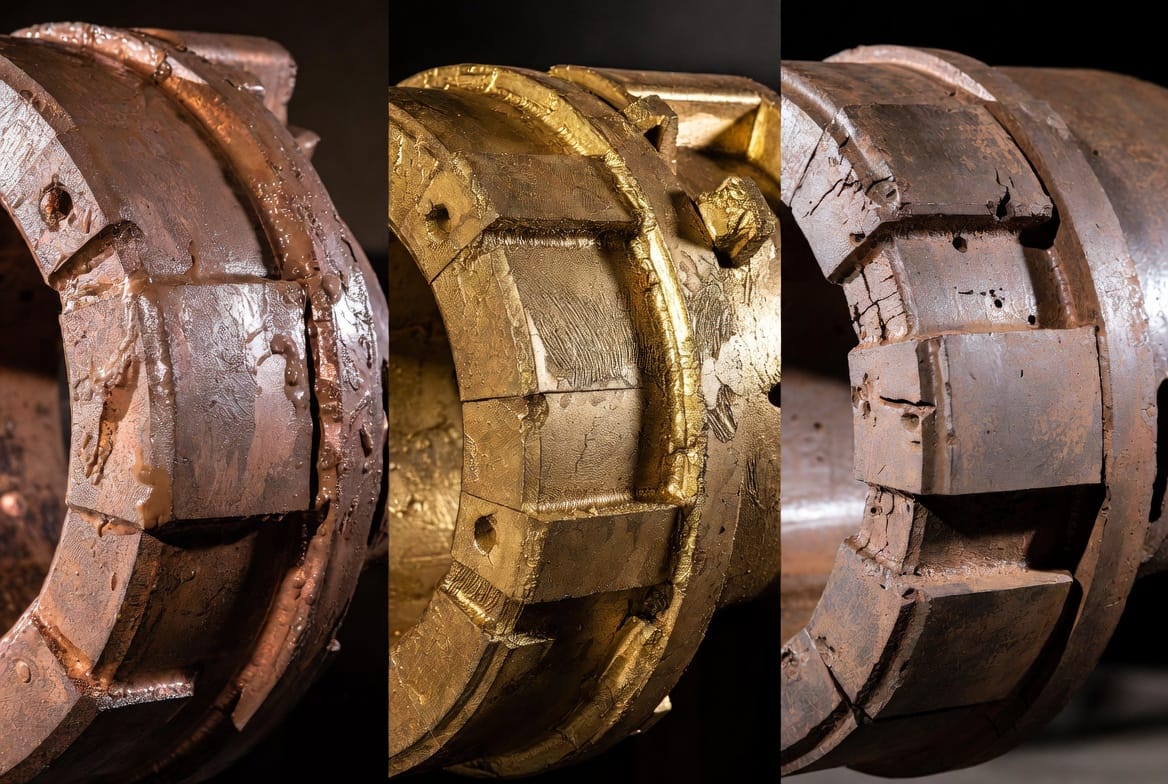
Not all hard rock is created equal. The mineralogy of your ore dictates the dominant wear mechanism — and therefore which mining crusher liner material selection guide you should follow.
- Copper ore: Medium-to-high hardness with sticky, adhesive characteristics. You get a mix of impact and abrasion, plus material buildup that accelerates fatigue.
- Gold ore: Extremely high quartz/silica content. This is pure abrasive hell — the rock literally sands your liners away.
- Iron ore: High density and massive impact forces. Think “sledgehammer” rather than “sandpaper.”
In plain English: gold mines grind you to death, iron mines smash you to pieces. Copper sits in the middle and demands balance.
That’s why infrastructure crusher parts and liner chemistry must be matched to the ore — not just copied from the last mine down the road. The right choice here sets up every downstream decision.
Primary Crushing: Key Parts for Jaw and Gyratory Crushers
Primary crushers take the biggest hits. Whether you run a jaw crusher or gyratory crusher, the wear parts here are your first line of defense.
Jaw Crusher
- Jaw plates take direct impact from 1.5 m+ boulders.
- I’ve literally seen the wrong jaw plate material last less than a week before it’s completely destroyed.
Gyratory Crusher
- Mantle and concave must absorb both crushing force and abrasive flow.
For copper ore operations we recommend primary crusher jaw plate for copper ore engineered with higher manganese content and work-hardening properties. Impact resistance is king at this stage — wear resistance comes second.
Pre-SAG Crushing: Critical Feed Preparation for SAG Mills
SAG mill feed preparation crusher parts might not sound glamorous, but get this stage wrong and your entire grinding circuit efficiency drops like a stone.
The goal isn’t maximum wear life — it’s consistent particle size and steady feed rate. Unstable liners here cause power spikes, mill charge instability, and lost throughput.
Stability beats extreme abrasion resistance every time in this application.
Gold Mines and High-Silica Ores: Wear Challenges for Jaw Plates and Liners
Let’s be straight: gold mine jaw crusher wear parts live in the toughest abrasive environment on the planet.
When quartz content exceeds 70-80 %, you’re basically running sandpaper through your crusher 24 hours a day. Standard manganese steel simply melts away.
Proven solutions:
- Mn22 high-manganese grades (work-hardens under impact)
- MMC (metal matrix composite) liners for extreme abrasion
But here’s the catch: if occasional large boulders still sneak through, pure “hard” materials can crack. You need the right balance — not just the hardest plate on the market.
Iron Ore Crushing: Cone Crusher Liner Specs and Life Management
Iron ore is dense, heavy, and unforgiving on impact. Your cone crusher liners take punishment like no other application.
Key factors for iron ore cone crusher liner specification:
- Thicker profiles in high-impact zones
- Optimized manganese alloys that work-harden fast
- Precise cavity design for choke-fed operation
I’ve seen mines lose 15-20 % daily tonnage because liner change schedules were poorly managed. A good mining cone crusher liner change schedule isn’t guesswork — it’s data-driven prediction based on tonnage, power draw, and wear measurements.
Impact Crushers in Hard Rock: Choosing the Right Blow Bars
Impact crushers are increasingly used in hard rock circuits, but only when you pick the right hard rock mining impact crusher blow bar.
Material showdown:
- High chrome: excellent abrasion resistance but brittle under high impact — it can snap without warning.
- MMC composites: combine the best of both worlds.
Rule of thumb I always share: “Don’t just chase hardness numbers. In strong impact conditions, high chrome will break. In pure abrasion, it’s rock-solid.”
Material Selection Guide: Manganese Steel vs. High Chrome vs. MMC
Don’t let the fancy names intimidate you. The mining crusher liner material selection guide boils down to matching the alloy to the dominant wear mechanism.
| Material | Best For | Work Hardening | Abrasion Resistance | Impact Toughness | Typical Life Gain |
|---|---|---|---|---|---|
| Manganese Steel (Mn14/Mn18/Mn22) | High-impact primary crushing | Excellent | Good | Outstanding | Baseline |
| High Chrome | Pure abrasion zones | None | Excellent | Poor | +40-60 % in low-impact |
| MMC (Metal Matrix Composite) | Balanced hard rock | Good | Outstanding | Very Good | +80-150 % |
Simple decision framework:
- Dominant force = impact → go heavier manganese
- Dominant force = abrasion → high chrome or MMC
- Mixed hard rock → MMC is usually the winner
Cost Optimization for Mining Crusher Parts: Beyond the Purchase Price
Here’s the truth most purchasing departments don’t want to hear: the cheapest mining crusher parts are almost always the most expensive.
Real total cost of ownership (TCO) includes:
- Piece price
- Change-out frequency (downtime cost)
- Labor hours
- Lost production tonnage
When liners last twice as long, your mining crusher parts total cost reduction can exceed 35-45 % even if the upfront price is 20 % higher. That’s real money — not theory.
Spare Parts Inventory Management: Preventing Downtime Disasters
I’ve watched an entire crushing line sit idle for 48 hours because one critical liner was out of stock. Never again.
Smart mining crusher spare parts inventory management means:
- Calculating safety stock based on actual wear rates
- Using tonnage-based predictive scheduling
- Partnering with suppliers who hold dedicated stock for your mine
Prediction beats emergency procurement every single time.
How to Choose a Reliable Mining Crusher Parts Supplier
After 20+ years in the field, here’s what I actually look for in a supplier of Mining Crusher Parts and Heavy Duty Crusher Parts:
- Real, documented hard rock mine case studies (not just lab data)
- In-house material R&D and metallurgy team
- Ability to custom-engineer liners for your exact ore and circuit
- Transparent TCO calculations, not just price sheets
I don’t care how low the quote is if they’ve never survived a real iron ore or high-silica gold mine.
If you’re looking for proven hard rock mining solutions with long-life liners and genuine cost-reduction capability, check out the team at GUBT Casting → https://gubtcasting.com/
Conclusion: No One-Size-Fits-All – Only the Right Match for Your Mine
Copper mines need balance. Gold mines need extreme abrasion resistance. Iron mines need impact toughness.
There is no universal “best” mining crusher parts solution — only the right match for your ore body, your equipment, and your operating philosophy.
Stop accepting mediocre wear life. The difference between good and great crusher performance is measured in millions of dollars over the life of the mine.
Ready to cut your TCO and extend liner life? Visit https://gubtcasting.com/ and talk to engineers who actually understand hard rock.
Bonus: Ore Type vs Recommended Material vs Expected Wear Life
| Ore Type | Primary Wear | Recommended Material | Typical Life vs Standard Mn |
|---|---|---|---|
| Copper | Mixed | Mn22 or MMC | +60–100 % |
| Gold (high silica) | Abrasion | MMC or High Chrome | +100–180 % |
| Iron | High impact | Heavy Mn + reinforced MMC | +80–140 % |
Engineered for Excellence: The GUBT Edge
Choosing the right material is only half the battle; the casting precision and heat treatment are what define real-world performance. At GUBT, we specialize in high-grade Cone Crusher Liners and Jaw Crusher Liners designed specifically for the abrasive nature of hard rock. Whether you need the extreme toughness of our Mn22 series or the abrasion resistance of our Custom Castings, our parts are engineered to exceed OEM standards, ensuring your circuit maintains maximum uptime.
FAQ
How often should I change cone crusher liners? Best practice is tonnage-based, not calendar days. Track power draw and cavity profile — most iron ore operations change every 800,000–1.2 million tonnes depending on liner design.
What is the best jaw plate for hard rock mining? For true hard rock, Mn22 or MMC composites outperform standard Mn18 in 9 out of 10 mines. The exact chemistry depends on your ore’s silica content and feed size.
Want more case studies, wear curves, or a free TCO audit for your mine? Reach out at https://gubtcasting.com/. Your crushers — and your budget — will thank you.
Quality Assurance & Industry Standards
At GUBT, our commitment to quality is backed by rigorous international standards and proprietary manufacturing processes:
- ISO 9001:2015 Certified: Our quality management system ensures every liner meets strict dimensional and metallurgical tolerances. Learn more about our Service Excellence.
- Proprietary Heat Treatment: We utilize a specialized water-quenching process that optimizes the grain structure of our Manganese Steel, significantly increasing work-hardening rates compared to standard aftermarket parts.
- OEM Compatibility Guarantee: Every part is engineered to be 100% interchangeable with original equipment, backed by our comprehensive Disclaimer and Warranty.
Latest Insights
Cone Crusher Liners vs Jaw Plate Parts: Wear Mechanism, Structure Differences & Replacement Cycles
Long Life Crusher Liners:Material Selection, Wear Optimization & Cost Reduction Guide

Crusher Parts for Recycling:Applications:Concrete, Asphalt & Demolition Waste Selection Guide