Why Choosing the Right Screening & Feeder Parts Manufacturer Matters
Honestly, the impact of a poor manufacturer choice is rarely immediate. It shows up six weeks in, when screen panels that were supposed to last four months need replacing after seven weeks. It shows up in the labor cost of unplanned shutdowns. It shows up in the gradual realization that a supplier who quoted 20% less is costing you 40% more per ton of material processed.
I’ve seen operations run the same vibrating screen for years with one manufacturer’s panels and have no problems — then switch suppliers on price and spend the next season fighting premature wear, blinding issues, and inconsistent panel dimensions that create fitting problems on installation. The actual situation is this: screening and feeder parts fail quietly before they fail visibly. By the time you notice the performance drop, you’ve already lost production.
But most buyers still focus on price first. That’s understandable — the unit price difference is visible immediately, while the total cost difference takes months to appear. This guide is built around making that full cost picture visible before you commit to a supplier, not after.
| Performance Factor | Wrong Manufacturer | Right Manufacturer |
| Screen panel wear life | 30–50% shorter than stated | Consistent with or exceeding specification |
| Batch-to-batch consistency | High variance — unpredictable | Consistent — planned maintenance possible |
| Dimensional accuracy | Fitting issues on installation | Correct fit, no modification needed |
| Unplanned downtime frequency | High — parts fail without warning | Low — predictable wear intervals |
| Cost per ton processed | Highest — driven by replacement frequency | Lowest — consistent wear life |
| Long-term supplier reliability | Lead time and quality inconsistency | Stable delivery and stable specification |
Key Screening & Feeder Parts You Should Understand First
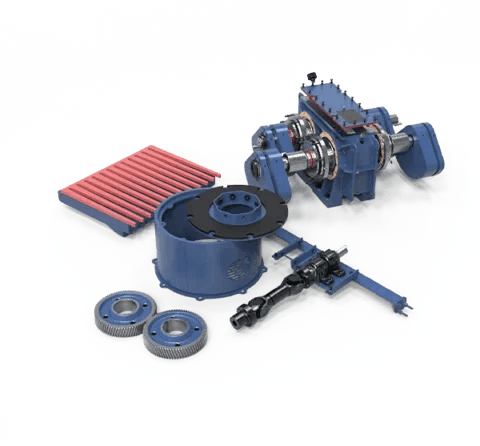
I’ve seen screen panels fail faster than expected, grizzly bars wear unevenly, and feeder liners crack under loading conditions the supplier said they could handle. In every case, the failure was traceable to either the wrong material specification or a manufacturing process that didn’t match the stated spec. Understanding what each part does — and what determines whether it lasts — makes every procurement conversation more productive.
Screen Panels (Wire Mesh, Polyurethane, Rubber)
Screen panels are the highest-frequency replacement item in most screening circuits. They classify material by size and experience continuous abrasive contact with the feed stream. Wire mesh panels are the baseline — lowest cost, shortest life in abrasive applications. Polyurethane panels last significantly longer in dry abrasive conditions, run quieter, and resist blinding better in some feed types. Rubber panels outperform both in high-impact zones and in wet screening where flexibility reduces pegging. Choosing the wrong material for your conditions is one of the most common and costly specification errors in screening operations.
Grizzly Bars
Grizzly bars are the first point of contact with ROM (run-of-mine) material — they take the heaviest impact loading of any screening component. Bar material selection is critical: mild steel bars wear quickly in hard rock primary applications and are really only appropriate for softer, lower-abrasivity feeds. High manganese alloy bars work-harden under impact and extend service life considerably in heavy primary screening. Chrome-moly alloy bars offer better pure abrasion resistance for dry, high-SiO2 feeds. The bar cross-section geometry also matters — a wider flat bar presents more wear surface but changes material flow characteristics compared to a narrower angled profile.
Feeder Liners
Feeder liners protect the pan or apron feeder structure from direct material contact. They’re a scheduled wear item — replaced on a planned cycle in well-managed operations, but replaced reactively (at high cost) in operations that don’t track them. Manganese steel liners work-harden under repeated impact and are the right choice for primary heavy-duty feeding. Chrome alloy liners offer better initial hardness and abrasion resistance in applications where impact loading is lower but abrasion is high. Wrong liner specification means wrong replacement interval predictions — and that breaks your maintenance planning.
Springs and Bearing Assemblies
Springs and bearings are mechanical components, not consumables — they fail through fatigue rather than abrasion. But their failure consequences are disproportionate: a broken spring causes immediate screening efficiency loss and can damage the screen body; a failed bearing typically means an extended unplanned shutdown. Both must be sourced with documented load ratings and fatigue life data. Purchasing springs and bearings on price alone, without specification verification, is a risk that most operations cannot afford in practice.
| Part | Wear Mechanism | Material Match Consequence | Replacement Driver |
| Wire mesh panels | Wire abrasion and breakage | Wrong gauge = premature failure; wrong steel = fast wear | Feed abrasivity and wire fatigue |
| Polyurethane panels | Aperture deformation and cracking | Wrong Shore hardness = deformation or cracking | Temperature, impact, and abrasion level |
| Rubber panels | Tearing and aperture deformation | Wrong compound = cracking or fast abrasion | Impact energy and moisture content |
| Grizzly bars | Abrasion + impact gouging | Wrong alloy = fast wear or cracking under load | Rock hardness and bar spacing |
| Feeder liners | Abrasion, work-hardening (Mn) | Wrong alloy = short or unpredictable life | Feed material hardness and flow velocity |
| Coil springs | Metal fatigue fracture | Wrong load rating = early fatigue failure | Dynamic load and operating frequency |
| Screen bearings | Rolling fatigue and contamination | Wrong class = early failure under load | Load factor and sealing quality |
Screening Parts Manufacturer vs Supplier vs Factory: What’s the Difference?
This is where many buyers get confused — and where the confusion is sometimes deliberately maintained by suppliers who benefit from the ambiguity. Not every supplier is a real manufacturer. The distinction matters because it determines your ability to control quality, specify custom requirements, and get consistent output across production batches.
| Entity Type | What They Actually Do | Quality Control Capability | Key Risk |
| Manufacturer / Foundry | Produces parts directly — owns casting, forming, and QC equipment | Full — controls material input, process, and output | Minimum order quantities may apply; custom work takes longer |
| Fabrication factory | Cuts, forms, and welds from purchased raw material | Moderate — controls fabrication but not material production | Material quality depends on their raw material sourcing |
| Authorized OEM distributor | Holds licensed stock of original equipment parts | High — but limited to OEM-specified items | Premium pricing; discontinued risk for older models |
| Trading company | Sources from multiple foundries and manufacturers, adds margin | Low to none — no direct production control | Batch-to-batch inconsistency; spec accuracy unverifiable |
| Mixed model supplier | Manufactures some items, sources others externally | Partial — varies by product | Critical to know which items are self-produced |
The verification test: ask any supplier for photos of their manufacturing equipment — casting furnace, forming presses, or vulcanizing equipment for rubber and polyurethane. Ask for heat treatment records or compound cure records for the specific batch you’re ordering. A real manufacturer can provide both within 24 hours. A trading company cannot — because they don’t run the process.
What Makes a Reliable Screening & Feeder Parts Manufacturer?
1. Material Quality: Steel, Polyurethane, and Rubber
Don’t just choose based on price — and don’t accept generic material descriptions. ‘Steel’ covers mild steel to high manganese to chrome-moly alloy, with wear life differences of 300–500% between extremes. ‘Polyurethane’ covers Shore 40A to Shore 90A, with completely different performance under abrasion and impact. I’ve seen wrong material choices double replacement cost within the first three months — not from defective parts, but from correctly-made parts that were specified incorrectly for the application.
The right material depends on your specific feed material, particle size, moisture content, and the wear mechanism your parts experience. Abrasion-dominant applications need hard materials — high-chrome alloy, high-Shore polyurethane. Impact-dominant applications need tough materials — manganese steel, reinforced rubber. Most real applications involve both, which is why application-specific specification matters more than general material preference.
| Material | Hardness / Grade | Best Application | Weakness | Indicative Price Premium vs Baseline |
| Mild steel wire mesh | Low tensile | Light-duty, low-abrasion feeds | Short life in hard rock | Baseline |
| High carbon steel mesh | High tensile | Hard rock, moderate abrasion | Less flexible — fatigue cracking | +30–60% |
| Polyurethane Shore 60A–70A | Moderate elasticity | Moderate abrasion, dry feed | Degrades above 60°C | +80–150% vs wire mesh |
| Polyurethane Shore 80A–90A | High hardness | High abrasion, dry feed | Less impact tolerance | +100–200% vs wire mesh |
| Standard rubber compound | High flexibility | High impact, wet feed | Lower abrasion resistance than PU | +60–130% vs wire mesh |
| Reinforced rubber compound | High flexibility + abrasion | Impact + abrasion combined | Cost premium over standard rubber | +120–200% vs wire mesh |
| Mn18Cr2 grizzly bars | ~200 HB, work-hardens to 500+ | Heavy-duty primary screening | Needs impact to work-harden | +80–150% vs mild steel bars |
| Chrome-moly feeder liners | 450–550 HB | High-abrasion dry primary feeding | Brittle under extreme impact | +60–120% vs Mn steel |
2. Manufacturing Process and Quality Control
I’ve seen identical specs perform completely differently — and the explanation is almost always in the manufacturing process, not the material certificate. Two polyurethane panel suppliers can quote the same Shore hardness and the same compound type, but if one controls their mix ratio and cure temperature tightly and the other doesn’t, the output performance differs by 30–50% in wear life. The same is true for cast alloy parts: the metallurgical structure of a manganese steel grizzly bar depends on pouring temperature, mold design, and heat treatment cycle, not just the chemical composition certificate.
What to look for in a manufacturer’s QC process: incoming material verification, in-process measurements at critical stages, and finished part inspection with documented results. A manufacturer who can provide batch-specific test records — not just a generic specification sheet — is one who actually monitors their process. One who can’t is guessing.
3. Customization Capability
Real-world conditions rarely match standard designs exactly. A non-standard screen aperture size, a feeder pan with unusual dimensions from a legacy installation, or a specific alloy grade needed for an unusual feed material — all of these require a manufacturer with genuine engineering and production flexibility. A supplier who only offers catalog items cannot solve these problems, and the workaround of adapting a standard part often creates new problems: poor fit, accelerated wear at modified edges, or performance that doesn’t match the application.
Customization capability also extends to aperture profile design for screen panels — self-cleaning aperture geometries, angled slots, or anti-blinding surface treatments that go beyond standard flat deck options. These features matter significantly in wet or sticky feed conditions and can extend panel service life substantially.
4. Production Capacity and Delivery Reliability
Delayed parts equal stopped production. A supplier who quotes a two-week lead time and consistently delivers in five is more expensive than a supplier who quotes four weeks and hits it every time. Delivery reliability is a procurement factor that is easy to overlook during a price comparison and very expensive to discover during a production emergency.
Ask specifically about current production backlog, the split between stocked and made-to-order items, and the on-time delivery rate for the past 12 months. For critical items — grizzly bars or specific screen panel configurations — ask whether a buffer stock arrangement is possible. A manufacturer who won’t discuss this question is telling you something about their capacity certainty.
OEM vs Aftermarket Screening & Feeder Parts
Actually, aftermarket parts often give better value — particularly for consumable wear items where the specification is well-understood and the manufacturing process is not proprietary. OEM screen panels and grizzly bars are designed to a specification set when the equipment was engineered; specialist aftermarket manufacturers have often improved on those specifications for specific application conditions.
However, OEM still matters in some cases. For mechanical components — vibrator units, bearing assemblies, and eccentric shafts — the dimensional precision and fatigue design are structurally important. For these items, OEM or a specialist equivalent with documented load ratings is the right choice. Using catalog aftermarket parts for mechanical components without specification verification is a risk that consumable wear parts don’t carry.
| Criterion | OEM Parts | Quality Aftermarket | Low-Cost Aftermarket |
| Unit price | Highest — 30–60% premium | Competitive — often 15–30% below OEM | Lowest — 40–65% below OEM |
| Material consistency | Controlled to OEM spec | High — from foundry-owning manufacturers | Low — sourced variably batch to batch |
| Dimensional accuracy | Guaranteed — OEM tooling | High — verified against OEM drawings | Variable — limited QC inspection |
| Wear life vs OEM | Baseline (100%) | Equal or better in optimized specs | Often 40–70% of OEM life |
| Availability — current models | Good | Good | Variable |
| Availability — legacy equipment | Often discontinued | Often still produced | Unpredictable |
| Application optimization | Fixed to original design | Can be improved for specific conditions | No — catalog copy only |
| Technical support | Full OEM support | Good from established suppliers | Minimal |
| Best use case | Mechanical components, warranty period | Wear panels, bars, liners in proven ops | Trial only — verify before volume |
How to Evaluate Screening & Feeder Parts Quality Before Buying
Don’t rely on catalog photos or generic specification sheets. I’ve seen buyers regret skipping testing — not occasionally, but regularly, and always for the same reason: they assumed the specification on the quotation reflected the quality of the finished part. It doesn’t always.
| Evaluation Step | What to Request | What It Reveals | Red Flag |
| Material specification | Chemical composition cert (steel) or Shore hardness cert (PU/rubber) — batch traceable | Actual material grade, not claimed grade | Generic spec sheet with no batch reference |
| Hardness / hardness profile | Cross-section hardness results for alloy parts; durometer results for elastomers | Heat treatment quality and consistency through thickness | Surface hardness only — core may be softer |
| Dimensional inspection | Measurement report against drawing for critical dimensions | Fit without modification — and aperture size accuracy | No inspection records — ‘we check visually’ |
| Process records | Heat treatment cycle records for alloy parts; cure cycle records for PU/rubber | Whether process is controlled or guessed | Cannot produce records — process not documented |
| Production facility evidence | Photos of casting equipment, vulcanizers, or wire drawing equipment | Manufacturer vs. trading company | Stock photos or redirect — no direct facility evidence |
| Application references | Names of operations using same part in similar feed conditions | Real-world wear life and consistency | References in different applications or no references at all |
| Trial set | 1–2 sets installed and tracked through a full wear cycle | Actual performance under your conditions | Refusal to supply trial — or conditions on trial volume |
Application Matters: Mining vs Quarry vs Aggregate
Application matters more than most buyers think — and the price of the right part for your application may be higher than the price of a general-purpose part, but the total cost will almost always be lower. Specifying to the application rather than to the catalog is the single change that most consistently improves wear part economics in screening operations.
| Application Segment | Typical Conditions | Screen Panel Grade | Grizzly Bar Grade | Feeder Liner Grade | Key Priority |
| Hard rock mining — primary | ROM ore, coarse, high SiO2, heavy impact | Reinforced rubber | Mn18Cr2 or Cr-Mo | Mn18 or Cr-Mo alloy | Impact resistance above all |
| Hard rock mining — secondary | Crushed ore, 30–120mm, abrasive | PU heavy duty or HC wire mesh | Cr-Mo alloy | Cr-Mo alloy | Abrasion resistance |
| Limestone quarry — primary | Blasted rock, variable size, moderate hardness | Rubber or PU standard | Mn steel | Mn steel | Balance of toughness and wear |
| Limestone quarry — secondary/tertiary | Crushed product, smaller fraction | PU standard | Not typically applicable | Cr-Mo for dry chutes | Cost-efficiency — softer feed |
| River gravel processing | Wet rounded gravel, high silica | Rubber (wet grade) or PU | Cr-Mo alloy | Cr-Mo alloy | Silica abrasion resistance + wet handling |
| Dry aggregate screening | Dry crushed product, <50mm | PU heavy duty | Not typically applicable | Cr-Mo liner | Abrasion resistance, low noise |
| Recycled concrete / C&D | Variable — includes rebar, ceramic fragments | Rubber — impact tolerance | Mn steel (impact priority) | Mn steel | Impact tolerance — unpredictable feed |
| Coal / soft mineral | Soft, low-abrasion, sometimes wet | PU standard or wire mesh | Mild steel acceptable | Mild steel or Mn13 | Cost-efficiency — low wear demand |
Cost vs Value: Why the Cheapest Parts Cost More
Cheap parts are often the most expensive choice — not always, but consistently enough that it should be treated as a default assumption until the numbers prove otherwise. The mechanism is simple: a lower-priced part that wears out faster requires more frequent replacement, more labor, and more production downtime. Each of those has a real cost that doesn’t appear on the supplier’s invoice.
| Part Tier | Unit Price | Typical Wear Life | Annual Replacements | Annual Parts Cost | Annual Change-out Labor | Est. Annual Total Cost |
| Budget wire mesh | $50 – $80 | 2–3 weeks | 18–26 sets | $900 – $2,080 | $1,800 – $3,900 | $2,700 – $5,980 |
| Standard HC wire mesh | $100 – $160 | 5–10 weeks | 5–10 sets | $500 – $1,600 | $750 – $1,500 | $1,250 – $3,100 |
| Standard polyurethane | $120 – $200 | 3–6 months | 2–4 sets | $240 – $800 | $300 – $600 | $540 – $1,400 |
| Heavy duty polyurethane | $200 – $350 | 6–14 months | 1–2 sets | $200 – $700 | $150 – $300 | $350 – $1,000 |
Note: Labor estimated at $150/change-out event for a single panel. Unplanned failure events cost significantly more — emergency labor, possible adjacent component damage, and extended downtime. These figures assume a dry aggregate application; hard rock or wet applications will show larger differences between budget and premium options.
| True Cost Component | Budget Parts | Premium Parts |
| Parts spend per year | High — driven by frequency | Lower — fewer replacements |
| Labor spend per year | High — many change-out events | Low — fewer events |
| Unplanned failure exposure | High — short life is less predictable | Low — consistent wear behavior |
| Inventory carrying cost | High — large safety stock required | Low — predictable reorder cycle |
| Cost per ton screened | Usually highest | Usually lowest over the year |
| Downstream impact | Variable gradation from worn apertures | Consistent gradation throughout panel life |
How to Choose the Right Manufacturer: Step-by-Step
Don’t rush this decision. I’ve seen rushed decisions cause long-term problems — not because the supplier was dishonest, but because the qualification process was too short to reveal the inconsistencies that only show up at scale. Here is the sequence that consistently produces the best outcome:
- Define your application precisely before contacting any supplier — feed material type and hardness (Mohs scale if possible), feed particle size range, moisture content, screen deck position (primary, secondary, tertiary), and current replacement interval. Without this, no supplier can give you a meaningful specification.
- Determine the correct material for your conditions — use the application guide in this document as a starting point. Match the wear mechanism (abrasion-dominant vs impact-dominant vs combined) to the material’s primary strength. This step prevents the most common and most expensive specification errors.
- Shortlist 3–5 potential suppliers — include a mix of manufacturers and distributors. Check for manufacturing facility ownership, years in business in your specific application segment, and whether they can name current customers in similar applications.
- Request documentation packages from each shortlisted supplier — material certification (batch-traceable), hardness test records, dimensional inspection reports, and a reference list of operations using the same parts in comparable applications.
- Contact at least two references per supplier directly — ask specifically about wear life consistency across multiple batches, dimensional fit accuracy, delivery reliability, and how the supplier responded when a quality issue arose. This single step eliminates most weak options.
- Order a trial set from your top one or two candidates — install under actual operating conditions and track wear life in operating hours and tonnage processed through a complete wear cycle. Do not make a volume decision on partial data.
- Calculate cost per ton processed for each trial — part cost plus labor per change-out, divided by tons processed per set. This is the only valid comparison metric across suppliers with different unit prices and different wear lives.
- Negotiate supply terms in writing before committing to volume — confirm lead times, minimum order quantities, batch documentation requirements, buffer stock options, and warranty terms. Get everything in writing before placing a production order.
Common Mistakes Buyers Make
I’ve seen entire batches fail within weeks — and the cause is almost always traceable to one of these errors. Shorter sentences here, because these points deserve emphasis:
- Buying on unit price without calculating cost per ton. The number that matters is replacement cost per ton screened — not cost per panel.
- Accepting ‘polyurethane’ or ‘high manganese’ as a specification. They’re not. Require Shore hardness and compound grade for elastomers. Require alloy composition and heat treatment records for metals.
- Skipping the trial phase. One full wear cycle under actual conditions is worth more than any catalog claim. It is non-negotiable before volume commitment.
- Not verifying manufacturer status. Many ‘manufacturers’ own no production equipment. Ask for facility photos. A real manufacturer responds within 24 hours. A trading company redirects.
- Choosing the same specification for all applications. A screen panel correct for limestone will fail fast in granite. A liner specified for high-impact feeding will underperform in a high-abrasion, low-impact chute. Specify per application, not per equipment model.
- Ignoring lead time reality. ‘Standard lead time is two weeks’ is not ‘your order will arrive in two weeks.’ Ask for the on-time delivery rate across the past 12 months. Then plan safety stock accordingly.
- Not tracking wear life data. If you don’t record installation date and hours to replacement for every set, you have no basis to evaluate supplier performance or justify a specification change.
Final Thoughts: Choosing a Long-Term Supplier
The cheapest supplier rarely becomes a long-term partner. What starts as a price saving usually becomes a quality management problem, then a delivery problem, then a decision to switch — at the cost of time, testing, and the production disruption of changing specifications mid-season.
The suppliers worth building a long-term relationship with are the ones who demonstrate consistent material quality across batches, hit their delivery commitments reliably, and engage technically with your specific application rather than just sending a price list. Those qualities are not visible on a quotation form. They become visible through a structured qualification process — documentation review, reference checks, and a trial under real conditions.
Some experienced manufacturers focus more on wear life optimization than on competing for the lowest price — working with you to refine the specification over time based on your actual wear data and operating conditions. That level of engagement consistently delivers lower total cost of ownership than the lowest-quote option. It is worth finding and worth keeping.
| Long-Term Supplier Characteristic | What It Looks Like in Practice |
| Consistent material quality | Batch-to-batch wear life variance under ±15%; traceable documentation per batch |
| Reliable delivery | On-time delivery rate above 90% over 12 months; honest communication when delays occur |
| Technical engagement | Asks about your feed material and conditions; recommends specification changes based on your wear data |
| Customization support | Can produce non-standard aperture sizes or alloy grades without excessive lead time or price premium |
| Quality issue response | Defined process for quality claims; replacement or credit within agreed timeframe |
| Long-term pricing stability | Volume pricing commitment; doesn’t re-quote aggressively upward after you’re reliant on their parts |
| Safety stock support | Willing to hold buffer stock for your critical items; structured consignment or stock reservation possible |
Conclusion: Choosing the Right Partner

Selecting a screening and feeder parts manufacturer is more than a procurement task—it is a strategic decision that directly impacts your operational uptime. As highlighted in this guide, the lowest unit price often leads to the highest annual total cost. True value is found in material durability, manufacturing precision, and a supplier’s deep understanding of your specific site conditions. By implementing a rigorous evaluation process—from reviewing material certifications to conducting on-site trials—you can significantly reduce unplanned downtime and optimize your cost per ton.
Learn More About GUBT
As a leading provider of wear solutions for the mining and aggregate industries, GUBT is dedicated to delivering high-performance parts through advanced manufacturing and strict quality control.
- Explore Our Products: We offer a comprehensive range of Screening & Feeder Parts, including screen panels, grizzly bars, and feeder liners, available in various alloys and elastomers to suit any application.
- Visit Our Official Website: Discover our full manufacturing capabilities, technical support services, and industry insights at the GUBT Home Page.
- Contact Our Experts: For custom requirements or technical inquiries, please visit our Contact page or email us directly at info@gubtcasting.com. Our team is ready to provide professional application advice and tailored quotes.
Frequently Asked Questions
How many trial sets should I order before committing to volume?
For screen panels, a minimum of one full deck — enough to run a complete wear cycle under actual conditions. For grizzly bars, trial a full bar set across the deck to observe wear distribution. Track hours to replacement and tonnage processed for each set. If wear life varies significantly between panels in the same set, that is a signal of manufacturing inconsistency that needs to be understood before you commit to volume orders.
What documentation should I require from any new screening parts supplier?
At a minimum: a chemical composition or material grade certificate traceable to the specific production batch, a hardness test result from multiple sample points, and a dimensional inspection report against the part drawing. For polyurethane and rubber panels, additionally require Shore hardness certification per batch and a compound specification confirming the grade and temperature rating. These are standard documents for any serious manufacturer and should require no more than a few days to compile.
Can I use aftermarket screen panels without voiding my screen warranty?
In most jurisdictions, using compatible aftermarket wear parts does not void equipment warranty under competition law, provided the parts meet the dimensional and material specifications of the original. However, if an aftermarket part causes damage to a structural or mechanical component — for example, an incorrect panel weight causing screen body fatigue — the OEM may decline warranty coverage for that damage. For mechanical components (vibrators, bearings, shafts), OEM or a certified equivalent is safer during the warranty period.
How should I handle different screen applications within the same plant?
Specify per deck position and per feed condition, not per equipment model. A primary deck in a crusher circuit has a completely different wear environment than a tertiary deck screening product to size. Buying the same panel for both because they’re the same screen model wastes money on one deck and under-specifies the other. Most operations benefit from 2–3 panel specifications rather than one, even in a single plant.
What is a reasonable warranty expectation for screening and feeder parts?
For consumable wear parts (screen panels, grizzly bars, feeder liners), a ‘fit for purpose’ warranty covering manufacturing defects is standard. Wear life is not covered — it’s application-dependent and cannot be guaranteed by the manufacturer without knowing your exact conditions. For mechanical components (springs, bearings, vibrator units), a minimum of 12 months from installation against manufacturing defects is a reasonable baseline. Get warranty terms in writing, including the claims process and resolution timeframe, before placing a volume order.
Authoritative Resources & Further Reading
The following sources provide technical and commercial depth on screening equipment, wear material standards, and procurement practice:
Material Standards
- ASTM A128 — Austenitic Manganese Steel Castings — Standard specification for high manganese steel used in grizzly bars and heavy-duty feeder liners. Use to verify supplier alloy claims against published composition grades.
- ASTM A532 — Abrasion-Resistant Cast Iron — Specification for high-chrome alloy grades used in feeder liners and chute wear plates. Reference for chrome content and hardness standards.
- ISO 4649 — Rubber Abrasion Resistance (Rotating Drum) — Standard test for rubber wear resistance — relevant when specifying rubber screen panels and feeder chute liners. Ask suppliers for test results per compound grade.
- ASTM D2240 — Standard Test Method for Rubber Hardness (Shore Durometer) — Defines Shore hardness measurement for elastomeric materials. Use this standard when specifying polyurethane and rubber panel hardness — not all suppliers measure correctly.
Industry & Technical Bodies
- Society for Mining, Metallurgy & Exploration (SME) — Professional body for mining and mineral processing engineers. Publishes technical guidance on screening circuit design, wear part selection, and maintenance planning.
- AggNet — Aggregates & Quarrying Industry — Industry resource covering vibrating screen performance, screen media selection, and feeder equipment maintenance in quarry and aggregate production contexts.
- Rock Products Magazine — Trade publication covering aggregate and mining processing equipment, including screen media, feeder design, and wear part management.